Book summary
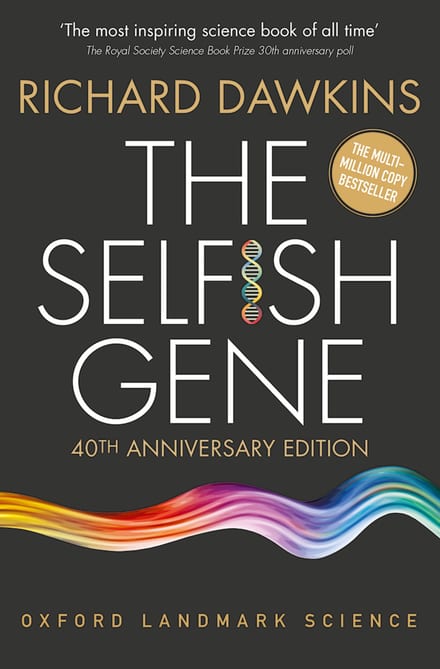
The Selfish Gene
The full book runs ~352 pages — roughly 6 hours of reading. You get the key ideas here in 5 minutes.
The key ideas
- Flip the camera: the gene, not the organism, drives selection
- Altruism is arithmetic—we protect copies of our own genes
- Kin selection scales help by genetic relatedness
- Cooperation wins through evolutionarily stable strategies
- Mating is a genetic arms race between unequal investors
- Memes replicate like genes, letting us rebel against our programming
The summary
Evolution snaps into focus when you stop watching the animal and start watching the gene. A body, whether yours or a bee’s or a fig tree’s, is a temporary vehicle DNA builds to copy itself forward. From that vantage point, the fundamental unit of natural selection isn’t the organism or the group but the gene, a stretch of DNA whose only “goal,” in the coldest mechanical sense, is to replicate. We exist because our genes assembled bodies good enough to survive and reproduce. As Dawkins puts it, “We are survival machines, robot vehicles blindly programmed to preserve the selfish molecules known as genes.” Even death fits: Dawkins suspects we age and die because harmful genes switch on only after we’re past reproducing, beyond the reach of selection.
Why selfish genes cooperate to build you
If genes are selfish, why don’t they sabotage each other instead of teaming up to build a working human? The answer is the evolutionarily stable strategy. Picture a population of pure doves, passive animals that never fight; a single aggressive hawk would win every contest and spread, until hawks grew common enough to keep injuring one another, at which point the gentler doves regained the advantage. The system settles into a stable balance. Genes behave the same way. A gene that plays well with the rest of its genome joins a stable coalition rogue genes struggle to break into, and its success depends on context, on the environment and surrounding gene pool. A gene for sharp teeth is useless without genes for digesting meat; a gene for cold resistance fails in a warm climate.
Genes handed us brains because they let organisms react fast, simulate outcomes, and communicate, all of which raised the odds of surviving, with memory arising to refine those behaviors. Dawkins likens the setup to a programmer who writes a chess program: he sets the rules but lets the program choose each move. Genes supply the long-term strategy; brains handle the tactics, and the genes stay in charge.
Altruism is arithmetic
The behaviors that look most selfless dissolve into gene-level self-interest. A parent shares half its genetic information with each child, so a gene that drives parents to protect their young is really protecting copies of itself. This is kin selection, altruism aimed at relatives in proportion to shared genes, and no animal does the math, because genes simply program behavior favoring those who seem related. It also explains an asymmetry: parents are more devoted to children than children are to parents, since a parent’s genes gain enormously from a child who goes on to reproduce, while a child’s genes gain far less from keeping an aging parent alive.
The suicidal worker bee fits too. “Kamikaze” bees die when they sting, but the stinging bees are sterile, so no genes are lost, and the hive they defend is packed with sisters carrying the same DNA. Even restraint is selfish: birds lay fewer eggs than they physically could, not out of concern for the population, but because overproducing chicks means none survive, so genes favoring quality over sheer quantity win. In the wild, animals almost never die of old age; starvation, disease, and predators reach them first, and most die in childhood.
The war between the sexes
Mating is a genetic arms race that starts from a basic inequality. Eggs are large and scarce, sperm small and abundant, so females tend to invest heavily in each offspring while males try to invest as little as possible and fertilize as many partners as they can. That mismatch breeds a whole repertoire of strategy. Female birds demand long courtship to keep a male invested after mating. Male mice secrete chemicals that trigger miscarriage in females carrying another male’s young. Male lions kill the existing cubs when they take over a pride. None of it is cruelty from the gene’s point of view; it’s just the math of replication. Dawkins captures the stakes with a line about predator and prey: the rabbit runs faster than the fox, because the rabbit is running for its life while the fox is only running for its dinner.
Memes, and the one rebellion available to us
Then Dawkins introduces a second replicator, unique to human culture: the meme, from the Greek mimeme, meaning something imitated. Memes are units of cultural transmission, and just as genes leap from body to body through sperm and eggs, memes leap from brain to brain through imitation: tunes, catchphrases, clothing fashions, ways of building an arch. Like genes, they vary in success, mutate as they spread, and compete for scarce resources like memory and attention. Unlike genes, some replicate intact for centuries, such as religions, and they’re shaped by psychological appeal rather than survival value, which is how a meme like celibacy can persist against every biological drive.
Genes also reach beyond the body. A beaver’s dam and a bird’s nest are what Dawkins calls the extended phenotype, structures that exist because they help the underlying genes survive. And selfishness isn’t the end of the story, because nature is often a non-zero-sum game where cooperation pays. Fig trees and fig wasps keep a mutual bargain, the wasp pollinating and the tree feeding its larvae, though either could cheat, because defection would collapse the whole arrangement. Nice guys, it turns out, can finish first. Most striking of all, we are the one species with the foresight to see our own programming, and, as Dawkins writes, “We, alone on earth, can rebel against the tyranny of the selfish replicators.”
The bottom line
You are a machine built by genes to carry those genes forward, and almost everything that looks like kindness in nature is that same self-interest doing its arithmetic. What makes us different is that we can see the game and choose not to play it, teaching altruism against the grain of our own biology. Read this if you want to understand why you exist, and why you don’t have to obey.
Fact check
Popular books repeat findings that later research has complicated. Where The Selfish Gene makes a testable claim, here's what the evidence actually shows.
The gene, not the organism or the group, is the fundamental unit that natural selection acts on.
The gene's-eye view is mainstream and enormously productive, but the claim that it is the fundamental level remains an open argument among evolutionary biologists rather than a settled result. In 2010 Nowak, Tarnita and Wilson argued in Nature that inclusive-fitness theory is a special case resting on restrictive assumptions and that standard natural-selection models describe eusociality better; 137 biologists co-signed a reply defending inclusive fitness as general and empirically well supported. Much of the dispute is over accounting rather than facts, since gene-level and multilevel formulations are often mathematically translatable into each other.
Sterile worker bees sting themselves to death because the hive they defend is packed with close relatives carrying copies of their genes.
The prediction that high relatedness comes first was tested across all eight independent origins of eusociality in insects, and it held every time: the ancestral state in each lineage was a queen mating with a single male, the arrangement that maximises relatedness among the workers she produces. Multiple mating, which dilutes relatedness, only appeared in lineages where workers had already lost the ability to reproduce, so it is a consequence of eusociality rather than a cause of it. One detail of Dawkins' 1976 telling has aged less well — the idea that the unusual three-quarters relatedness of haplodiploid sisters is what drove the pattern, given that eusociality also evolved in fully diploid termites — but the underlying relatedness argument is what the data support.
- Hughes WO, Oldroyd BP, Beekman M, Ratnieks FL. Ancestral monogamy shows kin selection is key to the evolution of eusociality. Science. 2008;320(5880):1213-6. PubMed
We age and die because harmful genes only switch on after we are past reproducing, where natural selection can no longer weed them out.
Genome-wide association data fit that mechanism in part: risk variants for late-onset diseases are carried at higher frequencies and with larger effects than those for early-onset diseases, which is what mutation accumulation predicts. The same analysis, though, found a significant excess of variants that help early in life and harm later — antagonistic pleiotropy — and these clustered in genes related to ageing, meaning selection has actively favoured some of what eventually kills us rather than simply failing to see it. Dawkins' version names one of the two mechanisms; there is still no consensus on the ultimate cause of senescence.
- Rodríguez JA, Marigorta UM, Hughes DA, Spataro N, Bosch E, Navarro A. Antagonistic pleiotropy and mutation accumulation influence human senescence and disease. Nat Ecol Evol. 2017;1(3):55. PubMed
Prey outrun their predators because the prey is running for its life while the predator is only running for its dinner.
Collar-mounted GPS and motion sensors on wild lions, zebras, cheetahs and impalas in Botswana found the athletic asymmetry running the other way. Within each predator-prey pair the predator had 20% higher muscle fibre power, 37% greater acceleration and 72% greater deceleration capacity than the animal it hunted, and simulations indicated the predator has to be the more athletic of the two to sustain a viable success rate. Prey survive not by being faster but because hunts unfold at lower speeds, where their manoeuvring capacity can be brought to bear. The asymmetric-selection reasoning behind the aphorism is a separate question, but its most quotable prediction failed on the measured animals.
- Wilson AM, Hubel TY, Wilshin SD, et al. Biomechanics of predator-prey arms race in lion, zebra, cheetah and impala. Nature. 2018;554(7691):183-188. PubMed
Frequently asked questions
What is The Selfish Gene about?
Evolution snaps into focus when you stop watching the animal and start watching the gene. A body is a temporary vehicle DNA builds to copy itself forward, which makes the gene — not the organism or the group — the fundamental unit of natural selection. We are, in Dawkins's phrase, "survival machines" blindly programmed to preserve the selfish molecules that made us.
What are the key takeaways from The Selfish Gene?
Selfish genes cooperate to build working bodies because natural selection settles into an evolutionarily stable strategy, like a balance of "hawks" and "doves." Behaviors that look selfless dissolve into gene-level arithmetic: kin selection means protecting relatives protects copies of your own genes, which explains devoted parents and the sterile, self-sacrificing worker bee. Mating is a genetic arms race driven by the mismatch between scarce eggs and abundant sperm. Dawkins also introduces the "meme" — a unit of culture that spreads brain to brain by imitation — and the "extended phenotype," and ends on the one rebellion available to us: we alone can choose to defy our own programming.
Who should read The Selfish Gene?
Anyone who wants to understand why they exist — and why they don't have to obey their own biology.
Is The Selfish Gene worth reading?
It's a landmark that makes gene-centered evolution genuinely intuitive through vivid images — survival machines, hawks and doves, the fox running only for its dinner — and it coined the word "meme." The relentless "selfishness" framing can read as bleak or be misread as endorsing selfish behavior, when the closing point is the opposite, that we can teach altruism against the grain, so it rewards reading to the end.