Book summary
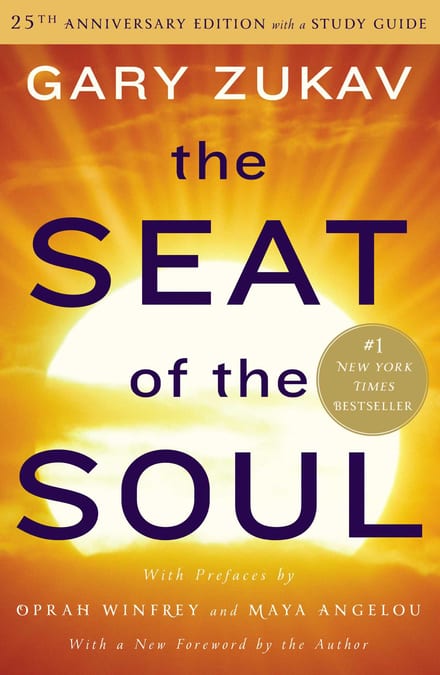
The Seat of the Soul
The full book runs ~256 pages — roughly 5 hours of reading. You get the key ideas here in 5 minutes.
The key ideas
- Separate external power — money, rank, status — from power nobody can take.
- Read karma as impersonal energy balancing, not moral judgment; judging creates more of it.
- Follow your feelings inward — every gap between intent and emotion marks a hidden part.
- Name your unconscious intentions; the strongest one, not the stated one, wins.
- Rehearse a choice's consequences before deciding — temptation is a dry run, not a trap.
- Practice humbleness, forgiveness, clarity and love, the four marks of authentic power.
The summary
Money, rank, a badge, an agile mind, a belief you’d be frightened to lose — Gary Zukav files them all under one heading. Each is external power: acquired or lost, bought or stolen, inherited or fought over, where your gain is somebody else’s loss. Every institution we have reflects that idea, and after millennia the insecurity underneath is no better for it. Another kind of power exists, he argues; reaching it is what evolution is for, and the crossing happens one choice at a time.
Power you can lose was never power
He calls it authentic power: what you have when your thoughts, emotions and actions line up with the deepest part of you. It can’t be bought, inherited or hoarded, and the test is behavioral — an authentically empowered person can’t make anyone a victim, being so strong that using force never occurs to them.
Two distinctions hold that up. The first separates the personality — born into time, dying within it, the only part of you that feels rage, shame or vengeance — from the soul, the immortal part that loves without restriction and doesn’t judge. The second separates five-sensory from multisensory perception, which registers what the senses can’t: a warm heart beneath a harsh manner, a cold one beneath polished words. Our species is crossing between them, he argues, which makes the usual definition of evolution — survival of the fittest — a leftover from the phase we’re leaving.
Karma is energy bookkeeping, not morality
Every action, thought and feeling is driven by an intention, and an intention is a cause welded to its effect: take part in the cause and you can’t sit out the effect. But karma isn’t moral — morality is a human invention, and the Universe doesn’t judge. It’s an impersonal balancing of energy, the dynamic Newton’s third law reflects in physical reality: you receive from the world what you give it.
Which makes judging an act with consequences of its own: saying “she is worthy” or “he is not” creates negative karma. That isn’t a case for passivity — hold the drunk driver who wrecks your car responsible, just don’t act from indignation. He calls the alternative non-judgmental justice, pointing to Gandhi, beaten nearly to death twice, who refused to prosecute his attackers because he saw they were doing “what they thought was right.”
Your intentions build the reality you live in
Say you want to save your marriage. Wanting changes nothing; the intention does, and most people carry more than one. If a conscious intention to repair it sits next to a stronger unconscious intention to end it, the marriage ends — and you conclude that things didn’t work out despite your best efforts. They worked out exactly as you intended. The strongest intention wins, known or not.
He calls this a splintered personality: parts with their own values and goals, most out of sight. The way in is emotional — the road to your soul runs through your heart, and any gap between what you intend and what you feel marks a part needing healing. A wife tells her husband she has a meeting she’d rather skip to be with him, and he hears rejection. Had he questioned the feeling — why does this land this way, does my experience of her support it — he’d have found his own inability to trust, and learned in an afternoon what distrust otherwise teaches over years.
Choice is the engine, temptation is the rehearsal
The method is responsible choice: before deciding, project yourself into the probable future each option creates and ask whether you’d accept all the consequences.
Temptation, in this reading, isn’t a trap but a dress rehearsal — a chance to feel the full pull of what you’d regret and release it privately instead of spilling it into other lives. Each time you challenge it, it loses power and you gain some. Authentic power is earned this way; it can’t be meditated or prayed into being.
Addiction is where that gets hardest — the wants strong enough that you believe you can’t resist them, each with an issue of power beneath it. An addiction can’t be satisfied, only anesthetized, which is why it resurfaces the moment you feel threatened. The odds are better than they look: when someone overhauls their diet for their health, ninety percent of the personality may fight it, and the ten percent with the clearest intention still wins.
Humbleness, forgiveness, clarity, love
Four qualities mark authentic power. Humbleness is harmlessness — being so able that showing power through harm never enters your mind. Forgiveness he treats as physics rather than ethics: refusing to forgive is agreeing to wear dark, distorting glasses that only you are forced to look through. It also means not holding anyone else accountable for your experience, which is why complaining counts as manipulation. Clarity is seeing what actually drives your reactions. Love is an active force, not a mood — and the basis for what he proposes in place of marriage: spiritual partnership, equals committed to each other’s growth for as long as they grow together.
The bottom line
The search for power over things and people has gone as far as it goes; what comes next is power nobody can take, built as you notice what you feel, name what you actually intend, and choose again. The book is demanding for one reason: it hands every outcome back to you. Read it if you want a metaphysical account of why your life looks the way it does, and can sit with claims about souls, reincarnation and nonphysical teachers offered as description rather than argument.
Frequently asked questions
What is The Seat of the Soul about?
Gary Zukav draws a line between two kinds of power. External power is anything that can be acquired or lost, bought or stolen, inherited or fought over — money, rank, status, a body or a belief you'd be frightened to lose — and it always makes your gain someone else's loss. Authentic power is what you have when your thoughts, emotions and actions line up with the deepest part of you, and the book argues that reaching it, one choice at a time, is what human evolution is actually for.
What are the key takeaways from The Seat of the Soul?
Four ideas carry the book. Karma is impersonal energy bookkeeping rather than moral judgment — you receive from the world what you give it — which is why judging others creates consequences of its own, and why Zukav points to Gandhi refusing to prosecute the men who nearly beat him to death. Your intentions build your reality, and when a conscious intention competes with a stronger unconscious one, the hidden one wins, so following your feelings is how you find the parts of yourself pulling the other way. Responsible choice means projecting yourself into the probable future of each option before you decide, and treating temptation as a dry run rather than a trap. Authentic power shows up as four qualities: humbleness, forgiveness, clarity and love.
Who should read The Seat of the Soul?
It suits readers who want a spiritual explanation for why their life keeps producing the same patterns, and who are open to a framework built on souls, reincarnation, karma and nonphysical guidance. If you're already drawn to books about inner work but want one that ties emotions, relationships and addiction to a single idea about power, this is that book.
Is The Seat of the Soul worth reading?
It's strong where it gets specific: the account of competing intentions inside a failing marriage, the husband whose distrust manufactures the rejection he feared, and the reframing of forgiveness as something you do for your own sight rather than someone else's benefit. It's demanding in a useful way too, since it hands every outcome in your life back to you. But its central claims about souls, past lives and nonphysical teachers are presented as description rather than argued for, so readers who want evidence rather than assertion will find it hard going.