Book summary
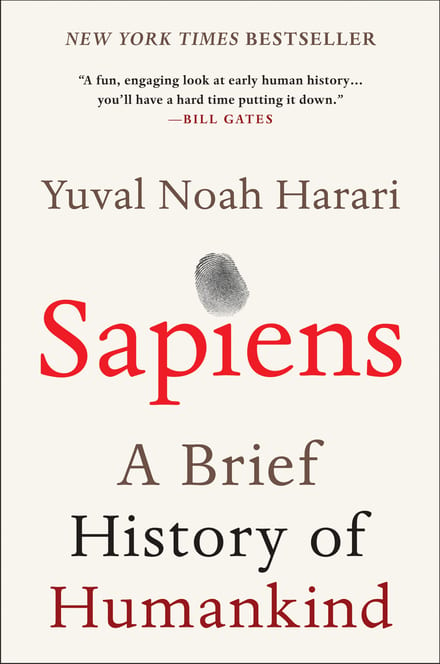
Sapiens: A Brief History of Humankind
The full book runs ~456 pages — roughly 8 hours of reading. You get the key ideas here in 5 minutes.
The key ideas
- Language for fiction let us cooperate in unlimited numbers.
- Agriculture grew populations but worsened most individual lives.
- Kings and gods were stories justifying centralized power.
- Writing enabled bureaucracy, specialization, and codified oppression.
- History changes constantly but never guarantees moral progress.
- Recognizing myths as fictions lets us rewrite them.
The summary
Large-scale human cooperation runs on things that don’t exist. Money, nations, corporations, and gods are invented realities, and they work only as long as enough people believe in them. That is the engine behind everything Homo sapiens has built, and the reason we came to dominate the planet. When Homo sapiens appeared about 300,000 years ago in East Africa, we were no more remarkable than any other animal. What changed everything was the Cognitive Revolution: language sophisticated enough to share not just information but ideas about things that aren’t physically real. With shared fictions, humans could cooperate flexibly in enormous groups, far beyond the handful of people who can actually know one another, and that let us unify and conquer.
Farming grew populations, not happiness
For most of the human story we lived as hunter-gatherers — mobile bands of thirty to fifty people, following animals and seasonal plants, cooperating closely because survival depended on it, with rough social equality and little organized violence. Their beliefs stayed close to immediate concerns; there were no elaborate myths or religions.
Then, roughly 10,000 years ago, the Agricultural Revolution changed the terms. Settled farming could feed far more people per acre, so agricultural societies grew larger and eventually overran the foragers. But bigger didn’t mean better for the individual. Agriculture brought social hierarchy, inequality, and new diseases, along with organized violence between classes, ethnic groups, and states. Farmers won out not because their lives were happier — a less varied diet and harder labor suggest they weren’t — but because their numbers, and their soldiers, overwhelmed everyone else.
Civilization runs on invented stories
Large-scale farming demanded coordination on a new scale. Irrigation systems don’t build themselves, and the flood myths that recur across cultures, from Noah’s Ark onward, likely echo early agricultural societies wrestling with water control and the organization it required. Damns and canals needed collective labor, which needed centralized authority, which needed a story to justify itself. So came kings, priests, and gods. Egypt’s pyramids were tombs meant to carry pharaohs safely to the afterlife, but they were also advertisements for divine power — proof a ruler could mobilize vast resources and thousands of laborers, who endured brutal conditions in the name of a mythical common good.
Every large human organization since works the same way. A nation-state is an imagined entity that binds millions of strangers under one identity and authority. A limited-liability corporation is an imagined reality that separates a company from its owners so strangers can pool resources for huge ventures. Money is an abstract standard of value that lets people cooperate without intimacy, and today’s system is mostly fiat currency, backed by nothing but faith in the system itself — which is exactly why it’s vulnerable to collapse. None of this is a flaw; shared fiction is our superpower. The danger is forgetting these are fictions. Ruling classes have always used stories about gods and national glory to justify inequality, and the ruled comply because the arrangement feels as natural and inevitable as law. We accept perpetual economic growth and its costs to nature for the same reason.
Writing built bureaucracy, and its costs
Writing, which emerged around 5,000 years ago, transformed societies by making these fictions durable across time and space. Oral traditions were bound by memory and distorted with each retelling; writing gave humans a reliable, permanent record, and with it came tax rolls, legal codes, and standardized religious texts — the machinery of bureaucracy and large civilizations. It also changed how we think. We began leaning on external records rather than internal memory, and the flood of recorded information soon outran anyone’s ability to hold it all, forcing specialization and formal education. The same tool that enabled complex civilization also enabled more consistent oppression, since hierarchies and laws could now be codified and enforced across generations, and many modern legal systems still trace back to ancient religious codes.
History has no moral arrow
None of this unfolded by moral logic. Judaism began as an insignificant desert cult and became a major world religion through a string of improbable events. Christianity took hold in the Roman Empire because of contingent factors — urbanization, literacy, transport networks — not because it was ethically superior to its rivals. The European empires that conquered the world weren’t more virtuous; they simply industrialized first, largely by chance. The Nazis were defeated by industrial might, not by the triumph of justice.
This should unsettle any assumption that our present values represent the summit of progress. Dominant social structures win through chaos and coincidence, not moral merit, and people readily embrace beliefs that cast the existing order as natural and inevitable. Change is constant, but change is not the same as progress. We’ve gained technology and longevity, yet it’s debatable whether we’ve grown happier or more ethical, and our advances have brought environmental damage and nuclear weapons along with them. Future generations may judge our values as harshly as we judge the injustices of the past. The Scientific Revolution began with a discovery of ignorance — the recognition of how little we truly understand — which drove the search for empirical evidence over supernatural explanation. But history remains open. There are many possible outcomes, and the choices we make now will shape which one arrives.
The bottom line
Human civilization rests on shared myths — money, nations, laws, corporations — that have no existence outside our collective belief in them. Seeing them as useful fictions rather than eternal truths is what gives us the power to change them when they stop serving us. Read this if you want to understand why the world works the way it does, and whether it has to.
Fact check
Popular books repeat findings that later research has complicated. Where Sapiens makes a testable claim, here's what the evidence actually shows.
A single Cognitive Revolution gave Homo sapiens a new kind of language — one that could describe things that don't physically exist — and that leap is what changed everything.
Symbolic thinking really does underpin large-scale cooperation, but the archaeology points to accumulation rather than one switch flipping. McBrearty and Brooks catalogued the supposed markers of modern behaviour — pigment use, bone tools, blade technology, long-distance transport of raw material, beads — appearing piecemeal across the African Middle Stone Age from roughly 250,000-300,000 years ago, tens of thousands of years before any proposed revolution, and argued the sudden 'revolution' was an artefact of a Europe-centred record. A 23-author synthesis in 2018 reached a similar conclusion from genetics and fossils: our species emerged from structured populations spread across Africa, with modern traits assembling at different times in different places.
- McBrearty S, Brooks AS. The revolution that wasn't: a new interpretation of the origin of modern human behavior. J Hum Evol. 2000;39(5):453-563. PubMed
- Scerri EML, Thomas MG, Manica A, et al. Did our species evolve in subdivided populations across Africa, and why does it matter? Trends Ecol Evol. 2018;33(8):582-594. PubMed
Farming fed more people per acre but left the average individual worse off — a poorer diet and harder labour than foragers had.
The health half holds up. A review of the bioarchaeological record found that most studies report stature falling as reliance on agriculture rose, alongside more infectious and dental disease and more nutritional deficiency. A 2022 analysis that paired skeletal measurements with genomic height predictions for 167 prehistoric Europeans found Neolithic individuals about 3.82 cm shorter than their own genetics predicted, relative to Upper Palaeolithic and Mesolithic people. The 'harder labour' half is weaker: leg-bone bending strength across 1,842 European skeletons dropped steadily from the Neolithic through the Roman period, meaning early farmers moved less than the foragers they replaced, not more.
- Mummert A, Esche E, Robinson J, Armelagos GJ. Stature and robusticity during the agricultural transition: evidence from the bioarchaeological record. Econ Hum Biol. 2011;9(3):284-301. PubMed
- Marciniak S, Bergey CM, Silva AM, et al. An integrative skeletal and paleogenomic analysis of stature variation suggests relatively reduced health for early European farmers. Proc Natl Acad Sci U S A. 2022;119(15):e2106743119. PubMed
- Ruff CB, Holt B, Niskanen M, et al. Gradual decline in mobility with the adoption of food production in Europe. Proc Natl Acad Sci U S A. 2015;112(23):7147-52. PubMed
Hunter-gatherer bands lived with rough social equality and little organized violence before farming arrived.
Warfare does look rare among mobile foragers, but violence was not. Across 21 mobile forager societies drawn from the standard cross-cultural sample, more than half of lethal events were committed by lone individuals and nearly two-thirds arose from accidents, family disputes, within-group executions or personal rivalries — homicides rather than war, with 20 of the 21 societies not especially warlike. Group killing still happened: of twelve articulated skeletons at Nataruk in West Turkana, Kenya, ten died violently, one with an obsidian bladelet still lodged in the skull, though other researchers have contested that reading. A comparative study across more than 1,000 mammal species put lethal violence at roughly 2% of deaths in prehistoric bands and tribes — low by the standards of later states, not near zero.
- Fry DP, Söderberg P. Lethal aggression in mobile forager bands and implications for the origins of war. Science. 2013;341(6143):270-3. PubMed
- Mirazón Lahr M, Rivera F, Power RK, et al. Inter-group violence among early Holocene hunter-gatherers of West Turkana, Kenya. Nature. 2016;529(7586):394-8. PubMed
- Gómez JM, Verdú M, González-Megías A, Méndez M. The phylogenetic roots of human lethal violence. Nature. 2016;538(7624):233-237. PubMed
Forager beliefs stayed tied to immediate practical concerns; elaborate myths and organized religion only arrived with farming and its need for centralized authority.
Ritual life and imagined beings are documented well before agriculture. A painted panel at Leang Bulu' Sipong 4 in Sulawesi, dated by uranium-series to at least 43,900 years ago, shows part-human, part-animal figures hunting pigs and dwarf buffalo — the oldest known narrative scene in art, and its central characters have no counterpart in the physical world. Göbekli Tepe in southeastern Turkey, the earliest known megalithic ritual architecture, was raised in the Pre-Pottery Neolithic before farming was established there, and three skulls from the site carry deliberate carved grooves, a drilled perforation and ochre traces — an organized skull cult, not a set of practical everyday beliefs.
Frequently asked questions
What is Sapiens about?
Large-scale human cooperation runs on things that don't exist — money, nations, corporations, and gods are invented realities that work only as long as enough people believe in them. That capacity for shared fiction, born in the Cognitive Revolution, is why Homo sapiens went from an unremarkable animal to the planet's dominant species. The book traces how those myths built everything we call civilization.
What are the key takeaways from Sapiens?
Three revolutions structure the story: the Cognitive Revolution gave us language for shared fictions that let strangers cooperate flexibly in huge numbers; the Agricultural Revolution grew populations but brought hierarchy, inequality, and disease without making individuals happier; and the Scientific Revolution began with an admission of ignorance. Civilization runs on invented stories — nations, money, corporations, laws — and writing made those fictions durable enough to build bureaucracy. History has no moral arrow: dominant structures win through chance and contingency, not virtue, so change is constant but isn't the same as progress.
Who should read Sapiens?
Anyone who wants to understand why the world works the way it does — and whether it has to.
Is Sapiens worth reading?
It's sweeping and genuinely reframing, tying money, religion, and politics together under one idea about shared belief that stays with you. It moves fast across enormous territory and states some contested claims confidently, so it's best read as a provocative big-picture argument rather than a settled account of every era it covers.