Book summary
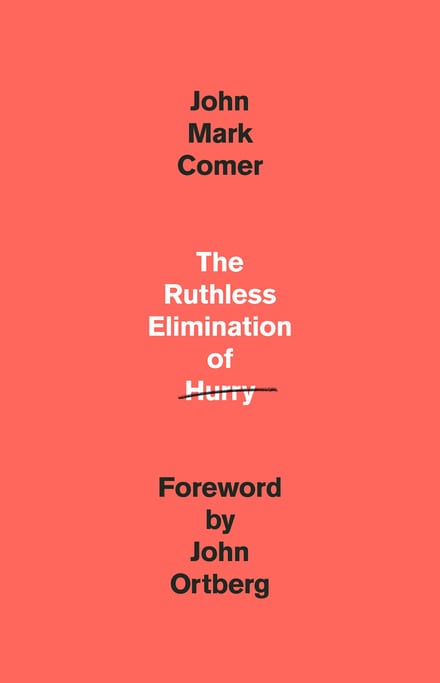
The Ruthless Elimination of Hurry: How to Stay Emotionally Healthy and Spiritually Alive in the Chaos of the Modern World
How to Stay Emotionally Healthy and Spiritually Alive in the Chaos of the Modern World
The full book runs ~304 pages — roughly 6 hours of reading. You get the key ideas here in 5 minutes.
The key ideas
- Willard's whole answer to Ortberg: ruthlessly eliminate hurry, and nothing else.
- Recognise hurry sickness — irritability, numbness, a neglected body, abandoned practices.
- Refuse the time-management fix; every labor-saving invention raised the ambient speed.
- Practice silence and solitude, Sabbath, simplicity, and deliberate slowing.
- Accept that you already live by a rule — the culture wrote yours by default.
- Note the limit: much hurry is imposed rather than chosen.
The summary
In the late 1990s, John Ortberg — then on staff at Willow Creek, one of the most influential churches in the world — phoned the philosopher Dallas Willard and asked what he needed to do to become the person he wanted to be. After a long silence, Willard told him to ruthlessly eliminate hurry from his life. Ortberg asked what else. Willard said there was nothing else: hurry is the great enemy of spiritual life in our day.
John Mark Comer built a book on that answer, and the frame is worth naming up front: he’s a pastor, the argument is explicitly Christian, and the model throughout is the life of Jesus. If that isn’t your frame, the diagnosis still lands — it’s drawn as much from psychology, survey data and the author’s own burnout as from scripture.
Comer was leading a fast-growing multisite megachurch in suburban Portland, adding more than a thousand people a year for seven years straight, and by the end he was teaching six times every Sunday. He describes himself then as emotionally flat, quietly anxious, spiritually empty, permanently rushed. The question that cracked it open wasn’t how to fit more in but who am I becoming? His answer was to demote himself: hand back the multisite operation, take one smaller city church, walk to work, keep a Sabbath, work fewer hours.
Hurry is a condition, not a scheduling error
Willard defined hurry as a state of frantic effort you fall into in response to inadequacy, fear and guilt — which puts the problem inside the person, not on the calendar. Comer agrees that a full life isn’t the issue. Busyness turns pathological when you have more to do than the hours hold and the only way to keep the quota up is to rush.
And rushing corrodes exactly what people are rushing toward. Love is slow — patience is the first word in Paul’s description of it. Comer’s worst moments as a husband, father and pastor are all moments when he was late, and what surfaces then is tension and a critical edge, never love.
The resulting condition — hurry sickness, a term out of Friedman and Rosenman’s Type A research — is an unremitting attempt to do more and more in less and less time, and most people will recognize part of the symptom list: irritability, restlessness, workaholism, emotional numbness, a neglected body, escapist habits, abandoned practices, isolation. Michael Zigarelli’s Obstacles to Growth Survey, which polled more than twenty thousand Christians worldwide, found busyness a major obstacle to spiritual life, pastors the most rushed profession he measured, and the whole thing self-feeding: absorb the culture’s pace, drift from anything deeper, grow more susceptible to the culture’s assumptions, speed up again.
The solution isn’t more time
Comer’s second move refuses the obvious fix. Time management treats hurry as arithmetic. But the history he sketches — sundial, mechanical clock, artificial light, labor-saving appliances, the internet, the smartphone — is a run of inventions sold as a way to buy back hours that each raised the ambient speed of life instead.
The measurements agree. dscout’s 2016 study tracked every tap and swipe of 94 people for five days and put the average user at 2,617 touches a day across 145 minutes of screen time; the heaviest hit 5,427. And when Richard Wiseman re-measured how fast people walk down a city street against Robert Levine’s early-1990s numbers, the pace across the sixteen cities common to both studies had risen roughly 10 percent, Singapore up 30.
What’s scarce, Comer argues, isn’t time but the willingness to choose. People find thousands of hours for entertainment and none for what they claim matters most. Accepting a hard limit isn’t an obstacle to a good life; it’s the condition of having one with any shape.
The model is a person, not a system
Here the frame becomes load-bearing. Comer reads the gospels as biography and notices a pace: Jesus is interrupted constantly and never appears hurried. The invitation in Matthew 11 — take my yoke, it’s easy — isn’t a promise that the weight disappears. A yoke is equipment; it’s what makes a load carryable. You can’t have someone’s interior life, the claim goes, while refusing their exterior one: the rhythms, withdrawals and refusals that made it possible.
The structure for that is what monastics call a rule of life — an ordered set of practices holding your days in a shape, like a trellis a plant grows along. You already live by one, Comer points out. Yours was written by the culture, by default, and you never chose it.
Four practices for unhurrying
- Silence and solitude. Time alone with no inputs. Comer is candid that mindfulness is this practice adapted for a secular audience, and treats small pockets of boredom as openings rather than dead air.
- Sabbath. A full day of stopping — not a day off for errands and catch-up. He frames it as resistance: evidence you aren’t owned by your output.
- Simplicity. Fewer possessions, fewer commitments, chosen deliberately. Every purchase costs money and then time; advertising is propaganda for a life you didn’t pick.
- Slowing. Deliberate friction. Drive in the slow lane, take the longest checkout line, single-task, cook, leave the phone in another room. The body trains the soul at least as much as the reverse.
Comer says plainly there’s no formula here, and concedes he isn’t writing from the position of a single mother working two jobs. That’s honest, and it marks the argument’s edge: much hurry is imposed rather than chosen, and this book has little for that case.
The bottom line
Hurry hollows out attention, patience and the relationships you’d name as most important, and no amount of efficiency fixes a life with too much in it. The remedy is unglamorous — fewer things, a deliberate rhythm, real practice at stopping. Read it if you look fine from the outside and feel frayed inside, and don’t mind an argument built on the life of Jesus.
Fact check
Popular books repeat findings that later research has complicated. Where The Ruthless Elimination of Hurry makes a testable claim, here's what the evidence actually shows.
The average smartphone owner touches their phone about 2,617 times a day.
The number is real and correctly attributed. dscout logged every tap, swipe and pinch on the phones of 94 Android users for five days in 2016 and got a mean of 2,617 a day. What it counts is individual finger contacts, not how often someone reaches for the phone — that figure is far smaller. Andrews and colleagues logged 23 adults' phones for two weeks and recorded a mean of 84.68 uses a day across 5.05 hours, with participants' own estimates of how often they picked up the phone showing no correlation with the log. One 94-person convenience sample of Android users from a single year is a thin basis for a figure quoted as a fact about everyone.
Chronic hurry — living with a permanent sense of time urgency — measurably damages your health.
Time urgency on its own does predict something. In the CARDIA cohort of 3,308 adults followed for 15 years, those scoring highest on time urgency and impatience had 1.84 times the odds of developing hypertension compared with the lowest scorers (95% CI 1.29–2.62), in a dose-response pattern. The larger Type A story that produced the phrase 'hurry sickness' did not hold up: Myrtek's meta-analysis of prospective studies found essentially no association between Type A personality and coronary heart disease (R = 0.003 across 74,326 people, p = 0.21), and only a very small one for hostility (R = 0.022). Hurry looks like a genuine risk marker at the blood-pressure end, not the heart-attack engine the 1970s literature described.
- Yan LL, Liu K, Matthews KA, Daviglus ML, Ferguson TF, Kiefe CI. Psychosocial factors and risk of hypertension: the Coronary Artery Risk Development in Young Adults (CARDIA) study. JAMA. 2003;290(16):2138-48. PubMed
- Myrtek M. Meta-analyses of prospective studies on coronary heart disease, type A personality, and hostility. Int J Cardiol. 2001;79(2-3):245-51. PubMed
- Shekelle RB, Hulley SB, Neaton JD, Billings JH, Borhani NO, Gerace TA, et al. The MRFIT behavior pattern study. II. Type A behavior and incidence of coronary heart disease. Am J Epidemiol. 1985;122(4):559-70. PubMed
People now walk roughly 10 percent faster than they did in the early 1990s, so the pace of life is measurably speeding up.
The 10 percent comes from a publicity project rather than a paper. Wiseman and the British Council timed pedestrians over a 60-foot stretch in 32 cities between 11.30am and 2pm on one day in August 2006, compared the 16 cities that overlapped with Robert Levine's earlier data, and reported a 10 percent rise, with Singapore up 30 percent. It was never peer-reviewed, and a single midday snapshot per city is a fragile basis for a claim about a decade of cultural change. The study underneath it is real work: Levine and Norenzayan measured walking speed, postal-clerk work speed and clock accuracy across 31 countries between 1992 and 1995, and found faster places had higher coronary heart disease death rates — but also higher reported wellbeing, which complicates reading speed as simply corrosive.
Keeping a Sabbath — one full day a week of stopping — produces measurable gains in wellbeing.
The evidence is thinner and softer than the prescription's confidence. The largest study to look at it directly, a survey of 1,300 teachers in Christian schools across the US, Canada, Indonesia and Paraguay, found Sabbath-keeping inversely and significantly related to burnout, and the relationship held across several model specifications. But it is cross-sectional, so it cannot show which way the arrow runs — teachers who are not already burned out may simply find it easier to stop for a day. An interview study of 13 observant Jews found the expected benefits (rest, contemplation, deeper relationships) alongside real costs: some reported worrying more on the Sabbath precisely because the distractions were gone.
- Cheng A, Lee MH, Djita R. A Cross-Sectional Analysis of the Relationship Between Sabbath Practices and US, Canadian, Indonesian, and Paraguayan Teachers' Burnout. J Relig Health. 2023;62(2):1090-1113. PubMed
- Dein S, Loewenthal KM. The mental health benefits and costs of Sabbath observance among Orthodox Jews. J Relig Health. 2013;52(4):1382-90. PubMed
Frequently asked questions
What is The Ruthless Elimination of Hurry about?
It grows out of one piece of advice: when John Ortberg asked Dallas Willard what he needed to do to become the person he wanted to be, Willard told him to ruthlessly eliminate hurry, and said there was nothing else. John Mark Comer treats hurry as a condition rather than a scheduling error — a frantic state you fall into in response to inadequacy, fear and guilt — and argues it corrodes exactly what people are rushing toward. The frame is explicitly Christian and the model throughout is the life of Jesus.
What are the key takeaways from The Ruthless Elimination of Hurry?
Hurry sickness has a recognizable symptom list: irritability, restlessness, workaholism, emotional numbness, a neglected body, escapist habits, abandoned practices, isolation. More time won't fix it — the run of inventions sold as a way to buy back hours, from the mechanical clock to the smartphone, each raised the ambient speed of life instead, and the measurements agree, with dscout logging an average of 2,617 phone touches a day and city walking pace up roughly 10 percent since the early 1990s. What's scarce isn't time but the willingness to choose, since every yes is bought with a pile of noes. The remedy is a rule of life built on four practices: silence and solitude, Sabbath, simplicity, and slowing.
Who should read The Ruthless Elimination of Hurry?
Read it if you look fine from the outside and feel frayed on the inside, and you don't mind an argument built on the life of Jesus.
Is The Ruthless Elimination of Hurry worth reading?
The diagnosis lands even if the frame isn't yours, because it's drawn as much from psychology, survey data and Comer's own burnout as from scripture, and the four practices are concrete enough to start this week. Comer is also honest about the limits: he says plainly there's no formula, and concedes he isn't writing from the position of a single mother working two jobs. That marks the real edge of the argument — much hurry is imposed rather than chosen, and the book has little for that case.