Book summary
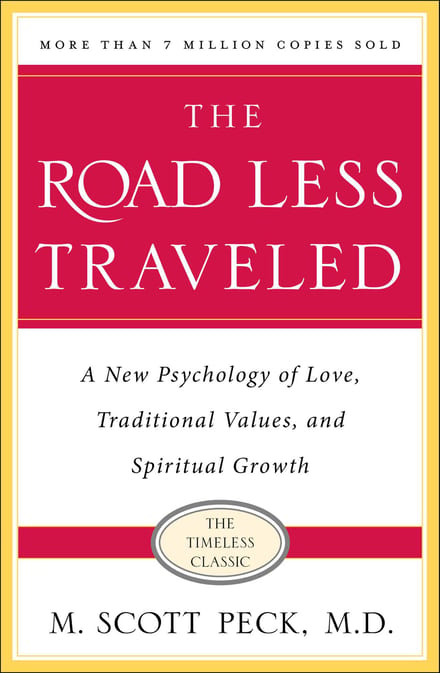
The Road Less Traveled: A New Psychology of Love, Traditional Values and Spiritual Growth
A New Psychology of Love, Traditional Values and Spiritual Growth
The full book runs ~316 pages — roughly 6 hours of reading. You get the key ideas here in 5 minutes.
The key ideas
- Discipline is four tools: delay gratification, take responsibility, face truth, keep balance.
- Falling in love is ego boundaries collapsing — effortless, temporary, and not love.
- Real love is the will to extend yourself for another person's spiritual growth.
- Dependency isn't love: needing someone to survive is parasitism, not choice.
- Everyone has a religion, including atheists who never consciously chose theirs.
- Symptoms like depression and panic are signals to change, not just afflictions.
The summary
“Life is difficult.” Peck opens with those three words and calls them one of the greatest truths: once you genuinely accept it, life stops being quite so hard. He was a practicing psychiatrist, and nearly every claim here rests on someone who sat in his office. Life is a series of problems, discipline is the toolkit, and love is what makes you pick the tools up.
Four tools for suffering on purpose
Discipline is four techniques for taking pain constructively instead of dodging it.
Delaying gratification. A financial analyst couldn’t stop procrastinating until Peck asked how she ate cake. Frosting first, obviously — and she spent the first hour of each workday on the enjoyable part of her job and six hours dreading the rest. One hour of pain then six of pleasure beats the reverse. She stopped.
Accepting responsibility. A sergeant in Okinawa was drinking himself out of the army and had an excuse for every alternative Peck offered, ending at “This damn island would drive anyone to drink.” Neurotics take on too much responsibility and say “I should”; character-disordered people take too little and say “I can’t.” Peck includes himself: at thirty he carried his crushing schedule to his clinic director and got back only, “It’s your problem with your time.”
Dedication to truth. Your view of reality is a map, and maps go stale. One computer technician, taught early that his parents’ promises were worthless, generalized it to “You can’t trust a goddamn soul” and then made therapy impossible rather than revise it.
Balancing. Discipline itself must be disciplined, and its essence is giving up. Peck wrecked an evening of chess with his fourteen-year-old daughter rather than hurry his moves so she could sleep; killing off his need to win cost him a real depression — healthy depression, he says, since that is what an old self dying feels like.
Love is an act of will, not a feeling
Peck defines love as “the will to extend one’s self for the purpose of nurturing one’s own or another’s spiritual growth.” Will, not desire — the difference between “I’d like to go swimming tonight” and “I will.” Love is as love does.
That rules out most of what we call love. Falling in love is a temporary collapse of ego boundaries, a trick the genes play to pair us off: effortless, always ending, leaving you no larger. The myth that one particular person was meant for you he calls a dreadful lie. Dependency is no better. A punch press operator arrived devastated after his wife left with the children — “I’m nothing now” — though he’d ignored all three for years. Two days later he bounced in grinning, having met a woman at his bar. What he’d lost was an identity, not a relationship. Self-sacrifice fails too: a minister who worked himself ragged for a depressed wife and two college-dropout sons had to learn that withholding at the right moment beats giving at the wrong one.
What love takes instead is attention, whose plainest form is listening — hard work, not warm feeling. It also means holding the other person separate. Peck understood narcissism the day he told a mother her schizophrenic daughter was finally well and watched her weep, unable to tell the girl’s suffering from her own. A marriage, he tells couples, is a base camp and not the summit.
Everyone has a religion, including the atheists
A religion, in his usage, is your working answer to what life is about, and you have one whether you know it or not — assembled less from what your parents preached than from how they behaved. Stewart, a depressed engineer and declared atheist, felt a blade of steel in his throat and dreamed of a man coming to cut it. Under the atheism sat a monster-god eager to punish him, built by parents who preached a God of love and beat him with belts, boards and brooms.
So is belief in God a sickness? The cases refuse to generalize. Kathy, chanting a thousand compressed prayers in five minutes to hold off her own fantasies, got well by taking the Catholic Church apart and walking away. Ted, a hermit who had renounced enthusiasm after a rejection and a friend’s death, came back through a Hopkins poem and went to divinity school, signing his name Theodore — “lover of God.”
Grace, which he refuses to explain away
The final section is unapologetically religious, and it’s where the psychiatry runs out. A businessman came to him with a mild neurosis. Born illegitimate to a deaf and mute mother in the Chicago slums, taken from her at five, raised in three foster homes, partially paralyzed at fifteen by a ruptured aneurysm, jailed at seventeen — and three years after his release, the youngest department head in his company’s history. Peck could trace the neurosis exactly. The health he couldn’t explain at all.
That gap is his evidence: we know why people get ill, not why they survive as well as they do. He calls the difference grace, “a powerful force originating outside of human consciousness which nurtures the spiritual growth of human beings,” and means it literally. His hypothesis is a God who wants us to grow, followed to a conclusion he calls terrifying: God wants us to become God. It’s the obligation, not the belief, that people flee. The obstacle is laziness, which he equates with entropy and original sin — Adam and Eve’s real failure wasn’t the fruit, it was never asking why the rule existed.
The bottom line
Love is a decision, renewed in what you do when you don’t feel like doing it, and discipline follows from having made it. The case histories give that argument its weight; the last quarter is real theology, not metaphor. Read it if you’ve ever mistaken a feeling for love, or want a clinician’s case for why the harder path is the only one that goes anywhere.
Frequently asked questions
What is The Road Less Traveled about?
It starts from the line "Life is difficult" and argues that growing up means solving problems instead of dodging the pain they cause. M. Scott Peck, a psychiatrist, lays out four tools of discipline and then redefines love as an act of will — the choice to extend yourself for someone's growth — rather than a feeling that happens to you. The final section turns explicitly religious, arguing that a force he calls grace pushes people to grow whether they ask for it or not.
What are the key takeaways from The Road Less Traveled?
Four are practical: delay gratification, accept responsibility for your own problems, stay dedicated to the truth even when your map of reality has to be redrawn, and keep balance by giving things up. The fifth is the book's spine: love is what you do, not what you feel, so falling in love, dependency and self-sacrifice are none of them love. Peck also argues that everyone carries a religion — a working picture of what life is — usually absorbed from how their parents behaved rather than what they preached.
Who should read The Road Less Traveled?
Anyone untangling a relationship where good intentions keep producing bad results, or wondering why willpower alone never sticks. It suits readers who want a clinician's evidence rather than slogans, and who don't mind a book that ends up talking about God.
Is The Road Less Traveled worth reading?
The case histories are what make it land — patients you can picture, and an argument about love that is genuinely hard to shake off once you've read it. The last quarter is real theology, not metaphor: Peck means grace and God literally, and readers looking for secular self-help will find themselves somewhere they didn't expect. Worth knowing that before you start rather than halfway through.