Book summary
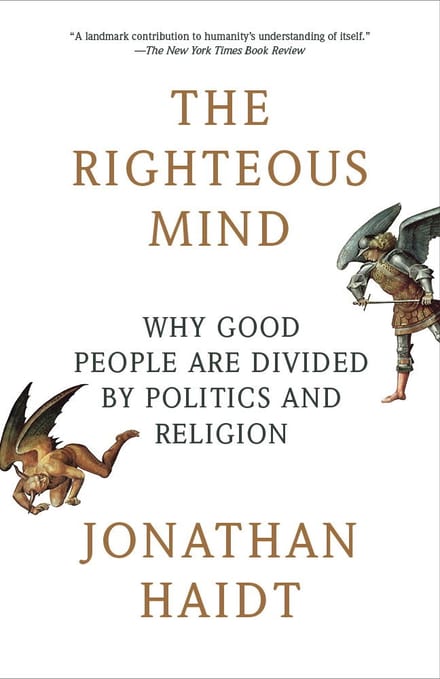
The Righteous Mind: Why Good People Are Divided by Politics and Religion
The full book runs ~493 pages — roughly 9 hours of reading. You get the key ideas here in 6 minutes.
The key ideas
- Intuition leads, reason follows like a hired lawyer.
- Mind is a rider (reason) atop an elephant (emotion).
- Persuasion works by addressing gut feelings, not logic.
- Six moral foundations, not two, shape morality.
- Liberals use two foundations; conservatives draw on all six.
- Humans are groupish, wired to bind into cooperative hives.
The summary
Your moral convictions feel like conclusions you reasoned your way to. Jonathan Haidt argues they’re nothing of the sort. The verdict—that’s disgusting, that’s unfair, that’s wrong—arrives first, in a flash of gut feeling, and your careful arguments show up afterward like a lawyer hired to defend a client who’s already been chosen. Get this backwards and you’ll never understand why political and religious arguments so rarely move anyone, or why people on the other side look not just mistaken but morally rotten.
Haidt reached this against his own instincts. As a young psychologist he was a rationalist: he assumed children reason their way to morality by generalizing from the experience of harm. Then he ran studies in Brazil and Philadelphia and watched the theory break. Working-class subjects judged harmless taboos—a man having private sex with a dead chicken he found, a family eating their dog after it was killed in an accident—as genuinely wrong, while educated subjects reached for the harm principle: if nobody’s hurt, it’s merely weird. Culture and class were shaping morality in ways pure reason couldn’t. And in experiment after experiment, people delivered a snap judgment and then improvised justifications, clinging to their explanations even after being shown they were wrong. Haidt caught himself doing it, snapping a reflexive excuse at his wife over unwashed dishes to protect his own reputation. As David Hume put it, “Reason is, and ought only to be the slave of the passions.”
The rider serves the elephant
Haidt’s image for the mind is a rider on an elephant. The rider is conscious reasoning; the elephant is the vast, automatic weight of intuition and emotion. The rider evolved to serve the elephant, not to steer it. So if you want to change someone’s mind on a moral question, talk to the elephant first and appeal to the gut. Lead with a conclusion that offends their intuitions and they’ll pour all their cleverness into finding an escape hatch, some reason to dismiss you, and they’ll almost always find one. We ask “Can I believe it?” about claims we like and “Must I believe it?” about claims we don’t, and the answers come out conveniently.
This means moral reasoning behaves less like a scientist chasing truth and more like a press secretary defending whatever the president already decided. It also means we’re groupish rather than simply selfish: we wield our reasoning to back our team and prove our loyalty to it. That’s why rural, working-class voters often support candidates whose economics may not serve them—they’re voting their moral interests, not being tricked. Tellingly, expertise in ethics doesn’t make people behave better; it just makes them better at justifying what they were going to do anyway. To improve conduct, change the incentives and the environment, not the arguments.
Six moral flavors, not two
Haidt proposes that human morality runs on six foundations, like taste receptors on the tongue: Care/harm, Fairness/cheating, Loyalty/betrayal, Authority/subversion, Sanctity/degradation, and Liberty/oppression. Liberals build mainly on the first two, caring most about protecting the vulnerable and treating people fairly. Conservatives spread their weight more evenly across all six, which is why conservative appeals often land harder—they activate more of the moral palate at once. Each side then misreads the other: liberals hear talk of loyalty, authority, and sanctity as backward or cruel, while conservatives hear the liberal focus on harm and fairness as naive and blind to everything that holds a community together. Even the shared word “liberty” splits along these lines—the left hears protection of the oppressed, the right hears freedom from government intrusion.
Part of the disconnect is that educated Westerners are unusual. WEIRD cultures—Western, Educated, Industrialized, Rich, Democratic—are statistical outliers whose moral world narrows mostly to harm and fairness, while most societies across history have drawn on community, hierarchy, and purity as well. Step outside your own moral matrix and rival configurations stop looking evil and start looking coherent. A morality reduced to a single principle, whether utilitarian “greatest good” or Kantian rights, is like a restaurant that serves only one flavor: survivable, but a thin version of what humans actually hunger for.
Ninety percent chimp, ten percent bee
Where do these instincts come from? Haidt makes the contested case that we’re products of group selection as well as individual competition. At some point selfish primates learned to bind into cooperative groups so cohesive they behaved almost like single organisms, and the tightest, least free-riding groups outcompeted the rest. We ended up with a dual nature: mostly self-interested apes, but with a streak of hive insect that longs to merge into something larger. Haidt felt his own “hive switch” flip after 9/11, when a liberal professor wary of nationalism suddenly wanted a flag on his car. Rituals, music, even drugs can throw that switch, working through mechanisms like oxytocin and the mirror-neuron system. Religion has been flipping it for millennia—less through supernatural claims than by knitting people into sacred communities that suppress selfishness and sustain sacrifice, which let human groups scale into civilizations. The switch can be exploited, as fascists have shown, but it also powers everything from corporations to a country founded, deliberately, on many competing groups so no single hive could tyrannize the others.
The bottom line
Politics divides good people not because one side is wicked but because our minds were built for groupish righteousness—intuitions first, reasoning as their advocate, morality binding us into teams that run on different mixes of the same six foundations. A healthy society needs both the liberal reflex to protect the vulnerable and the conservative reflex to preserve what already works. Read this if you’ve ever been genuinely baffled that intelligent people on the other side can’t see what seems obvious to you.
Fact check
Popular books repeat findings that later research has complicated. Where The Righteous Mind makes a testable claim, here's what the evidence actually shows.
Moral judgment arrives first as a gut intuition, and conscious reasoning only invents justifications afterward.
Moral dumbfounding itself replicates and is not a quirk of Western undergraduates: the standard task run in China (n = 165), India (n = 181) and a mixed MENA sample (n = 264) found people holding onto judgments they could not defend in all three. The stronger claim — that reasoning does no real work — is where the evidence thins. A critique in Cognition argued the classic scenarios confound harm with purity, so participants may be tracking a hidden victim rather than reasoning from nothing, and that moral judgment is more deliberative and revisable than the paradigm implies. The affect-priming evidence has weakened badly too: a meta-analysis of 50 experiments put incidental disgust's effect on moral judgment at d = 0.11, which fell to d = -0.01 after correcting for publication bias.
- McHugh C, Zhang R, Karnatak T, Lamba N, Khokhlova O. Just wrong? Or just WEIRD? Investigating the prevalence of moral dumbfounding in non-Western samples. Mem Cognit. 2023;51(5):1043-1060. PubMed
- Guglielmo S. Unfounded dumbfounding: How harm and purity undermine evidence for moral dumbfounding. Cognition. 2018;170:334-337. PubMed
- Landy JF, Goodwin GP. Does Incidental Disgust Amplify Moral Judgment? A Meta-Analytic Review of Experimental Evidence. Perspect Psychol Sci. 2015;10(4):518-36. PubMed
Human morality runs on six innate foundations, like taste receptors, that show up across cultures.
The six foundations work well as a vocabulary but poorly as a measured structure. When the short-form Moral Foundations Questionnaire was tested across 27 countries spanning five continents, the five-factor model could not be specified so that it converged without problems across those populations — the precondition for treating the foundations as universal, innately prepared receptors rather than a taxonomy built from Western samples. Haidt's own point about WEIRD outliers cuts at his instrument as well as at his opponents.
- Iurino K, Saucier G. Testing Measurement Invariance of the Moral Foundations Questionnaire Across 27 Countries. Assessment. 2020;27(2):365-372. PubMed
Liberals build their morality on two foundations while conservatives draw on all six.
The basic liberal-conservative difference holds up in a meta-analysis of 89 samples covering 33,804 independent participants, but it is smaller and less portable than the clean two-versus-six framing suggests. Heterogeneity was moderate, and the associations shifted by region, by country, and between White and Black respondents. The effect sizes drawn from YourMorals.org — the 192,870-person dataset behind much of the popular account — came out inflated relative to independent samples, apparently because politically interested people selected themselves into it.
- Kivikangas JM, Fernández-Castilla B, Järvelä S, Ravaja N, Lönnqvist JE. Moral foundations and political orientation: Systematic review and meta-analysis. Psychol Bull. 2021;147(1):55-94. PubMed
The group-bonding "hive switch" works through mechanisms like oxytocin and the mirror-neuron system.
Both named mechanisms are shakier than the aside implies. A registered replication of the founding oxytocin-and-trust experiment, powered above 95%, found no effect of intranasal oxytocin on trusting behavior in the social-contact condition. The mirror-neuron account of social understanding was challenged in a review laying out eight problems with it, including that no monkey data directly test the theory and that the human evidence argues against it. That people bind into groups through ritual, synchrony and shared awe is well documented; the neurochemistry offered as the how is not.
Frequently asked questions
What is The Righteous Mind about?
Your moral convictions feel like conclusions you reasoned your way to, but the verdict — that's wrong, that's unfair — actually arrives first as a gut feeling, with your careful arguments showing up afterward like a lawyer defending a client already chosen. Get that backwards and you'll never understand why political and religious arguments so rarely move anyone, or why the other side can look not just mistaken but morally rotten.
What are the key takeaways from The Righteous Mind?
The mind is a rider (conscious reasoning) on an elephant (automatic intuition), and the rider serves the elephant — so to change someone's mind, appeal to the gut first. Human morality runs on six foundations, like taste receptors: care, fairness, loyalty, authority, sanctity, and liberty. Liberals build mainly on the first two while conservatives use all six, which is why each side misreads the other. Educated Westerners (WEIRD cultures) are statistical outliers whose morality narrows to harm and fairness. And we're "90% chimp, 10% bee" — groupish creatures with a "hive switch," which is how religion binds people into cooperative communities.
Who should read The Righteous Mind?
Anyone who's been genuinely baffled that intelligent people on the other side of politics or religion can't see what seems obvious to them.
Is The Righteous Mind worth reading?
It's a rigorous, evenhanded explanation of moral disagreement that treats both left and right as coherent rather than one side as wicked, and the moral-foundations framework is genuinely clarifying. The group-selection argument is contested even within the book's own telling, so readers should take that section as a case being made rather than settled science.