Book summary
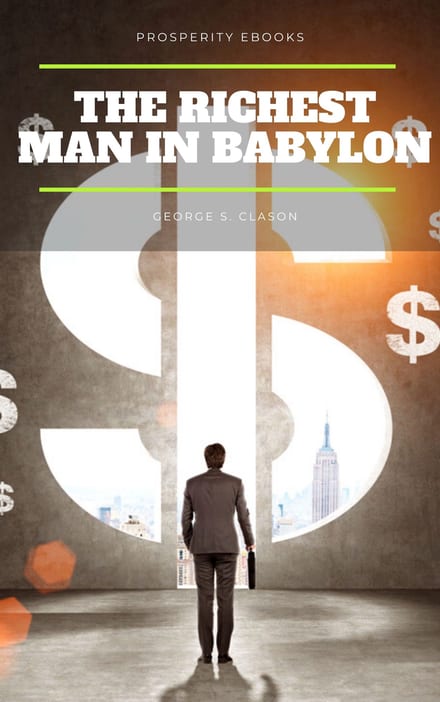
The Richest Man in Babylon
The full book runs ~124 pages — roughly 2 hours of reading. You get the key ideas here in 5 minutes.
The key ideas
- Pay yourself first, before every other claim on income
- Save one coin of every ten, always
- Put idle gold to work, then reinvest the returns
- Protect principal; small safe gains beat risky ones
- Take money advice only from proven experts
- Seize opportunity now; procrastination kills luck
The summary
A part of all you earn is yours to keep. That one sentence holds the whole book. Most people believe everything they earn belongs to the butcher, the landlord, the sandal-maker, the tax collector, and that whatever is left over is theirs. Clason flips this. The first claim on your income should be your own future, paid before anyone else gets a coin. Set aside no less than a tenth of what you earn, keep it, and put it to work. Do that consistently and wealth follows as surely as a tree grows from a seed. The parables in this book, all set in ancient Babylon, exist to drive that single truth home from every angle.
Pay yourself first
The book opens with two friends stuck where most of us get stuck. Bansir the chariot builder and Kobbi the musician have worked hard their whole lives in the richest city on earth and have empty purses to show for it. They’ve never learned how money works, so they ask the one man who clearly does: Arkad, the richest man in Babylon.
Arkad’s own story is the engine of the book. As a young scribe carving clay tablets for coppers, he begged the money lender Algamish for the secret to wealth. The answer stunned him with its plainness: “I found the road to wealth when I decided that a part of all I earned was mine to keep.” Arkad started keeping one coin of every ten. He barely noticed the difference, yet the hoard grew. His early attempts to invest it were disasters. He handed his savings to Azmur, a brickmaker, to buy jewels in far-off Tyre, and the Phoenicians sold the fool bits of glass. The lesson stuck: take savings advice only from those competent to give it — ask a jeweler about jewels, not a brickmaker. Arkad kept saving, learned to make his gold earn and its earnings earn again, and became the wealthiest man in the city.
The mechanism is almost embarrassingly simple, which is exactly Arkad’s point. Every gold piece you save is a slave that works for you; every coin it earns is a child that can work too. Spend the children and you stay poor. Let them multiply and you build an army.
The seven cures for a lean purse
When the king asks Arkad to teach the whole city, Arkad lays out seven remedies. Read them as one connected program, not a menu:
- Start thy purse to fattening. For every ten coins you place in your purse, spend only nine. Like the egg merchant who puts ten eggs in the basket each morning and takes nine out, the basket eventually overflows.
- Control thy expenditures. What you call “necessary expenses” will always grow to swallow your whole income unless you fight back. Budget deliberately, and don’t confuse necessities with the endless desires no income can satisfy.
- Make thy gold multiply. Idle gold earns nothing. Put it to work so it returns a steady stream, then reinvest those returns so your capital compounds on itself.
- Guard thy treasures from loss. The first principle of investing is protecting your principal. Chase big returns and you’ll probably lose everything, as Arkad did with the brickmaker. A small, safe return beats a large, risky one.
- Make of thy dwelling a profitable investment. Own your home rather than rent. It cuts your cost of living and puts confidence behind everything you do.
- Insure a future income. Provide for your old age and for your family if you die. Small regular payments compound into real security.
- Increase thy ability to earn. Sharpen your skill and your earnings rise with it. Cultivate strong, definite desires, pay your debts, and act so you respect yourself.
The five laws of gold
Arkad’s son Nomasir was sent into the world with a bag of gold and a clay tablet carved with five laws. He promptly lost it all on a rigged horse race and a bad partnership. Broke and desperate, he finally read the tablet, learned the laws by heart, and rebuilt a fortune larger than what he’d lost, returning home with three bags of gold to prove the wisdom was worth more than the money.
The laws restate the cures as principles about gold’s behavior. Gold comes gladly to the man who saves at least a tenth of his earnings. It labors and multiplies for the owner who finds it profitable employment. It clings to the cautious owner who invests under wise advice. It slips away from anyone who puts it into ventures he doesn’t understand. And it flees the man who chases impossible returns or trusts the “alluring advice of tricksters and schemers.”
Luck follows the man who acts
One chapter takes on our favorite excuse: that rich people are simply lucky. Arkad’s forum concludes that luck isn’t found at the gaming tables, where the odds are rigged against you, but in the willingness to seize opportunity when it appears. A merchant recalls turning down a share in a barren tract of land his father begged him to buy; the venture made everyone in it rich without him. A cattle buyer let a bargain flock of sheep slip away by stalling on a deal he knew was good. The enemy in both stories has a name: procrastination. Opportunity waits for no one, and men of action are the ones the goddess of good luck favors.
The bottom line
Wealth is not luck, inheritance, or a high salary. It is a habit: keep at least a tenth of everything you earn, protect it, and make it multiply until your money earns more than your labor does. The sooner you plant that first coin, the sooner you rest in the shade of the tree it becomes. Read this if you earn money but can never seem to hold onto it and you want the fundamentals explained plainly enough to start today.
Fact check
Popular books repeat findings that later research has complicated. Where The Richest Man in Babylon makes a testable claim, here's what the evidence actually shows.
Saving at least a tenth of everything you earn is enough to build lasting wealth.
A tenth is almost exactly right for the early starter the parables assume, and badly short for everyone else. The Center for Retirement Research calculates that a medium earner who begins saving at 25 and retires at 65 needs 10% of earnings a year to hit a 70% replacement rate — but 15% if they start at 35 and 27% if they start at 45. Working to 70 instead drops the 25-year-old's requirement to 4%; retiring at 62 raises it to 15%. Clason's rule survives, on the condition he never states: start young.
- Munnell AH, Webb A, Hou W. How Much Should People Save? Center for Retirement Research at Boston College, Issue in Brief No. 14-11. July 2014. Source
- Munnell AH, Webb A, Hou W. How Much Should People Save? Center for Retirement Research at Boston College, Issue in Brief No. 14-11, Table 5. July 2014. Source
Owning your home rather than renting it makes the dwelling a profitable investment.
Residential property returned roughly 7% a year in real terms across 16 advanced economies from 1870 to 2015 — compounding at 6.6% against 4.6% for equities, at less than half the volatility (10% versus 22%). But about half of that return is rental yield rather than price appreciation, which is really Clason's other point: an owner stops paying rent. The figures are for housing as an asset class, before the maintenance, taxes, insurance and transaction costs a real owner absorbs. The Federal Reserve's 2022 Survey of Consumer Finances puts homeowners' median net worth at $396,200 against $10,400 for renters, though that gap reflects who manages to buy as much as what buying does.
- Jordà Ò, Knoll K, Kuvshinov D, Schularick M, Taylor AM. The Rate of Return on Everything, 1870-2015. Q J Econ. 2019;134(3):1225-1298. Source
- Board of Governors of the Federal Reserve System. Changes in U.S. Family Finances from 2019 to 2022: Evidence from the Survey of Consumer Finances. October 2023. Source
Frequently asked questions
What is The Richest Man in Babylon about?
A part of all you earn is yours to keep — that one sentence holds the whole book. Most people believe everything they earn belongs to others and whatever's left over is theirs; Clason flips it, making your own future the first claim on your income. Set aside at least a tenth of what you earn, protect it, and put it to work, and wealth follows as surely as a tree grows from a seed.
What are the key takeaways from The Richest Man in Babylon?
Told through parables of ancient Babylon, it lays out the seven cures for a lean purse: start your purse to fattening by saving a tenth, control your expenditures, make your gold multiply, guard it from loss, own your home, insure a future income, and increase your ability to earn. The five laws of gold restate these as principles — gold comes to those who save, multiplies under wise employment, clings to the cautious, and flees the careless and the greedy. Take money advice only from those competent to give it (ask a jeweler about jewels, not a brickmaker), and know that luck favors people who act rather than procrastinate.
Who should read The Richest Man in Babylon?
Anyone who earns money but can never seem to hold onto it and wants the fundamentals explained plainly enough to start today.
Is The Richest Man in Babylon worth reading?
The parable format makes timeless principles memorable, and the core habit — pay yourself first, save at least 10% — is genuinely durable advice. The lessons are simple by design and the archaic "thy/thee" phrasing won't suit everyone, so readers who already save consistently may find little new beyond the storytelling.