Book summary
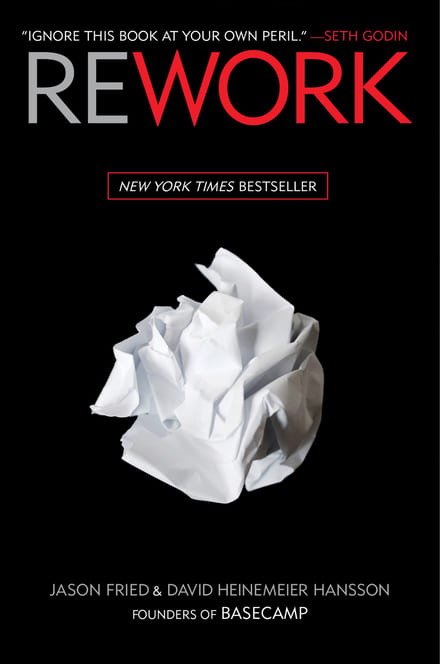
Rework
The full book runs ~279 pages — roughly 5 hours of reading. You get the key ideas here in 3 minutes.
The key ideas
- Launch the smallest version that does one thing well
- Say no to features until demand proves real
- Teach freely—it beats any advertising budget
- Hire only when a specific problem demands it
- Quit failing projects instead of sinking more time
- Take a stand; your values make you uncopyable
The summary
Most business advice assumes you need investors, a five-year plan, and a payroll before you can begin. Jason Fried and David Heinemeier Hansson, the founders of Basecamp, say you need almost none of it. The cost of starting has collapsed—tools that once ran into the thousands are now cheap or free, one person can do what took a whole department a decade ago, and you can work from anywhere. So test the idea on nights and weekends with the equipment you already own, no debt and no outside money, and see if it holds. The real question isn’t whether you have enough resources. It’s whether you can start small and stay disciplined.
Build the smallest thing you’d actually use
Your first version should do one thing well rather than ten things poorly. When Gordon Ramsay turns a failing restaurant around, his first move is almost always to trim the menu, and the same instinct applies to a product: launch with the core and nothing else, then improve from there. Most of the features you’re sure you need, you don’t—a smaller, sharper offering is easier to build, easier to explain, and easier for a newcomer to use than a bloated competitor.
That means learning to say no. When customers request a feature, decline it at first and wait to see whether the same request keeps surfacing over time; if it doesn’t, you’ve saved yourself from building something nobody wanted. Staying lean isn’t stinginess, it’s a way of keeping your decisions reversible, which is a small company’s real advantage. Make quick calls for the short term and adjust as you go instead of staying chained to a plan written months ago. And make it about something you’d be proud of and would use yourself—treat the business like a committed relationship, not a fling you hope to flip.
Teaching beats advertising
Advertising is expensive and forgettable; teaching builds an audience that trusts you. Share what you know—write, blog, tweet, make videos, whatever fits—and give the valuable stuff away, and people will come back when they’re ready to buy. For a small company it’s the most effective marketing there is, and it costs you nothing but effort. When you do want press, skip the mass outlets and approach niche journalists you can actually reach with a personal note.
It helps to remember that everything you do is marketing. Every email you send, every interaction, every error message in your software, and, if you run a restaurant, the after-dinner mint—marketing isn’t a few campaigns but the sum total of how you show up. So make it everyone’s job, not one department’s, and speak like a person rather than a corporation hiding behind jargon. Let people taste the product for free so they come back hungry for more.
Stay small and uncopyable
What no competitor can clone is your point of view. They can copy a feature list, but not the passion and values you pour into the work, and a copycat is always a step behind—following, never leading, shipping a knockoff that’s already dated. So take a genuine stand on something you care about; it sets you apart and pulls in customers who share it. Don’t let rivals dictate your strategy either—focus on your own vision.
Keeping the company small protects all of that. Hire only when a specific problem truly demands another person, because extra headcount tends to invent its own busywork, and a lean team talking straight to customers understands them faster than any layer of management. When you do hire, test-drive candidates on a small real project rather than trusting a résumé, hire for roles you’ve done yourself so you can judge the work, and when two people are close, hire the better writer—clear writers think clearly, know what to omit, and can put themselves in someone else’s shoes. Remote work opens the whole world as a talent pool and forces the honest, direct communication that lets people manage themselves in a culture built on trust and autonomy.
Move fast, and know when to quit
Productivity comes from focused, uninterrupted work and a taste for quick wins, not from long hours or perfectionism. Carve out blocks of interruption-free time, kill the meetings that produce more talk than action, and break big projects into small goals measured in weeks rather than years. Don’t let hypothetical problems paralyze you—handle them if and when they actually arrive.
Sometimes the most productive move is to quit. People equate quitting with failure, but if you’ve already sunk too much time into something that isn’t working, walking away is the right call; you can’t recover the time you’ve spent, and the only real mistake is spending more. Finally, watch your language: words like need, must, can’t, easy, just, only, always, never, and ASAP force everything into black and white and shut down conversation, when most decisions live in the nuance.
The bottom line
Build the smallest version of something you’d genuinely use, decline nearly every feature request, and teach what you know—openly sharing your expertise will do more than any ad budget. Stay small enough to change your mind, and quit what isn’t working. Read this if you’re tired of conventional business advice and want to build something real without debt, investors, or a grand plan.
Frequently asked questions
What is Rework about?
Most business advice assumes you need investors, a five-year plan, and payroll before you can begin. The founders of Basecamp say you need almost none of it, because the cost of starting has collapsed — so test the idea on nights and weekends with what you already own, no debt and no outside money. The real question isn't whether you have enough resources; it's whether you can start small and stay disciplined.
What are the key takeaways from Rework?
Build the smallest version that does one thing well, then say no to nearly every feature request and wait to see if it keeps resurfacing. Teaching beats advertising — give your expertise away and people return when they're ready to buy — and remember everything you do is marketing. Compete on your point of view, which no rival can copy, and stay small enough to keep your decisions reversible. Hire only when a problem truly demands it, test-drive candidates on real work, favor the better writer, and know when quitting something that isn't working is the productive move.
Who should read Rework?
Anyone tired of conventional business advice who wants to build something real without debt, investors, or a grand plan.
Is Rework worth reading?
It's punchy, contrarian, and fast — short chapters that puncture startup orthodoxy and stick. The flip side is that its lessons come from a lean, bootstrapped software company, so founders in capital-heavy or fast-scaling businesses may find some advice doesn't map cleanly onto their world.