Book summary
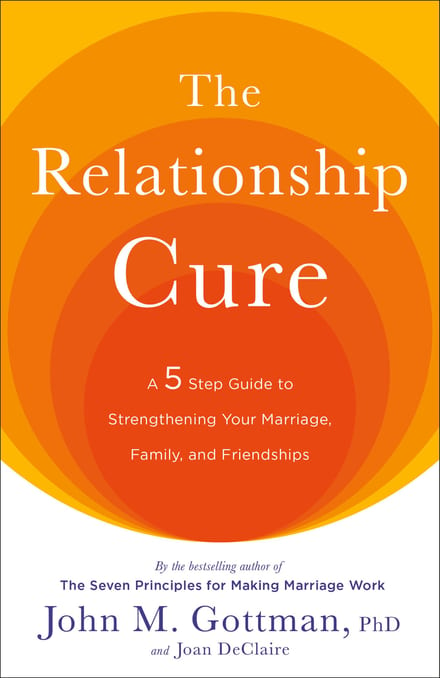
The Relationship Cure
The full book runs ~328 pages — roughly 6 hours of reading. You get the key ideas here in 3 minutes.
The key ideas
- Turn toward small bids for connection instead of away or against.
- Patterns of response, not single moments, decide relationships.
- Read beneath surface talk to find the real unmet need.
- Emotional heritage shapes how people bid and hear criticism.
- Make your own bids soft, clear, and need-based.
- Shared rituals and vision keep the connection foundation strong.
The summary
Closeness doesn’t get built in big heart-to-heart conversations. It gets built in the small stuff — a passing comment about the weather, a glance across the room, a question about your day. John Gottman calls each of these little moves a “bid” for connection, and how you answer them, over and over, decides whether a relationship grows or quietly dies. In his “Love Lab,” Gottman’s team watched 60 couples for twelve hours a day and found almost no dramatic “opening up.” Most talk was mundane. What separated the happy couples from the miserable ones wasn’t what they discussed; it was how they responded to each other’s bids.
Three ways to answer a bid
A bid can be a question, an exclamation, a gesture, even a facial expression — any small attempt to connect. You can meet it in exactly three ways. If your partner calls to ask whether you want to read an article and you say, “Yes, send it over,” you’ve turned toward the bid. If you brush it off with “Do you know what time it is?”, you’ve turned away. If you snap, “Can’t you see I’m busy?”, you’ve turned against it. Turning toward tells the other person they matter; turning away or against tells them they don’t.
The stakes are higher than they look. In marriages that ended in divorce, husbands turned away from or against their wives’ bids 82 percent of the time. In stable marriages, that number was 19 percent. No single response makes or breaks anything — it’s the pattern that decides.
Bids are rarely what they seem
Small talk often carries a much bigger request underneath. A woman on the couch asks, “Isn’t it a bit chilly?” She may not want the thermostat touched at all; she may want to be held. She phrases it vaguely on purpose, because a disagreement about temperature is far easier to absorb than a rejection of physical closeness. Bids get harder to read when they arrive wrapped in negative feeling. A child’s tantrum is often a bid for comfort. A partner’s complaint that you never call is a bid for more connection. If you hear only the criticism, you miss the need, and the right move — hugging the melting-down child rather than scolding him — becomes invisible.
Emotional heritage shapes how we bid
To read someone’s bids well, you have to understand where they come from. Gottman describes a couple, Sarah and Rick. Sarah would get angry when Rick watched TV instead of talking, and a fight would follow. Rick had been raised by a grandmother who resented and constantly belittled him, so when Sarah criticized him, he didn’t hear a request — he heard “you can’t do anything right,” his grandmother’s voice all over again. Sarah, one of seven children, had learned to keep her needs quiet until they finally burst out as complaints. What she actually wanted was closeness. Her history just made her ask for it as a grievance.
The same awareness applies to your own bids. Gottman recalls waiting for his wife at dinner and finally snapping, “Stop working! It’s family time!” She felt attacked and fired back. Had he softened it — “Honey, we miss you, come have dinner when you can” — she’d have answered very differently. Naming the real need gently works better than a demand nearly every time. And you don’t have to say yes to turn toward a bid; if someone suggests lunch and you’re swamped, proposing tomorrow instead still keeps the connection alive.
Build the pattern, not the moment
Because it’s the pattern that counts, the work is consistency. Invite someone to dinner and get a warm yes most of the time, and you feel wanted; get turned down again and again with no counteroffer, and you slowly conclude they’d rather not be around you. Relationships rarely collapse in a single blowup — they erode through accumulated turning-away. Gottman also warns about the “four horsemen” that speed the decline: criticism, defensiveness, contempt, and stonewalling.
When conflict starts to dominate, ask what isn’t being discussed; fights over trivia usually stand in for a need no one has named. And to keep individual bids from carrying impossible weight, build a shared foundation — a common sense of purpose, plus small rituals like regular dinners or a standing weekend walk that give the relationship somewhere solid to stand.
The bottom line
Relationships live and die in the smallest moments, not the grand conversations. Learn to spot the bids for connection, hear the need underneath them, and turn toward them again and again. Read this if you want practical tools for any relationship you care about — partner, family, friend, or colleague.
Fact check
Popular books repeat findings that later research has complicated. Where The Relationship Cure makes a testable claim, here's what the evidence actually shows.
Husbands in marriages that ended in divorce turned away from or against their wives' bids 82% of the time, versus 19% in stable marriages.
The direction holds up: Gottman and Levenson's study of 73 couples found that "nonregulated" couples showed more negative and less positive emotional expression, more defensiveness, and more stubbornness and withdrawal, and were at greater risk of separation. The specific 82/19 split is another matter — it comes from Gottman's own apartment-lab observation of a small sample and does not appear in the peer-reviewed record with those figures or from an independent group. Treat it as an illustration of a real pattern rather than a measured rate.
- Gottman JM, Levenson RW. Marital processes predictive of later dissolution: behavior, physiology, and health. J Pers Soc Psychol. 1992;63(2):221-33. PubMed
Watching how a couple interacts in the lab reveals whether their relationship will survive.
Gottman's prediction models were fitted and scored on the same samples they were derived from. When Heyman and Smith Slep reanalysed divorce-prediction data with proper crossvalidation, "accuracy and predictive value drops precipitously," and they advised skepticism toward any such study that skips the step. The best-known result of this kind — forecasting 6-year marital outcome from the first three minutes of a conflict discussion — rests on 124 newlywed couples with no independent validation sample.
Small everyday moments of responsiveness, not big heart-to-heart conversations, are what decide a relationship's fate.
The emphasis on how partners feel treated day to day matches the largest test so far: random-forest models across 43 longitudinal datasets from 29 labs found the top predictors of relationship quality were perceived-partner commitment, appreciation, sexual satisfaction, perceived-partner satisfaction, and conflict. But those relationship-specific variables predicted up to 45% of variance at baseline and only up to 18% by each study's end, and change in relationship quality was largely unpredictable from any combination of self-reports. Observing newlyweds four times over nine months likewise found communication and satisfaction linked at any given moment, yet neither longitudinal pathway between them was robust.
- Joel S, Eastwick PW, Allison CJ, et al. Machine learning uncovers the most robust self-report predictors of relationship quality across 43 longitudinal couples studies. Proc Natl Acad Sci U S A. 2020;117(32):19061-19071. PubMed
- Lavner JA, Karney BR, Bradbury TN. Does Couples' Communication Predict Marital Satisfaction, or Does Marital Satisfaction Predict Communication? J Marriage Fam. 2016;78(3):680-694. PubMed
Frequently asked questions
What is The Relationship Cure about?
Closeness gets built in small moments, not big heart-to-heart talks — a passing comment, a glance, a question about your day. Gottman calls each of these little moves a "bid" for connection, and how you respond, over and over, decides whether a relationship grows or quietly dies. In his Love Lab, what separated happy couples from miserable ones wasn't what they discussed but how they answered each other's bids.
What are the key takeaways from The Relationship Cure?
You can meet any bid three ways — turning toward it, turning away, or turning against it — and the pattern matters far more than any single response: divorcing couples turned away 82% of the time, stable ones only 19%. Bids are rarely literal, so "Isn't it chilly?" may be a request to be held, and a child's tantrum or a partner's complaint is often a bid for connection wrapped in negative feeling. Your emotional history shapes how you bid and how you hear others, so naming the real need gently beats a demand. Watch for the "four horsemen" — criticism, defensiveness, contempt, stonewalling — and build shared rituals so no single bid carries impossible weight.
Who should read The Relationship Cure?
Anyone who wants practical tools for a relationship they care about — a partner, family member, friend, or colleague.
Is The Relationship Cure worth reading?
It's grounded in real lab observation rather than slogans, and the "bid" idea is simple enough to use immediately across any relationship, not just marriage. The core insight repeats, so readers who grasp turning-toward quickly may find the examples more reinforcing than revelatory — but the framework is genuinely useful.