Book summary
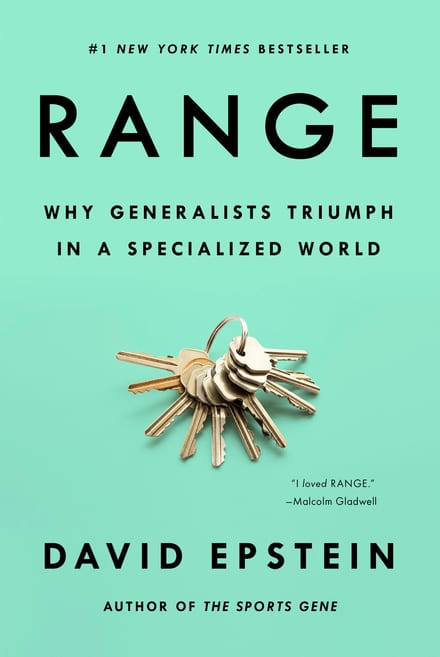
Range: Why Generalists Triumph in a Specialized World
The full book runs ~352 pages — roughly 6 hours of reading. You get the key ideas here in 5 minutes.
The key ideas
- Most valuable skills develop in "wicked" environments where feedback is slow or misleading, and narrow experience can breed confidence without competence.
- Eventual elites usually sample many pursuits first, then specialize late once they know their "match quality."
- Learning that lasts feels slow and inefficient: struggle, spacing, and mixing problems beat cramming and hint-heavy drilling.
- Breakthroughs often come from outsiders and analogies: the further a problem sits from your specialty, the fresher your angle on it.
- Range, not a head start, is what lets you connect distant ideas and adapt when the rules change.
The summary
Roger Federer and Tiger Woods both reached the summit of their sports, but they climbed by opposite routes. Tiger was swinging a club before he could talk, guided by a father who had already mapped out his destiny. Roger played squash, skiing, wrestling, basketball, handball, table tennis, and soccer, and only drifted toward tennis as a teenager, after “pully” parents kept nudging him to stop taking it so seriously. We repeat the Tiger story endlessly, with its ten-thousand-hours rule and its earlier-is-better head start, and almost never tell Roger’s, even though his path is the far more common one. David Epstein’s argument is that in most of the domains that actually matter, breadth beats early hyperspecialization. The people who sample widely, think by analogy, and specialize late develop the range that lets them solve problems no specialist saw coming.
Kind worlds versus wicked worlds
The reason the Tiger recipe works for golf and chess is that those are what psychologist Robin Hogarth called “kind” learning environments. Patterns repeat, the rules hold still, and feedback is fast and accurate, so years of repetition build the pattern-recognition that lets a grandmaster know his move in seconds. Most of life is not like that. In “wicked” environments the rules are unclear, patterns don’t cleanly repeat, and feedback is delayed or downright misleading. Hogarth’s grim example is a celebrated New York physician who diagnosed typhoid by feeling patients’ tongues — and, using only his hands, seeded more infections than Typhoid Mary, with every “correct” diagnosis reinforcing the worst possible habit. When Daniel Kahneman evaluated Israeli officer candidates, his team gave confident judgments that never beat chance, yet the confidence never dropped. Treat a wicked world as if it were kind and experience breeds certainty without skill; specialists can actually get worse over time while growing surer of themselves.
Why sampling beats a head start
When researchers track elite athletes from childhood, they find a “sampling period” first — a variety of sports, lightly structured, before any narrowing. Germany’s World Cup winners typically didn’t out-train amateurs until their twenties; Ester Ledecka won Olympic gold in two different sports. The same pattern holds far from the field. Economist Ofer Malamud found that English and Welsh students, forced to specialize early, switched careers after graduation more often than Scots who sampled longer — and the Scots quickly caught up in pay. Learning about yourself, it turns out, beats piling up narrow skills. Epstein calls this “match quality.” Van Gogh cycled through five careers, testing each with maniacal intensity before erupting into art in his final years. Frances Hesselbein held four chief-executive jobs, never applied for a single one, and started out running a Girl Scout troop she agreed to lead for six weeks. Following your interests and changing course isn’t aimless drifting; it’s how a good fit gets found.
Learning that feels like falling behind
The most effective learning looks inefficient. Robert Bjork’s research on “desirable difficulties” shows that obstacles which slow you down and make you struggle produce knowledge that lasts. Being forced to generate an answer before you’re told it helps, even when you guess wrong — and the more confidently wrong you were, the better the correction sticks. Spacing practice out beats cramming by a wide margin; in one study, learners tested a month after studying Spanish retained 250 percent more years later than those tested the same day. Mixing problem types instead of drilling one at a time makes knowledge flexible. The catch is that all of this feels worse in the moment. The engaging eighth-grade teacher who hands out hints boosts today’s quiz and undercuts durable understanding, and the professors whose students struggle now but excel in later courses get punished with worse evaluations. Good performance today is a poor measure of learning.
The power of thinking sideways
Facing a question with no existing evidence — why do distant planets move more slowly? — Johannes Kepler reasoned his way toward a precursor of gravity by firing off analogies: heat, light, magnets, a scent spreading, boatmen steering across a current. Range is what makes that possible. Kahneman and Tversky contrasted the “inside view,” anchored in the details right in front of you, with the “outside view,” which finds structurally similar cases far afield; a whole reference class of loose analogies predicts better than the single closest one. Philip Tetlock’s decades of forecasting tournaments make the same point. His “hedgehogs” know one big thing and bend every event to their pet theory — great on television, about as accurate as a dart-throwing chimp. His “foxes” know many little things and, at their best, become “foxes with dragonfly eyes,” synthesizing many perspectives at once. The outsider edge is real and measurable: on the InnoCentive platform, the further a problem sat from a solver’s specialty, the likelier they were to crack it. A retired engineer used radio waves to predict solar storms that had stumped NASA for thirty years; a chemist solved a stuck-oil problem by borrowing a concrete vibrator he’d seen once on a construction job. Comic-book creators got better not with more experience but with more genres under their belt. And Gunpei Yokoi, a self-described mediocre engineer, built Nintendo’s Game Boy on deliberately “withered technology” — cheap, obsolete, nearly indestructible — and buried rivals with far better screens. Breadth is what lets you spot the solution sitting in the next trench over.
The bottom line
The world is not golf, and most of it isn’t even tennis. In the wicked, shifting domains that make up most of work and life, the durable advantage comes from breadth: sampling widely, learning slowly, and borrowing ideas from well outside your specialty, even when that means forgoing an early head start. Read it if you feel behind for having zigzagged, if you’re deciding whether to push a kid to specialize young, or if you lead people and want a team that can see the whole puzzle.
Fact check
Popular books repeat findings that later research has complicated. Where Range makes a testable claim, here's what the evidence actually shows.
The ten-thousand-hours story is a poor general recipe: accumulated practice explains elite performance mainly in stable, rule-bound fields and very little elsewhere.
A meta-analysis found deliberate practice accounted for 26 percent of the variance in performance for games, 21 percent for music and 18 percent for sports, but only 4 percent for education and under 1 percent for professions — precisely the gradient Epstein describes, with practice mattering most where the rules hold still and feedback is fast. A 2019 double-blind replication of the Ericsson violinist study that the rule came from failed to reproduce its core finding that accumulated practice tracked each skill level; practice still mattered, but by a considerably smaller margin than the 1993 paper reported.
- Macnamara BN, Hambrick DZ, Oswald FL. Deliberate practice and performance in music, games, sports, education, and professions: a meta-analysis. Psychol Sci. 2014;25(8):1608-18. PubMed
- Macnamara BN, Maitra M. The role of deliberate practice in expert performance: revisiting Ericsson, Krampe & Tesch-Römer (1993). R Soc Open Sci. 2019;6(8):190327. PubMed
Athletes who reach the very top usually sample several sports first and specialise later than those who don't.
A meta-analysis of 477 effect sizes covering 6,096 athletes, 772 of them elite, found that adult world-class athletes did more childhood and adolescent multisport practice, started their main sport later, accumulated less main-sport practice, and progressed more slowly at first than national-class athletes. The pattern inverts in youth competition: better junior athletes started their main sport earlier, practised it more, did less of other sports, and improved faster. Early specialisation buys junior results; it is the multisport background that tracks who is still world-class as an adult.
- Güllich A, Macnamara BN, Hambrick DZ. What Makes a Champion? Early Multidisciplinary Practice, Not Early Specialization, Predicts World-Class Performance. Perspect Psychol Sci. 2022;17(1):6-29. PubMed
Spacing study out beats cramming by a wide margin — learners tested a month after studying Spanish retained 250 percent more years later.
The spacing effect itself is about as well established as findings in learning research get: a synthesis of 839 assessments from 317 experiments in 184 articles confirmed spaced study beats massed study, with the important qualification that the best gap grows with how long you need to remember the material — short intervals for next week's test, long ones for retention over years. The 250 percent figure is narrower than it sounds. It traces to a single 1987 experiment in which students relearned Spanish vocabulary at different intervals and were retested eight years later, and it has not been reproduced at that scale. Take the direction as settled and the multiplier as one study's number.
The further a problem sits from a solver's own specialty, the likelier they are to crack it.
Jeppesen and Lakhani studied 166 problems that R&D labs had failed to solve internally and broadcast to a platform of more than 12,000 registered scientists. Success was more likely the further the problem sat from the solver's own field of expertise, and women — marginal in a different sense — were also more likely to produce winning solutions. Worth noting the setting: these were self-selected volunteers attacking problems their posting organisations had already given up on, which is where an outsider's angle should help most, so the result is stronger evidence for opening hard problems up than for generalists beating specialists at everyday work.
- Jeppesen LB, Lakhani KR. Marginality and problem-solving effectiveness in broadcast search. Organ Sci. 2010;21(5):1016-1033. Source
Frequently asked questions
What is Range about?
The book argues that in most fields worth caring about, generalists outperform early specialists. Drawing on sports, science, art, business, and forecasting, David Epstein shows that people who sample broadly, learn slowly, and specialize late build the adaptability that solves unfamiliar problems.
What are the main lessons in Range?
A few stand out: most of life is a "wicked" learning environment where early specialization backfires; sampling widely helps you find work that fits, what Epstein calls match quality; the most durable learning feels slow and difficult; and analogical thinking plus an outside perspective beats narrow expertise on novel problems.
Who should read Range?
Anyone who worries they've wandered too much, parents deciding whether to push a child into one pursuit early, and leaders who want teams that see the whole picture. Career changers and late bloomers will find the strongest reassurance in the book.
Is Range worth reading?
Yes. It's well reported and full of memorable examples, from Federer versus Woods to Van Gogh, the Game Boy, and the Challenger disaster, that make its counterintuitive case stick. If you've absorbed the ten-thousand-hours gospel, the book is a bracing, evidence-based counterweight.