Book summary
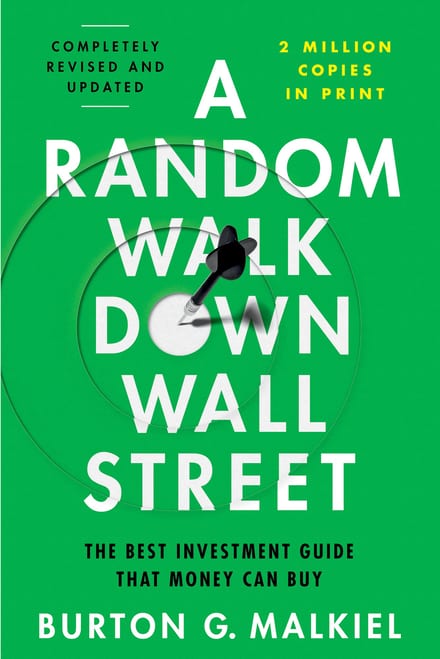
A Random Walk Down Wall Street: The Time-Tested Strategy for Successful Investing
The Time-Tested Strategy for Successful Investing
The full book runs ~440 pages — roughly 8 hours of reading. You get the key ideas here in 5 minutes.
The key ideas
- Two theories of value: intrinsic worth versus what a greater fool will pay.
- Tulips, South Sea shares, dot-coms, housing — the script barely changes.
- Charts drawn from coin flips fooled a chartist into demanding the company's name.
- Analysts' five-year earnings forecasts scored worse than naive extrapolation of past trends.
- The heaviest-trading households earned 11.4 percent while the market returned 17.9.
- Index funds cost a twentieth of one percent; active funds average a full percent.
The summary
Every asset carries two prices. One is what it’s worth — for a stock, the discounted value of all the cash it will ever pay out. The other is what the next buyer will hand you. Malkiel names these the firm-foundation theory and the castle-in-the-air theory, and forty years of editions reach one verdict: both are partly right, neither is reliable enough to trade on.
Intrinsic value versus the beauty contest
The firm foundation runs from John B. Williams, who set a stock’s intrinsic value at the discounted worth of its future dividends, through Graham and Dodd’s Security Analysis, down to Warren Buffett. Buy below the foundation, sell above it, wait for the correction. The catch: that foundation is built from guesses about how fast a company will grow and for how long. Nobody guesses well.
The castle in the air belongs to Keynes, who played the market from bed for half an hour each morning and multiplied King’s College’s endowment tenfold. His image for it is a newspaper beauty contest where the prize goes not to whoever picks the prettiest face but the face most other entrants pick. Morgenstern’s motto for investors: a thing is worth only what someone else will pay for it.
Four centuries, one script
Holland, 1634 to 1637: a virus that striped tulip petals made the oddest bulbs the most prized, and a visiting sailor ate a Semper Augustus he took for an onion — a bulb that would have fed a ship’s crew for a year. Prices rose twentyfold in January 1637, then fell further in February.
London, 1720: among a hundred bubble companies pitching everything from extracting sunlight from cucumbers to perpetual motion, the prize went to “A Company for carrying on an undertaking of great advantage, but nobody to know what it is.” A thousand people subscribed within five hours; the promoter closed the books and left for the Continent. Isaac Newton, burned by the South Sea Company itself: “I can calculate the motions of heavenly bodies, but not the madness of people.”
Then the professionals took over and did no better. Irving Fisher judged in 1929 that stocks had reached a “permanently high plateau”; most blue chips lost 95 percent by 1932. In 1998 and 1999, sixty-three companies that merely added a web-sounding name to the letterhead beat their peers by 125 percent in ten days. Then came housing: banks stopped holding the loans they wrote, issued NINJA mortgages to people with no income, no job and no assets, and coined “jingle mail” for keys posted back when prices fell a third.
Neither method beats a coin flip
Malkiel had students build stock charts by flipping coins. Out came head-and-shoulders formations, triple tops, and one gorgeous breakout that sent a chartist friend scrambling for the company’s name so he could buy. Against the placebo of buy-and-hold, no technical rule survives its own trading costs. The fringe versions are funnier: hemlines, the Super Bowl winner’s original league, and the indicator most closely correlated with the S&P 500 — butter production in Bangladesh. Rules that do work die of popularity: the Dogs of the Dow stopped beating the index once billions poured into funds built on it.
Fundamental analysis fails more respectably. Malkiel and John Cragg asked nineteen of Wall Street’s most respected research firms for earnings estimates, then checked them against reality. The five-year forecasts came in worse than naive extrapolation of past trends; when analysts protested that five years was too far out, their one-year forecasts proved worse still. Only one in eight large companies managed consistent growth through the 1990s boom, and none carried it into the next decade. Ten thousand dollars indexed in 1969 was worth $736,196 by mid-2014; in the average managed fund, $501,470.
What behavioral finance wins, and what it doesn’t
Malkiel concedes plenty. Barber and Odean tracked 66,000 households through the 1990s: the average earned 16.4 percent against a market returning 17.9, and those that traded most earned 11.4. Kahneman and Tversky measured losses as about two and a half times as painful as equivalent gains are pleasant, which is why investors dump winners and cling to losers — backwards, for tax purposes. And arbitrage, the mechanism meant to scrub prices clean, has hard limits: hedge funds in 1999 didn’t attack the internet bubble, they rode it.
What he won’t concede is a door in. Prices are often wrong, but the correction always arrives and nobody can say in advance which way the error runs. The models that flagged a bubble in early 2000 also called stocks wildly overpriced in 1992, and again at Greenspan’s “irrational exuberance” speech in 1996; returns after those two warnings ran about 9 and 7.5 percent a year.
What’s left to do
The prescription hasn’t changed since 1973, when Malkiel asked for a fund that would simply buy the whole market and stop trading. Hold broad index funds — not only the S&P 500, which leaves out thousands of smaller companies, but a total-market index, plus international stocks, bonds and real estate. Costs decide the race: index funds run at a twentieth of one percent a year, active funds average a full percent and churn nearly their whole portfolio annually. Rebalance yearly, which quietly forces you to sell what has run up. Add money steadily. Skip IPOs, which lag the market by about four points a year over five years; the ones your broker offers you are the ones nobody else wanted.
The bottom line
Prices are set by a crowd that is sometimes rational and sometimes possessed, and from the inside you can’t tell which — so stop trying, buy everything, drive costs near zero, and hold. Read it for the evidence behind the slogan: four centuries of manias, the studies that gutted both charting and stock-picking, and a working portfolio at the end. Anyone shopping for an edge should know the book’s point is that there isn’t one.
Fact check
Popular books repeat findings that later research has complicated. Where A Random Walk Down Wall Street makes a testable claim, here's what the evidence actually shows.
Across 66,000 households in the 1990s, the average investor earned 16.4 percent a year against a market returning 17.9, and the heaviest traders earned only 11.4.
The numbers are reported accurately: Barber and Odean tracked 66,465 households at a large discount broker from 1991 to 1996 and found exactly those figures. What drives the gap is cost, not stock selection — before commissions and spreads these households earned 18.2 percent in aggregate, marginally ahead of the 17.9 percent market index. The most active households turned over more than 250 percent of their portfolios a year, and the trading bill is what pulled 18-ish percent gross down to 11.4 percent net.
- Barber BM, Odean T. Trading is hazardous to your wealth: the common stock investment performance of individual investors. J Finance. 2000;55(2):773-806. Source
Wall Street analysts' five-year earnings forecasts are no better than naively extrapolating past growth.
Long-horizon earnings growth turns out to be close to unforecastable. Chan, Karceski and Lakonishok examined growth rates across a broad cross-section of US stocks and found scant persistence in growth beyond chance and limited ability to identify firms with high future long-term growth; IBES analysts' long-term forecasts were too optimistic and had low predictive power, and regressions on a range of other predictors confirmed the same low predictability. Malkiel and Cragg's own nineteen-firm test dates to the 1970s, but its conclusion has held up on far larger samples.
- Chan LKC, Karceski J, Lakonishok J. The level and persistence of growth rates. J Finance. 2003;58(2):643-684. Source
Losses are about two and a half times as painful as equivalent gains are pleasant, which is why investors sell winners and hold losers.
The direction holds, the multiplier is smaller. A meta-analysis of 607 loss-aversion estimates drawn from 150 articles published between 1992 and 2017 put the mean coefficient at 1.955, with a 95 percent probability interval of 1.82 to 2.10 — nearer two than two and a half, and individual estimates scatter widely with few study characteristics explaining the spread. The behaviour Malkiel hangs on it is separately documented: Odean found investors realise gains at a substantially higher rate than losses, which costs them at tax time.
IPOs lag by about four percentage points a year over the five years after they list.
Real, but the size depends entirely on what you compare them against. Jay Ritter's running tally of 9,254 US IPOs from 1980 through 2024 shows they trailed firms of the same market capitalisation by an average of 3.6 percent a year over the five years after issuing, close to the book's figure. Match on book-to-market as well as size and the shortfall halves to 2.1 percent a year, since much of the gap reflects IPOs being small growth companies rather than anything peculiar to being newly issued. The underperformance is measured against matched firms, not against the index, and it dates back to Loughran and Ritter's original 'new issues puzzle' paper.
Frequently asked questions
What is A Random Walk Down Wall Street about?
It's about the two ways people price an asset: the firm-foundation theory, which says a stock is worth the discounted value of the cash it will pay out, and the castle-in-the-air theory, which says it's worth whatever the next buyer will hand you. Malkiel shows that both descriptions are partly right and neither is reliable enough to trade on, using four centuries of manias and decades of studies on forecasters and fund managers. The conclusion is that you should own the whole market cheaply and hold it.
What are the key takeaways from A Random Walk Down Wall Street?
Bubbles run the same script whether the asset is a tulip bulb, a South Sea share, a dot-com or a house — and professionals fall for it as readily as amateurs. Chart-reading fails: stock charts built from coin flips produce the same patterns technicians swear by. Fundamental analysis fails too — five-year earnings forecasts from nineteen top Wall Street firms did worse than naive extrapolation, and their one-year forecasts were worse still. Behavioral finance is right that investors are overconfident, loss-averse and prone to herding, but that doesn't hand anyone a way to beat the market. What's left: broad low-cost index funds, yearly rebalancing, steady contributions, and no IPOs.
Who should read A Random Walk Down Wall Street?
Anyone who has heard "just buy index funds" and wants the evidence rather than the slogan — the history, the studies, and the reasoning behind the advice. It's also for the investor who suspects they can pick winners and would rather find out cheaply.
Is A Random Walk Down Wall Street worth reading?
Yes, largely for the bubble history, which is genuinely entertaining, and for how thoroughly it documents the failure of both technical and fundamental analysis. The practical chapters are sober and usable: costs, diversification, rebalancing, and what to skip. Skip it if you already index and don't care why, or if you're shopping for an edge — the book's whole point is that there isn't one.