Book summary
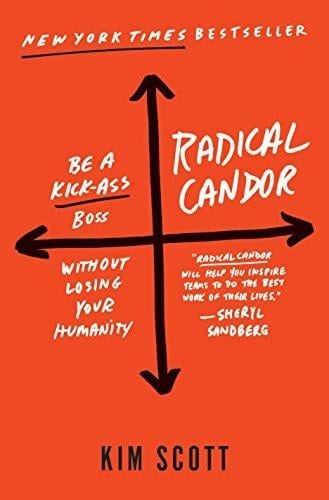
Radical Candor
Be a Kick-Ass Boss Without Losing Your Humanity
The full book runs ~297 pages — roughly 5 hours of reading. You get the key ideas here in 4 minutes.
The key ideas
- Combine caring personally with challenging directly to guide people.
- Avoid ruinous empathy: withholding hard feedback quietly harms performers.
- Reject manipulative insincerity and obnoxious aggression as broken feedback modes.
- Value both superstars seeking growth and rockstars craving stability.
- Collaborate, don't dictate: listen, clarify, debate, decide, persuade, execute.
- Give feedback immediately using situation-behavior-impact, not character judgments.
The summary
Good management lives at the intersection of two things people usually treat as opposites: genuinely knowing the people who work for you, and telling them plainly when their work misses. Kim Scott calls that intersection Radical Candor — caring personally while challenging directly, at the same time, in the same breath. The most common way managers fail isn’t cruelty. It’s the opposite: softening the hard truth out of affection, which quietly damages the very person you were trying to spare.
Scott’s favorite illustration came from a boss who once told her, “I can see you really love your dog.” In two seconds he’d established that he cared and wasn’t judging her. Then came the direct challenge: “But that dog will die if you don’t teach her to sit!” That’s the whole model. Show you’re on someone’s side, then tell them the truth.
The four ways guidance goes wrong
Drop either dimension and feedback breaks in a predictable way. Scott maps it onto four quadrants. Radical Candor — care plus challenge — is the goal. The other three are the failure modes.
Obnoxious Aggression is challenge without care: brutal honesty, front-stabbing. It’s the least bad of the three, because at least people know where they stand. Scott’s own example was firing off an arrogant email criticizing Larry Page’s policy at Google without pausing to understand his reasoning.
Ruinous Empathy is the most common mistake of all — care without challenge. You want to spare someone’s feelings, so you let poor work slide, and your kindness curdles into harm. Scott quotes a Russian tale about a man who loves his dog so much that, needing to dock its tail, he cuts off an inch at a time to spare it pain. All he does is draw the suffering out.
Manipulative Insincerity is the worst quadrant, neither caring nor challenging: fake niceness, backstabbing, passive aggression. When Jony Ive wouldn’t say clearly what was wrong with his team’s work, Steve Jobs asked why. “Because I care about the team,” Jony said. “No, Jony,” Jobs replied, “you’re just really vain. You just want people to like you.” Jony later admitted Jobs was right.
Not everyone wants the same thing
A healthy team needs two kinds of people, and confusing them is a management error. Superstars are on a steep growth curve; they need constant challenge and new opportunities or they’ll leave. Rockstars love stability and their craft — they’re excellent right where they are and don’t want your next promotion. Neither is better, and both are essential. Your job is to figure out which trajectory each person actually wants, which takes real, personal conversation, and to learn what gives each of them meaning. Scott retells the parable of three bricklayers: the first says “I’m working,” the second “I’m building a wall,” the third pauses and says, “I’m building a cathedral to the Almighty.” Same labor, wholly different sense of purpose.
Everyone can be excellent at something, and letting someone languish in a role where they’ll never thrive is just Ruinous Empathy again. When a poor performer isn’t improving, you do have to part ways — but only after you’ve given genuinely candid guidance, weighed the impact on the team, and sought a second opinion. And avoid permanent labels like “high performer” or “low performer,” because people’s trajectories shift across a career.
Get stuff done by collaborating, not dictating
Telling people what to do doesn’t work; Scott learned it the hard way when she pushed through a structural change with no one’s input and three of her five direct reports quit. Real results come from a collaborative cycle she calls the Get Stuff Done wheel: listen so every voice is heard, clarify the idea until it’s easy to grasp, debate it to sharpen it (about ideas, never egos), decide with facts rather than ego, persuade by joining emotion, credibility, and logic, execute while staying close to the actual work, and then learn from the results.
None of it works without trust, and trust means giving up control and allowing autonomy — respecting boundaries, mastering your own reactions to other people’s emotions rather than trying to manage their feelings. It also means caring for yourself. Scott rejects “work-life balance” as a zero-sum framing and prefers work-life integration: the eight hours of sleep you need to stay centered aren’t stolen from the job, because a life and a job can give each other what she calls a “double bounce.”
How to actually do it
Start by asking for criticism yourself — criticize yourself publicly, and sit with the discomfort of inviting feedback. When you give it, be humble, do it right away, keep it informal, and do it in person when you can. Use situation-behavior-impact: name the situation you saw, the behavior, and the impact it had, which keeps you from passing judgment on someone’s character or intelligence. Hold real career conversations: ask about a person’s life story to understand their values, ask them to name three to five dreams for the future and the skills each would take, then build an eighteen-month plan to get there. Treat your one-on-ones as your most important meetings, with the direct report setting the agenda while you listen. And stay aware of your outsized effect on culture — small things, down to how you park your car or an offhand remark, ripple further than you think.
The bottom line
Most managers fail by caring without challenging, which quietly harms the people they mean to protect. The best ones do both at once: they know their people deeply and tell them the truth plainly. Read this if you manage anyone — or if you want to understand what your own boss is getting right and wrong.
Frequently asked questions
What is Radical Candor about?
Good management sits where two things people treat as opposites meet: genuinely caring about the people who work for you and telling them plainly when their work misses. Kim Scott calls that combination Radical Candor — caring personally while challenging directly, at the same time — and the most common way managers fail isn't cruelty but softening hard truths out of affection, which quietly harms the person they meant to protect.
What are the key takeaways from Radical Candor?
Feedback breaks in predictable ways when you drop either dimension: Obnoxious Aggression (challenge without care), Ruinous Empathy (care without challenge, the most common mistake), and Manipulative Insincerity (neither). A team needs both Superstars, who want steep growth, and Rockstars, who want stability — figure out which each person wants. Get results through the collaborative "Get Stuff Done" wheel — listen, clarify, debate, decide, persuade, execute, learn — rather than dictating. And give feedback using situation-behavior-impact, ask for criticism of yourself first, and treat one-on-ones as your most important meetings.
Who should read Radical Candor?
Anyone who manages people — and anyone who wants to understand what their own boss is getting right and wrong.
Is Radical Candor worth reading?
It's memorable and practical, built on vivid stories — the "teach your dog to sit" moment, Jobs and Jony Ive — and a simple grid you can apply the next day. If you already give direct feedback naturally and know your team well, the framework mostly names what you do, but for managers who default to being nice, it's a sharp corrective.