Book summary
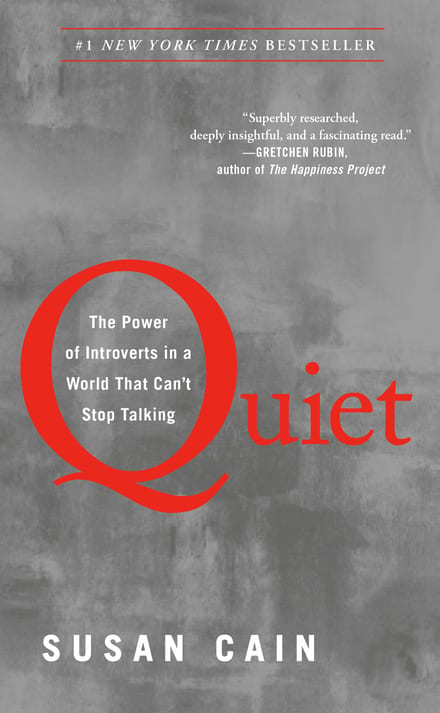
Quiet: The Power of Introverts in a World That Can't Stop Talking
The full book runs ~368 pages — roughly 7 hours of reading. You get the key ideas here in 3 minutes.
The key ideas
- Recognize temperament as biology: reactive brains shape introverts from infancy.
- Reject the extrovert ideal—a recent, cultural, not universal invention.
- Rethink open offices and brainstorming; solitude fuels the greatest creations.
- Deploy introverted leaders for complex, creative, cautious decisions.
- Design workplaces offering both collaboration and private focus.
- Distinguish introversion from shyness: recharging alone versus fearing judgment.
The summary
Western culture treats introversion as a problem to fix, but it isn’t shyness or a lack of confidence. It’s a nervous system tuned for lower stimulation. Susan Cain’s case is that introverts think before they speak, notice what others miss, and do their best work away from the noise — and that our reflexive preference for the bold, quick-talking extrovert is both a recent invention and a costly one. Somewhere between a third and a half of people are introverts, and the bias against them wastes a great deal of talent.
The temperament is wired in
The difference shows up in infancy. Researchers found that some babies have highly reactive amygdalae — the brain’s alarm system — and respond intensely to new sights, sounds, and smells. They startle, they fuss, they prefer calm. These high-reactive infants tend to grow into introverts who seek quiet because their brains are already working hard to process the world. Low-reactive babies need more to get going, so they grow into extroverts hunting for stimulation. Neither is better; they’re differently built. Cain borrows a memorable image: extroverted children are dandelions that thrive almost anywhere, while introverted children are orchids that wilt under pressure but flourish in the right conditions.
Introverts don’t dislike people. They prefer solitude because it’s where they recharge, and they trade a wide circle for a few deep friendships. They also think carefully through their mistakes — lose money in the market and an introvert will study what went wrong before reinvesting, while an extrovert is more likely to take the next big risk chasing the win. Many introverts are also highly sensitive: they process information deeply, react strongly to a sharp glance or a cup of coffee, and feel the weight of their own mistakes. That sensitivity is not the same as shyness, which is the fear of negative judgment. Barbra Streisand, an extrovert with fierce stage fright, is shy but not introverted.
The extrovert ideal is barely a century old
The preference wasn’t always there. As America moved from farms to cities across the twentieth century, its idea of an admirable personality shifted. In small rural communities, people knew you by years of visible conduct — whether you kept your word. In the anonymity of the city, first impressions took over, and you had to sell yourself to strangers. That rewarded flashy self-presentation over quiet industriousness, and by mid-century schools, corporations, and institutions had baked extroverted values into daily life, quietly equating confidence with competence and volume with intelligence.
It isn’t universal, either. In many Asian cultures, introverts are admired as studious, respectful, and humble — less arrogant than the stereotypically loud extrovert. The Western bias is cultural and recent, not a law of human nature.
Open offices and groupthink waste the quiet ones
Most workplaces are now built for extroverts: open floor plans, constant group brainstorming, collaboration as the default. Introverts struggle in that setting, drowning in interruptions and noise and unable to focus deeply with a coworker on speakerphone a few feet away. And the assumption that groups produce better ideas is shaky. A striking share of major creative and scientific work was done in solitude — Einstein’s theories, Chopin’s compositions, Orwell’s 1984, Wozniak’s early personal computer, Rowling’s Harry Potter.
Introverts can borrow extroverted behavior when a real purpose demands it. Many introverted professors stride into a lecture hall, project their voices, and hold the room, because teaching justifies the effort. But forcing that mode all day drains them and squanders their strengths. Companies do better when they offer flexibility — spaces for exchange and spaces for private focus — rather than treating one temperament as the standard.
Leadership research points the same way. For simple, repetitive tasks, extroverted leaders shine, driving motivation, rules, and speed. For complex, creative work, introverted leaders tend to generate more ideas because they listen more and dominate less, and they get more out of proactive employees by staying open to suggestions. During the 2008 financial crisis, firms led by extroverts had often made fast, risky bets with little data and suffered for it, while firms led by introverts had researched carefully before deciding and weathered the storm better. The lesson isn’t that one type wins; it’s that organizations need both, used well. In conflict, extroverts tend to turn aggressive and introverts tend to retreat, and the best teams form when each side understands the other rather than treating its own style as the default.
The bottom line
Introversion is a legitimate way of being wired, not a defect to correct, and organizations that ignore it — through open offices, endless brainstorming, and a cult of charisma — throw away the deep focus and careful judgment their quietest people offer. Read this if you’re an introvert tired of being told to speak up, or a manager wondering why your sharpest employees dread your collaboration drives.
Fact check
Popular books repeat findings that later research has complicated. Where Quiet makes a testable claim, here's what the evidence actually shows.
Somewhere between a third and a half of all people are introverts.
Extraversion is a continuous, roughly bell-shaped trait, so the headcount depends entirely on where the line gets drawn rather than on any natural boundary. Bess and Harvey re-analyzed Myers-Briggs data from about 12,000 people and found that the two-humped score distribution used to justify sorting people into types was an artifact of the scoring software's default settings; with better estimation the distribution became strongly center-weighted, most people clustering near the middle. Cain's range fairly reports the survey tallies she draws on, but those tallies reflect a scoring convention, not a discovered split in the population.
- Bess TL, Harvey RJ. Bimodal score distributions and the Myers-Briggs Type Indicator: fact or artifact? J Pers Assess. 2002;78(1):176-86. PubMed
Babies born with highly reactive amygdalae grow up to be introverts.
The temperament half holds up. Adults who had been classified as inhibited in their second year showed a greater amygdala response on fMRI to novel versus familiar faces than those classified as uninhibited, and the behavioral pattern is moderately stable from infancy into early adolescence. What it best predicts, though, is anxiety rather than introversion: a meta-analysis of seven studies put the odds of developing social anxiety disorder more than seven times higher for behaviorally inhibited children (OR 7.59), and roughly half of the 15% of children who show extreme inhibition go on to meet criteria. That outcome is shyness — fear of negative judgment — which is exactly what the book separates from introversion elsewhere.
- Schwartz CE, Wright CI, Shin LM, Kagan J, Rauch SL. Inhibited and uninhibited infants "grown up": adult amygdalar response to novelty. Science. 2003;300(5627):1952-3. PubMed
- Clauss JA, Blackford JU. Behavioral inhibition and risk for developing social anxiety disorder: a meta-analytic study. J Am Acad Child Adolesc Psychiatry. 2012;51(10):1066-1075.e1. PubMed
People brainstorming together produce fewer and worse ideas than the same number of people working alone.
A meta-analytic review of the brainstorming literature found interacting groups significantly less productive than nominal groups — the same number of individuals working separately, their ideas pooled afterward — on both quantity and quality, with the gap widening as groups got larger. Four experiments by Diehl and Stroebe traced most of that loss to production blocking: only one person can talk at a time, so everyone else waits, forgets, or suppresses what they had. Free riding and fear of being judged explained much less than the folk theory assumes.
Introverted leaders get more out of proactive employees than extroverted leaders do.
The specific reversal is real and was shown twice by the same team: pizza-delivery stores whose managers scored low on extraversion earned higher profits when employees were proactive, while high-extraversion managers did better with passive employees, and a laboratory study reproduced the pattern. But it is an advantage under one condition, not a general one. The broader evidence still favors extroverts — a meta-analysis of 222 correlations across 73 samples found extraversion the most consistent personality correlate of both leadership emergence and leadership effectiveness, at r = .31. The book's own conclusion is the defensible one: match the leader to the team rather than rank the temperaments.
- Grant AM, Gino F, Hofmann DA. Reversing the extraverted leadership advantage: the role of employee proactivity. Acad Manage J. 2011;54(3):528-550. Source
- Judge TA, Bono JE, Ilies R, Gerhardt MW. Personality and leadership: a qualitative and quantitative review. J Appl Psychol. 2002;87(4):765-80. PubMed
Frequently asked questions
What is Quiet about?
Introversion isn't shyness or a flaw to fix — it's a nervous system tuned for lower stimulation, wired in from infancy. The book makes the case that introverts think before they speak, notice what others miss, and do their best work in quiet, and that Western culture's reflexive worship of the bold, quick-talking extrovert is both recent and costly, wasting a great deal of talent.
What are the key takeaways from Quiet?
Temperament shows up early: high-reactive babies grow into introverts who seek calm, low-reactive ones into extroverts chasing stimulation — the "orchid and dandelion" image. The extrovert ideal is barely a century old, born when America moved from farms to cities and first impressions replaced years of visible character. Open offices and constant brainstorming waste introverts, when much landmark work — Einstein, Chopin, Orwell, Wozniak, Rowling — was done in solitude. And introverted leaders often outperform on complex, creative work because they listen more and dominate less.
Who should read Quiet?
Introverts tired of being told to speak up, and managers wondering why their sharpest employees dread group brainstorming and open-plan collaboration.
Is Quiet worth reading?
It's a well-grounded, sympathetic case backed by research on temperament, culture, and leadership, and it reframes a trait many people treat as a defect. For anyone who's felt out of step in a loud workplace it's clarifying; readers who already work in ways that suit them may find parts confirm what they already sense rather than surprise them.