Book summary
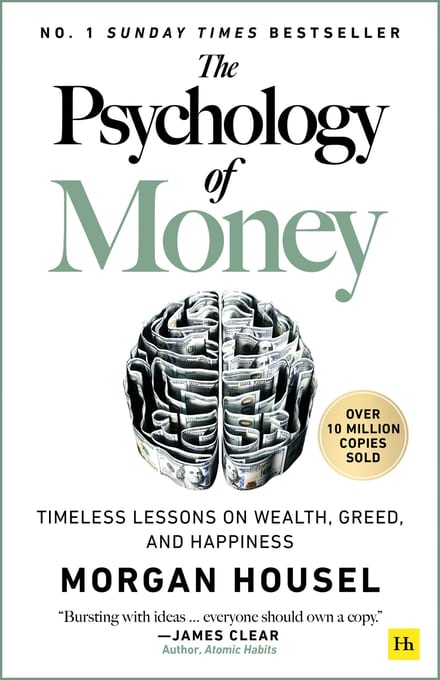
The Psychology of Money
Timeless lessons on wealth, greed, and happiness.
The full book runs ~289 pages — roughly 5 hours of reading. You get the key ideas here in 3 minutes.
The key ideas
- Shaped by experience: your money instincts mirror the era you grew up in
- Acknowledge luck: outcomes owe more to circumstance than skill
- Prioritize survival: keeping money is harder than making it
- Curb envy: comparison, not greed, destroys fortunes
- Embrace long tails: a few winners cover countless losses
- Think in decades: diversify, spend below ego, endure
The summary
Your relationship with money isn’t rational — it’s autobiographical. Morgan Housel’s central claim is that financial behavior tracks the economy you personally lived through, not the numbers on a spreadsheet. The Great Depression is remembered as a single national trauma, but JFK admitted his family’s wealth actually grew through it, and that’s the point: two equally rich people can hold opposite instincts because one came of age under runaway inflation and the other under calm stability. What any of us thinks we know about money is only our own thin slice of the whole.
That’s why the tidy economic assumption that people rationally maximize returns falls apart on contact with reality. Low-income households spend heavily on lottery tickets while struggling to cover emergency expenses — not rational, but understandable, since for many it’s the only visible route to luxuries they’ll otherwise never touch. Research bears out how personal it all is: how willing you are to hold stocks or bonds depends largely on what the market did during your early adulthood, even when years of contrary evidence pile up. And it helps to remember how new these tools are. The first currency appeared around 600 BC, retirement in its modern form is less than two generations old, and index funds, hedge funds, and retirement accounts are younger still. We struggle with money not because we’re stupid but because we’re improvising with concepts that are historical infants.
Luck does more than we admit
Luck drives far more of financial success than we’re willing to say out loud, because our psychology and our culture are both built to credit skill. We chalk our own wins up to hard work and our losses to bad luck, then flip the lens for everyone else. Housel points to a hard statistic: the incomes of siblings are more closely correlated than their heights or weights, which quietly reveals how much inherited privilege and opportunity do the heavy lifting. The practical move is to build randomness into how you think about outcomes, and to distrust any single success story. “Success is a lousy teacher” because it breeds overconfidence, and a few isolated winners can’t tell you what will work — you learn far more from broad patterns of success and failure. One such pattern worth copying: people are measurably happier when they structure their days.
Keeping money is harder than making it
Making money and keeping it are two different skills, and the second is the rarer one. Jesse Livermore was worth $100 million in today’s dollars by age 30, having made a fortune shorting stocks just before the 1929 crash — then lost all of it by making bigger and bigger bets. Forty percent of publicly traded companies eventually lose their entire value. Fortunes die where a winning streak gets mistaken for invincibility. The fastest way to join them is to spend money simply to show that you have it, which is why Housel reduces the whole thing to a formula: savings equals income minus ego. The entrepreneurs who last do it through perseverance, humility, and a refusal to take reckless risks. The cautionary figure is Rajat Gupta, former head of McKinsey and a Goldman Sachs board member — already extraordinarily wealthy, he went to prison for insider trading anyway. Envy, not greed, is the thing that ruins people, and a culture built on comparison keeps handing it fresh fuel.
A few big wins carry the rest
Here’s the liberating part: you can be wrong most of the time and still come out far ahead, because of the long tail. A small number of outsized successes can more than offset a long list of failures. Invest in a hundred different stocks and you only need a handful to soar. Housel’s example is Heinz Berggruen, who bought a small Paul Klee watercolor for $100 in 1940 and spent the following decades collecting, much of it work by unknown artists. But the collection also held Picassos, Klees, Matisses, and Braques, and by the 1990s it was worth about $1 billion. He didn’t need every bet to land — just a few of the right ones. Which is exactly why survival is the strategy: spread your risk, stay in the game, and give the long tail time to do its work.
The bottom line
The winning posture with money is endurance — spend below your ego, diversify your bets, and measure results in decades rather than quarters. Because luck and a handful of enormous winners matter more than skill, your real job is to survive long enough to catch them. Read this if you’re ready to stop confusing being smart with getting lucky, or you’re just tired of financial advice that treats you like a spreadsheet.
Fact check
Popular books repeat findings that later research has complicated. Where The Psychology of Money makes a testable claim, here's what the evidence actually shows.
Forty percent of publicly traded companies eventually lose their entire value.
The 40% figure comes from a J.P. Morgan study of every Russell 3000 member between 1980 and 2014 — about 13,000 stocks — but what it counted was a "catastrophic loss," defined as a 70% or greater fall from peak after which recovery was so weak that the eventual loss stays at 60% or more. That is permanent impairment, not a wipeout. The same report found 40% of stocks ended with negative absolute returns and two-thirds underperformed the index, so Housel's underlying point about concentration risk stands; the "entire value" wording does not.
A handful of enormous winners produce nearly all the gains, so most of your bets can fail and you still come out far ahead.
This is one of the better-documented facts in finance. Across every US common stock in the CRSP database since 1926, the majority had lifetime buy-and-hold returns below one-month Treasury bills, and the best-performing 4% of listed companies account for the entire net dollar gain of the US market over that span — the other 96% collectively did no better than T-bills. The skew is what makes poorly diversified portfolios underperform the average: miss the few winners and you get the median outcome, not the mean.
- Bessembinder H. Do stocks outperform Treasury bills? J Financ Econ. 2018;129(3):440-457. Source
How willing you are to hold stocks rather than bonds is set largely by what markets did during your own early adulthood.
Malmendier and Nagel, working from Survey of Consumer Finances data spanning 1960 to 2007, found that people who had personally lived through low stock returns reported lower willingness to take financial risk, were less likely to own stocks at all, held a smaller share of their liquid assets in stocks when they did, and were more pessimistic about future returns — all after controlling for age, year effects and household characteristics. Those who had lived through poor bond returns were correspondingly less likely to own bonds. One qualifier the popular retelling drops: recent experience carries more weight than distant experience. For a young investor early adulthood is most of the record, which is why the effect looks generational.
Frequently asked questions
What is The Psychology of Money about?
Its central claim is that your relationship with money isn't rational, it's autobiographical: financial behavior tracks the economy you personally lived through, not the numbers on a spreadsheet. Two equally rich people can hold opposite instincts because one came of age under runaway inflation and the other under calm stability. What any of us thinks we know about money is only our own thin slice of the whole, and we're all improvising with concepts that are historical infants.
What are the key takeaways from The Psychology of Money?
Luck drives far more of financial success than we admit, so build randomness into how you judge outcomes and distrust any single success story, since "success is a lousy teacher." Keeping money is a rarer skill than making it, captured in the formula savings equals income minus ego, and envy rather than greed is what ruins people, as with Jesse Livermore and Rajat Gupta. A few big wins carry the rest through the long tail, the way Heinz Berggruen's art collection turned a scattering of cheap buys into roughly a billion dollars. So survival is the strategy: spend below your ego, spread your risk, stay in the game, and measure results in decades.
Who should read The Psychology of Money?
Read this if you're ready to stop confusing being smart with getting lucky, or you're just tired of financial advice that treats you like a spreadsheet.
Is The Psychology of Money worth reading?
Yes if you want money wisdom about behavior rather than tactics, since its insights on ego, luck, and the long tail reframe how you think without requiring any math. It's about mindset, not a step-by-step plan, so a reader who wants specific portfolios, tax strategies, or concrete how-to instructions will need another book to sit alongside it.