Book summary
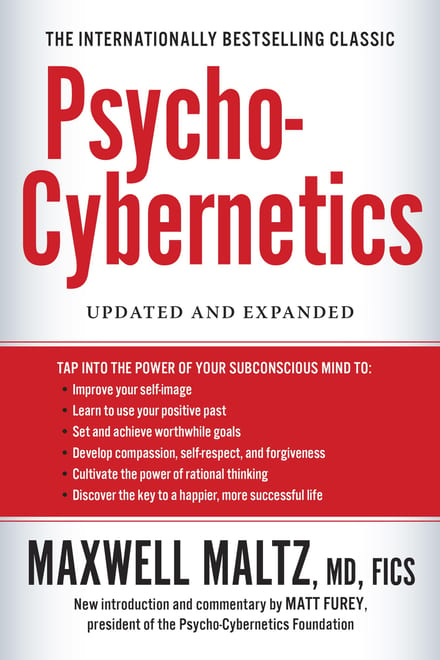
Psycho-Cybernetics: A New Way to Get More Living Out of Life
The full book runs ~270 pages — roughly 5 hours of reading. You get the key ideas here in 3 minutes.
The key ideas
- Rewire your self-image, because it dictates behavior and results.
- Interrogate irrational self-beliefs as harshly as you'd question others' judgments.
- Rehearse success mentally; your brain can't distinguish practice from reality.
- Set concrete goals and visualize completing each small step.
- Practice happiness now as a habit, not a future destination.
- Ignore others' opinions and delay your conditioned responses.
The summary
Maxwell Maltz stumbled onto his big idea in the operating room. As a plastic surgeon, he kept noticing that patients who got the new nose or chin they had wanted often walked out no more confident or happy than they walked in. He had changed their faces but not the picture they carried of themselves, and it turned out the picture was what governed their lives. Your self-image is a mental blueprint, and your nervous system reacts to it as though it were fact. That’s the core of the book: you will act like the sort of person you conceive yourself to be, whether or not that conception is accurate. See yourself as a failure and you’ll find ways to fail; see yourself as capable and you’ll find ways to succeed. Low self-esteem, as Maltz puts it, “is like driving through life with your handbrake on.”
Your self-image is built on conclusions, not facts
The trap is that a self-image comes from the conclusions you draw about your experiences, not from the experiences themselves and not from reality. A child whose grades slip after her parents divorce may decide she’s a failure, and that verdict can steer her behavior for decades even though the dip was temporary. Maltz describes a man convinced he was ugly when no one around him saw him that way. His conviction made him insecure and standoffish, people kept their distance in return, and he read that distance as proof they were judging him—a loop that fed on itself. These beliefs feel true only because the nervous system treats them as true. Plenty of people spend a lifetime insisting they’re “bad at math” on the strength of one poor grade or a single test. The fix is rational thinking: interrogate the conclusion the way you’d question anyone else’s harsh self-judgment. Would you brand another person a failure for one bad day? Just because you failed today does not mean you’ll fail tomorrow.
Rehearse success, because the brain can’t tell it from reality
Maltz names his method after cybernetics because he sees the brain and nervous system as an automatic, goal-seeking machine that steers by feedback, learning from remembered successes and imagination. The crucial fact is that this system cannot distinguish a real experience from a vividly imagined one; it reacts to whatever you believe or picture. That, he argues, is why an inaccurate self-image feels so solid—we are all, in a sense, half-hypnotized by ideas we absorbed uncritically or repeated to ourselves until they stuck, and those ideas shape behavior exactly as a hypnotist’s suggestions shape a subject’s. You can turn the same mechanism to your advantage. Top musicians and athletes practice mentally, running through flawless performances in their heads, and you can rehearse your own past wins—the feeling of succeeding and the details of what went right—so your subconscious imprints them onto your self-image. “You must have a clear mental picture of the correct thing before you can do it successfully,” he writes. So pick a purpose, break it into small realistic steps, and visualize completing each one until the positive beliefs outweigh the negative and your behavior follows.
Happiness is a habit you practice in the present
Maltz is blunt that happiness is an internal state you can’t outsource to circumstances. “Happiness is a mental habit,” he writes, “and if it is not learned and practiced in the present it is never experienced.” It can’t be made contingent on solving some external problem, because life is a series of problems—solve one and another takes its place. If you’re waiting to be happy until you’re married or rich, you’ll wait forever; when you’re unhappy, it’s usually the response you chose for the situation, not the situation itself. He points out that happy people tend to be physically healthier, and urges focusing on what’s working and treating difficulties as chances to improve. He packs the ingredients into two acronyms:
- SUCCESS — a Sense of direction, Understanding (free of fear-distorted perception), Courage to take calculated risks, Charity toward others, Esteem in place of “I can’t,” Self-confidence built on remembered wins, and Self-acceptance of your strengths and limits.
- FAILURE — Frustration, Aggressiveness turned self-destructive, Insecurity from unrealistic yardsticks, Loneliness, Uncertainty born of the fear of mistakes, Resentment that blames unfairness, and Emptiness.
Quiet the bells and drop the guard
The last cluster of advice is about protecting your peace of mind. Don’t fixate on how others see you—it’s inhibiting and suffocating—and instead practice disinhibition by speaking before you overthink, letting your real self out. Because the mind takes in positive ideas most readily when it’s relaxed, Maltz suggests building a mental “quiet room” you can retreat into for calm. He also warns about the conditioned “bells” we’ve been trained to obey, from a phone notification to a reflexive fear of strangers; the discipline is to delay your response, stretching the gap until you can ignore the bell entirely. And he treats emotional scars as walls we build to protect old hurts—walls that end up isolating us. Genuine forgiveness is what removes them, ideally so complete that you forget both the wrong and the act of forgiving it.
The bottom line
Your self-image is a blueprint your nervous system obeys as if it were reality, accurate or not, so behavior tracks the story you tell yourself rather than the facts on the ground. You redraw that picture by rehearsing past successes, disputing irrational conclusions, and practicing happiness as a present-tense habit. Read this if you’ve ever suspected your real limits live in your head rather than in the world.
Fact check
Popular books repeat findings that later research has complicated. Where Psycho-Cybernetics makes a testable claim, here's what the evidence actually shows.
The nervous system cannot tell a vividly imagined experience from a real one.
People do tell them apart, most of the time. A 2023 study found that imagined and perceived signals are intermixed in the brain and judged against a "reality threshold" — imagery is mistaken for reality only once it grows strong enough to cross that line, which makes the confusion the exception rather than the rule. Brain imaging points the same way: a meta-analysis pooling 303 motor-imagery and 142 movement-execution experiments found overlapping premotor-parietal networks, but overlap is not identity.
- Dijkstra N, Fleming SM. Subjective signal strength distinguishes reality from imagination. Nat Commun. 2023;14(1):1627. PubMed
- Hardwick RM, Caspers S, Eickhoff SB, Swinnen SP. Neural correlates of action: Comparing meta-analyses of imagery, observation, and execution. Neurosci Biobehav Rev. 2018;94:31-44. PubMed
Mentally rehearsing a skill improves how well you actually perform it.
Mental practice works, but the effect is small. A 2020 meta-analysis of 37 studies published between 1995 and 2018 — a replication of the 1994 review that made this idea famous — found r = 0.131, with the size depending on how long people rehearsed, the type of task and the type of imagery. The limits show up clearly on physical outcomes: a separate meta-analysis found no evidence that mental practice alone produces strength gains or improves on ordinary training.
- Toth AJ, McNeill E, Hayes K, Moran AP, Campbell M. Does mental practice still enhance performance? A 24 Year follow-up and meta-analytic replication and extension. Psychol Sport Exerc. 2020;48:101672. Source
- Manochio JP, Lattari E, Portugal EM, et al. From Mind to Body: Is Mental Practice Effective on Strength Gains? A Meta-Analysis. CNS Neurol Disord Drug Targets. 2015;14(9):1145-51. PubMed
Cosmetic surgery patients often walk out no more confident or happy than they walked in, because the operation changes the face and not the self-image.
Sixty years on, the honest answer is that nobody has measured it properly. A 2025 systematic review of 17 prospective studies with control cohorts found short-term gains in body-area satisfaction, self-esteem, sexual functioning and physical wellbeing, but limited and inconclusive evidence on mental health, overall body image, quality of life and social functioning — and few studies followed patients past six months. An earlier review of facial procedures reported modest psychosocial improvement in most studies while grading the literature weak for missing control groups and short follow-up. Maltz's observation is plausible and remains untested rather than refuted.
- Garbett KM, Paraskeva N, White P, et al. The psychosocial outcomes following cosmetic surgery are largely unknown: A systematic review. J Plast Reconstr Aesthet Surg. 2025;104:282-297. PubMed
- Imadojemu S, Sarwer DB, Percec I, et al. Influence of surgical and minimally invasive facial cosmetic procedures on psychosocial outcomes: a systematic review. JAMA Dermatol. 2013;149(11):1325-33. PubMed
Happy people tend to be physically healthier.
The association holds in healthy populations and is weaker than the phrasing suggests elsewhere. A review of 70 prospective studies found positive psychological wellbeing predicted lower mortality among healthy people (hazard ratio 0.82, 95% CI 0.76-0.89), but among people already living with disease the effect nearly disappeared (0.98, CI 0.95-1.00). These are observational studies, so some of the pattern runs the other way — poor health dragging down mood — and the direction of cause cannot be settled from them.
- Chida Y, Steptoe A. Positive psychological well-being and mortality: a quantitative review of prospective observational studies. Psychosom Med. 2008;70(7):741-56. PubMed
Frequently asked questions
What is Psycho-Cybernetics about?
A plastic surgeon noticed that patients who got the face they wanted often walked out no more confident than they walked in, because he'd changed their features but not the picture they carried of themselves. That self-image, Maltz argues, is a mental blueprint your nervous system reacts to as if it were fact: you act like the sort of person you conceive yourself to be, whether or not that conception is accurate. Behavior tracks the story you tell yourself rather than the facts on the ground.
What are the key takeaways from Psycho-Cybernetics?
Your self-image comes from the conclusions you drew about past experiences, not the experiences or reality themselves, so you can dispute those conclusions the way you'd question anyone else's harsh self-judgment. The nervous system is a goal-seeking machine that can't tell a real experience from a vividly imagined one, which is why you can rehearse past successes and visualize completing small steps to reprogram your self-image. Happiness is a mental habit practiced in the present, not something you postpone until a problem is solved, captured in his SUCCESS and FAILURE acronyms. And protect your peace by building a mental "quiet room," delaying reactions to conditioned "bells," and forgiving completely.
Who should read Psycho-Cybernetics?
Read this if you've ever suspected your real limits live in your head rather than in the world.
Is Psycho-Cybernetics worth reading?
Yes if the idea that your self-image, not your circumstances, sets your ceiling resonates, since its visualization and self-talk techniques are concrete and the surgeon's-eye origin gives them weight. The book predates modern psychology and leans on cybernetics as a metaphor, so a reader who wants current, peer-reviewed evidence rather than mid-century framing and acronyms may find parts dated even where the underlying advice still lands.