Book summary
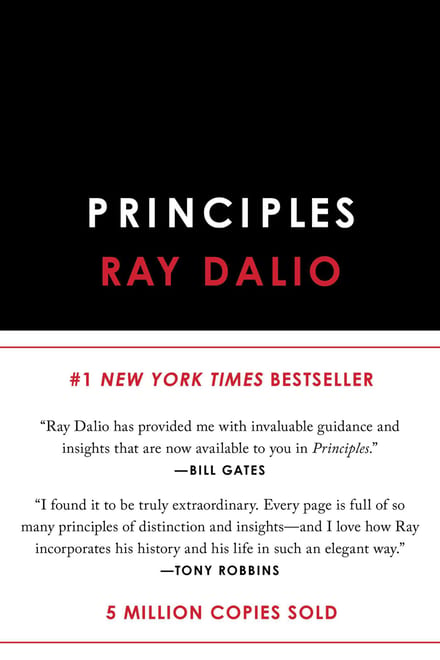
Principles: Life and Work
Life and Work
The full book runs ~592 pages — roughly 11 hours of reading. You get the key ideas here in 5 minutes.
The key ideas
- His 1982 depression call was so wrong Bridgewater shrank to one employee: him.
- He traded "I know I'm right" for "How do I know I'm right?"
- Pain + Reflection = Progress — go toward the painful signal, not around it.
- Five steps: goals, problems, diagnosis, design, push through — one at a time.
- Believable people have done it three times and can explain the cause and effect.
- Bridgewater tapes nearly every meeting and scores people live on dozens of attributes.
The summary
In November 1982, Ray Dalio sat in the guest chair on Wall Street Week with Louis Rukeyser and told the country there would be no soft landing. “I can say that with absolute certainty,” he said, “because I know how markets work.” Congress had invited him to testify weeks earlier. Mexico had defaulted in August, U.S. banks had lent about 250 percent of their capital to countries in the same shape, and his October memo put the odds at 75 percent that the Fed’s rescue would fail.
The opposite happened. Inflation dropped while growth accelerated, and the market began an eighteen-year run he calls the greatest noninflationary expansion in American history. He describes it as “a series of blows to the head with a baseball bat.” He let his people go one at a time until Bridgewater was down to a single employee — him — and borrowed $4,000 from his father to get by until they could sell the second car.
The lesson was a question, not an answer
He found three errors. He had been wildly overconfident and emotional. He had ignored history — debts in your own currency can be restructured, and when central banks stimulate simultaneously, as in March 1932 and again in 1982, inflation and deflation balance each other out. And he had tried to time markets, which his estimates were never precise enough to do.
Underneath all three sat one habit of mind, and changing it is the whole book. He went from thinking “I’m right” to asking “How do I know I’m right?” The practical answer: find the smartest people who disagree with you and let them break your reasoning. He also resolved to know when not to have an opinion, to write his decision rules down and test them, and to balance bets so no single call could ruin him. The crash, he says, gave him the humility to balance his aggressiveness.
Pain plus reflection equals progress
Dalio’s central life principle is arithmetic: Pain + Reflection = Progress. Painful feedback signals something that needs solving, and most people waste it: they can’t think while it hurts, then move on once it stops. His advice is blunt: go to the pain rather than avoid it. Each time you do, you’re choosing between healthy truth and comfortable delusion.
His 5-Step Process runs one step at a time, in order, because blurring them hides the real problem:
- Have clear goals.
- Identify problems and don’t tolerate them.
- Diagnose problems to get at root causes.
- Design a plan that gets around them.
- Push the design through to results.
Two things block it: the ego barrier, your need to be seen as capable, and the blind spot barrier, your inability to see in directions your brain isn’t wired for. Neither goes away, which is why so much of Bridgewater is external hardware for catching them.
Believability is a measurement, not a courtesy
Weighting all opinions equally is as dumb as weighting only your own. Dalio’s rule: the most believable opinions come from people who have done the thing successfully at least three times and can explain the cause-and-effect reasoning behind their conclusion. One out of two makes you somewhat believable; neither makes you noise.
That gets used literally. In spring 2012, Bridgewater’s researchers split in half over whether Mario Draghi would defy Germany and have the ECB buy bonds. They broke the tie with a believability-weighted vote scored on expertise and ability to synthesize; the weighted answer said Draghi would print, and days later he did. In forty years Dalio says he never once decided against the weighted outcome. His formula: Idea Meritocracy = Radical Truth + Radical Transparency + Believability-Weighted Decision Making.
The office where everything is recorded
The Work Principles section is where this stops sounding reasonable and starts sounding like a laboratory. Nearly every meeting at Bridgewater is taped and made available company-wide; his lawyers said he was crazy to create evidence, and he did it anyway, editing the tapes into training cases for new hires. The Dot Collector app lets people score each other in real time on dozens of attributes during the meeting itself, and runs the believability-weighted votes. Baseball Cards summarize each person’s strengths and weaknesses as stats, consulted when assigning work. Anything that goes badly must be entered in the Issue Log with its severity and owner — log it and you’re fine, hide it and you’re in deep trouble.
Criticism runs upward and in public. Dalio reprints an employee email that opens “Ray- you deserve a ‘D-’ for your performance today in the ABC meeting,” notes he rambled for 50 of his 62 minutes, and concludes he obviously hadn’t prepared. A dispute between a senior manager and the then-CEO was sent company-wide for everyone to judge. The pattern started early: when his head of trading forgot to place a client’s trade, costing several hundred thousand dollars, Dalio didn’t fire him — that would only teach everyone to hide mistakes — and the two built the error log instead.
He’s honest that this suits a minority. New hires need eighteen to twenty-four months to acclimate; some never do and are cut. Insiders describe it as an intellectual Navy SEALs, or a school of self-discovery run by the Dalai Lama.
The bottom line
Being wrong isn’t the problem — being wrong without a mechanism that catches it is. Everything Dalio built, from the error log to the live scoring of colleagues, exists because one confident forecast in 1982 wiped out eight years of work. The book is also enormous, much of it a three-level numbered outline he tells you to skim, and the certainty is baked in, down to his claim that “anyone following these principles can expect to produce broadly similar results.” Read it if you run a team and want a tested design for surfacing disagreement — and treat it as a menu, not a manual.
Fact check
Popular books repeat findings that later research has complicated. Where Principles makes a testable claim, here's what the evidence actually shows.
In 1982, US banks had lent roughly 250 percent of their capital to countries in the position Mexico was in.
The FDIC's own history puts loans to less-developed countries at 247.1% of capital at year-end 1982 for the average of the eight largest US money-center banks — 217.3% when measured against capital plus reserves. The figure applies to those eight banks, which dominated syndicated LDC lending, rather than to US banks as a whole. The FDIC also records that regulators deliberately did not force reserves against the restructured loans, because on a strict reading seven or eight of the ten largest US banks might have been deemed insolvent.
- Federal Deposit Insurance Corporation. Chapter 5: The LDC debt crisis. In: History of the Eighties—Lessons for the Future, Volume I: An Examination of the Banking Crises of the 1980s and Early 1990s. Washington, DC: FDIC; 1997:191-210, table 5.1a. Source
Weighting opinions by believability — counting most the people who have done the thing successfully at least three times — produces better decisions than weighting everyone equally.
The principle holds: aggregating a group's judgments with more weight on its demonstrably better judges beats a flat average. In the Good Judgment Project, the top 2% of forecasters were tracked into elite teams and both the behavioral interventions and the weighted statistical aggregation improved calibration and resolution, winning the tournament two years running; Budescu and Chen built a method that identifies which judges actually add signal and reweights the crowd accordingly, outperforming the undifferentiated group. The gap is in Dalio's proxy. Those systems weight people by a scored accuracy record on resolved questions, whereas 'has done it successfully three times' counts outcomes without checking whether the person was calibrated or lucky — and in a firm that scores its own people, who assigns the believability scores is not a neutral question.
Radical transparency — taping nearly every meeting, scoring colleagues live, airing criticism publicly — makes an organization perform better.
The error-surfacing half has support. Edmondson found that teams whose members felt safe admitting mistakes engaged in more learning behavior and performed better, which is close to what Bridgewater's issue log and its refusal to fire the trader who missed an order are designed to produce. The constant-observation half points the other way: in a field experiment on the lines of a Chinese phone factory, Bernstein found that a modest privacy screen from managerial observation raised output, because workers under permanent watch hid the useful improvisations they would otherwise have shared. The two findings are not in conflict so much as they separate the mechanisms — safety to report failure helps, being recorded while you work does not automatically follow. Dalio's own figure that new hires need 18 to 24 months and some never adjust is consistent with a real selection cost.
Pain plus reflection equals progress: deliberately working back over what went wrong measurably improves later performance.
Structured review of your own failures is one of the better-evidenced things in the book. A meta-analysis of 46 samples covering 2,136 people found debriefs improved performance by roughly 20-25% over controls (d = 0.67), holding for individuals as well as teams and in real settings as well as simulations. A later meta-analysis of 61 studies across 915 teams and 3,499 individuals put the effect at d = 0.79, larger than many standard training interventions. Both add a condition Dalio happens to meet: the gains depend on structure and on reviewing objective records of what actually happened, which is what an issue log and a taped meeting are.
- Tannenbaum SI, Cerasoli CP. Do team and individual debriefs enhance performance? A meta-analysis. Hum Factors. 2013;55(1):231-45. PubMed
- Keiser NL, Arthur W. A meta-analysis of the effectiveness of the after-action review (or debrief) and factors that influence its effectiveness. J Appl Psychol. 2021;106(7):1007-1032. PubMed
Frequently asked questions
What is Principles about?
In 1982 Ray Dalio testified before Congress and went on national television to declare a depression was certain. He was dead wrong, lost everything, and shrank Bridgewater to a single employee: himself. Principles is the memoir of that failure plus the decision-making system he built afterward, designed so that being wrong gets caught early instead of quietly compounding.
What are the key takeaways from Principles?
Swap "I know I'm right" for "How do I know I'm right?" and go find the smartest people who disagree with you. Pain + Reflection = Progress, so move toward painful feedback rather than around it. Run the 5-Step Process one step at a time: goals, problems, diagnosis, design, push through. And weight opinions by believability, meaning people who have done the thing successfully at least three times and can explain the cause and effect behind their conclusion.
Who should read Principles?
Anyone running a team or a company who wants a tested design for getting real disagreement onto the table instead of into the hallway. It also rewards anyone who has been badly, publicly wrong and wants a method rather than a pep talk.
Is Principles worth reading?
The memoir and the core ideas are excellent, and the Bridgewater machinery is described honestly enough that you can judge it for yourself: taped meetings, live scoring of colleagues on dozens of attributes, mistakes logged and dissected in public. The book is also enormous, and much of it is a three-level numbered outline Dalio himself tells you to skim, delivered with real certainty. Read the story and the spine, treat the rest as a menu.