Book summary
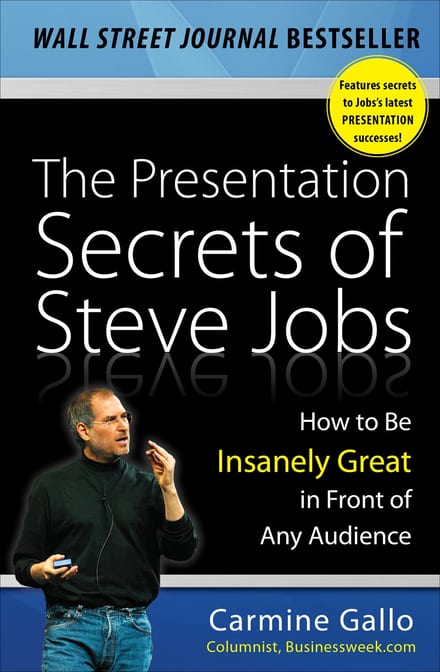
The Presentation Secrets of Steve Jobs
How to Be Insanely Great in Front of Any Audience
The full book runs ~255 pages — roughly 5 hours of reading. You get the key ideas here in 5 minutes.
The key ideas
- Stage a story: name a villain, then reveal the hero product
- Open with a headline short enough to tweet
- Organize everything into three key messages
- Strip slides to one image, a number, few words
- Script one unforgettable jaw-drop moment per keynote
- Rehearse obsessively so 'natural' delivery is engineered
The summary
Steve Jobs never walked on stage to deliver information. He staged an experience, and the script barely changed from launch to launch: name an enemy, build the tension, then reveal the hero. Clunky smartphones, a sluggish web, a rival’s monopoly—each keynote opened by casting a villain so the audience had a reason to care, then produced an Apple product as the rescue. Al Gore borrowed the same structure to make rising CO2 the antagonist of his climate talk. None of it was improvised. Jobs planned presentations the way a director plans a play, sketching on paper before touching a slide, then rehearsing for days until the whole thing looked spontaneous.
Underneath the theater sat a simple discipline: answer the one question the audience is actually asking, “Why should I care?”, before a single technical spec. Jobs sold benefits, not features, and he sold them with a near-messianic sense of purpose—he wasn’t moving computers, he was changing the world with them. It’s the same pitch he used to pull John Sculley away from PepsiCo: “Do you want to spend the rest of your life selling sugared water, or do you want a chance to change the world?”
One headline, three messages
Every launch opened with a headline short enough to tweet: “1,000 songs in your pocket,” “the world’s thinnest notebook.” Jobs wrote these early, repeated them through the keynote, and pushed them onto billboards and websites the same day, so reporters would quote them word for word. Then he organized everything into three parts, because short-term memory holds only three or four chunks at once. Introducing the iPhone, he teased “three revolutionary products”—a widescreen iPod, a phone, an internet communicator—repeated the list until the room caught on, and revealed they were one device. He also knew attention collapses after about ten minutes, so he broke each keynote into segments with demos, video, and guests. Intel’s CEO appeared in a bunny suit; Bill Gates joined by satellite in 1997. Sharing the stage added credibility and variety, and it let testimonials do the selling, since word of mouth moves buyers more than any ad.
Simplicity you can picture
Jobs’s slides were the opposite of the bullet-choked decks most executives inflict on a room. Drawing on the Zen idea of kanso, or simplicity, he’d put up a single image, a few words, sometimes one enormous number—and cognitive research backs him up, since people remember far more from clean, image-driven slides than from walls of text. He made numbers mean something by translating them: not “5 GB of storage” but “1,000 songs in your pocket,” not “four million units” but “20,000 iPhones every day.” His words were just as concrete and playful. The iPhone 3G was “amazingly zippy”; the iPod Shuffle was “smaller and lighter than a pack of gum”; the on-screen buttons looked “so good you’ll want to lick them.” Jargon builds distance. Specific, sensory language pulls people in.
The moment they’ll retell
Every great Jobs keynote had one engineered surprise—the beat people would describe to their friends afterward. He slid the MacBook Air out of a manila envelope to show how thin it was. He made a live call on the first iPhone. He identified the single message he wanted burned into memory, then choreographed its reveal down to the lighting. The showmanship carried into props and demonstrations built for every kind of learner: he passed a MacBook’s aluminum frame around so people could feel its weight, ran features live rather than on tape, and brought John Mayer out to play for a GarageBand demo. The point was always to let the audience touch, see, and hear the thing, not just read about it.
Effortless takes ten thousand hours
The casual ease was manufactured. Jobs rehearsed for days, obsessing over timing, word choice, and where he stood, because mastery—as Gladwell’s research on the 10,000-hour rule suggests—comes from deliberate practice, not talent. He recorded himself, cut filler words, and tuned his pacing until every pause landed. On stage he held strong eye contact, kept an open posture, and gestured naturally, knowing that how you sound and move carries more than the words themselves. He tossed the script, using slides that each held one idea as prompts so he could stay conversational, and he prepared for hard questions with a “bucket method,” sorting likely questions into categories with answers ready. He also let himself have fun: in 2002 he staged a mock funeral for Mac OS 9, casket and eulogy included, and turned technical glitches into jokes rather than apologies.
The bottom line
A great presentation isn’t slick slides or natural charisma; it’s clear thinking, ruthless simplicity, and enough rehearsal to make the hard work invisible. Build a story with a villain and a hero, give people one headline and three points, and script the single moment you want them to remember. Read this if you’ve ever sat through a lifeless deck and known there had to be a better way.
Fact check
Popular books repeat findings that later research has complicated. Where The Presentation Secrets of Steve Jobs makes a testable claim, here's what the evidence actually shows.
Short-term memory holds only three or four items at once, which is why a talk should be built around three messages.
The book's number is the current one, and better than the 7±2 most people quote. Cowan's review of the evidence puts the central capacity limit at about four chunks, and notes that Miller's famous seven was offered as a rough estimate and a rhetorical device rather than a measured limit. The caveat is that a chunk is elastic — practice and prior knowledge let people pack more into each one — so 'three points' is a sensible rule of thumb rather than a hard cognitive ceiling.
- Cowan N. The magical number 4 in short-term memory: a reconsideration of mental storage capacity. Behav Brain Sci. 2001;24(1):87-114. PubMed
Audience attention collapses after about ten minutes, so a presentation has to be broken into segments before that point.
There is no original study behind the ten-minute figure. Bradbury traced the citation chain for the widely repeated 'attention declines 10-15 minutes into a lecture' claim and found that nearly every source cites another source rather than data, and that the most-cited paper barely discusses attention at all; the few studies that did measure it had methodological problems. Wilson and Korn reached the same conclusion reviewing the same literature. Bradbury reports that the biggest driver of variation in student attention is which teacher is at the front of the room, not how many minutes have elapsed — which supports the book's actual advice (vary the delivery) for a different reason.
How you sound and move on stage carries more of the message than the words you say.
This is the 55/38/7 split, and it comes from two small 1967 experiments that were not about presentations. In both, participants judged what attitude a speaker held when the channels deliberately conflicted — a single spoken word paired with a contradicting tone of voice, or a tone paired with a facial photograph. That design measures which channel people trust when resolving a contradiction about someone's feelings, not what share of an informational message the words carry. Delivery does matter for a keynote; the specific arithmetic does not transfer to one.
Mastery comes from roughly 10,000 hours of deliberate practice rather than talent.
Practice matters, but nowhere near that much, and least of all in the domains a presenter cares about. A meta-analysis found deliberate practice explained 26% of the variance in performance for games, 21% for music and 18% for sports — but only 4% for education and under 1% for professions. Rehearsal almost certainly did make Jobs better on stage; it does not follow that hours are what separate him from everyone else.
- Macnamara BN, Hambrick DZ, Oswald FL. Deliberate practice and performance in music, games, sports, education, and professions: a meta-analysis. Psychol Sci. 2014;25(8):1608-18. PubMed
Frequently asked questions
What is The Presentation Secrets of Steve Jobs about?
It breaks down how Steve Jobs staged an experience rather than delivered information, using a script that barely changed: name an enemy, build tension, then reveal the hero. Underneath the theater sat one discipline, answering the question the audience is actually asking, "Why should I care?", before any technical spec. Gallo's larger point is that a great presentation isn't slick slides or natural charisma but clear thinking, ruthless simplicity, and enough rehearsal to make the hard work invisible.
What are the key takeaways from The Presentation Secrets of Steve Jobs?
Build a story with a villain and a hero so the audience has a reason to care, and sell benefits, not features. Open with one headline short enough to tweet, then organize everything into three parts, because short-term memory holds only three or four chunks. Keep slides simple in the spirit of kanso, using a single image or one big number, and translate figures into meaning, like "1,000 songs in your pocket." Engineer one surprising moment people will retell, such as sliding the MacBook Air out of an envelope. And make the ease look effortless through days of rehearsal, cutting filler and preparing for hard questions with a bucket method.
Who should read The Presentation Secrets of Steve Jobs?
Read this if you've ever sat through a lifeless deck and known there had to be a better way.
Is The Presentation Secrets of Steve Jobs worth reading?
Yes if you present to anyone and want a concrete template, since the villain-and-hero story, one headline plus three points, and the engineered moment are easy to copy and grounded in memorable keynotes. Because every example comes from Jobs and Apple launches, a reader who wants variety of speakers or advice for small everyday meetings rather than big product reveals may need to adapt the lessons themselves.