Book summary
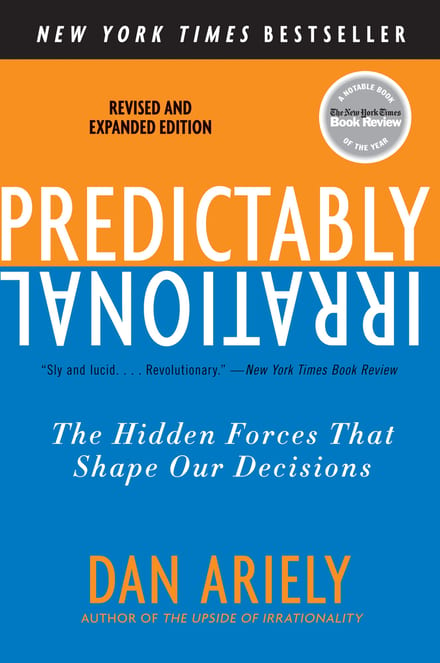
Predictably Irrational: The Hidden Forces That Shape Our Decisions
The full book runs ~368 pages — roughly 7 hours of reading. You get the key ideas here in 4 minutes.
The key ideas
- Judge everything by comparison, so decoys steer your choices
- Anchor to the first price you see, however random
- Overvalue what you own, clinging to objects and ideas
- Let expectations and price literally reshape what you experience
- Mix money into favors and you destroy social goodwill
- Cheat only enough to profit while feeling honest
The summary
You think you sit in the driver’s seat of your own decisions. Ariely, an MIT behavioral economist, spends the book showing that you’re closer to a pawn, moved by forces you barely notice: whatever price you happened to see first, whichever option sat next to the one you picked, whether the word “free” appeared, whether money got mentioned at all. The saving grace is that these mistakes aren’t random. They’re systematic and repeatable, which is exactly why marketers can exploit them and why you can, with some effort, design around them.
Everything is relative, and the first price anchors you
We judge almost nothing on its own terms; we compare it to whatever is nearby, and usually to whatever is closest at hand. Bring a slightly less attractive friend to a bar and you look better by contrast. Restaurants overprice their most expensive dish not to sell it but to make the second-most-expensive one look sensible. Offer three options and most people take the middle, so companies park their most profitable item there, flanked by a cheap decoy below and a premium one above that makes the middle feel like a bargain. The same reflex quietly corrodes contentment, because the more we have, the more we want, and there’s always someone with more. The only cure is to break the cycle of relativity and stop comparing.
Related is what Ariely calls arbitrary coherence: the first number you encounter becomes an anchor that warps what you’ll pay afterward. In one experiment, people who wrote down the last two digits of their Social Security number before bidding at an auction bid more when those digits were high, even though the number was meaningless. Starbucks used this deliberately. It couldn’t just charge more than Dunkin’ Donuts, so it built stores that felt like continental cafés, with French presses, fine pastries, better beans, and exotic Italian names for the cup sizes, until the experience felt different enough that customers accepted an entirely new price anchor.
We overvalue what we own, and expect what we’re told
Ownership distorts value. When Duke students won a lottery for basketball tickets, they wouldn’t sell for less than about $2,400, while students who didn’t win wouldn’t pay more than $170 for the same seat. Owning something breeds attachment, and we fixate on what we’d lose rather than what we’d gain. The effect isn’t limited to objects. Take ownership of a political position or a sports allegiance and you prize it beyond its worth, unable to bear the thought of giving it up, until an opinion hardens into an ideology, rigid and unyielding.
Expectations bend experience just as hard. In blind taste tests people prefer Pepsi, but show them the labels and Coke wins, because the brand changes what the tongue reports. The placebo effect is the same machinery: inert pills relieve pain because we expect them to, and pricier medicine is felt to work better than cheap medicine even when the chemistry is identical. Expectation even reaches into the body. People primed with words associated with the elderly, like “ancient,” “bingo,” and “Florida,” walked more slowly afterward without noticing.
Social favors and market deals don’t mix
We run on two separate rulebooks. Social norms cover friendly favors, where nobody keeps a tally, and market norms cover cold exchanges of work for pay. Apply the wrong one and goodwill collapses instantly, which is why offering to pay your mother for dinner insults her. Market norms also make people colder and more calculating. Lawyers who refused to work for a low rate would happily do the same work for free, because free triggers the social frame of helping while a small fee triggers the market frame of being underpaid. Once money enters the picture it’s very hard to switch back, so people will work for free or for a fair wage, but offer them a token payment and they’ll walk away.
We cheat a little, procrastinate, and can’t close doors
Most people, given the chance, cheat only a little. Grading their own quizzes for small prizes, they nudge their scores up, but not by much, and shrinking the odds of getting caught barely changes it, because we want to keep seeing ourselves as honest. That self-image is surprisingly steerable: participants asked to recall the Ten Commandments before a quiz cheated far less. We also excuse ourselves more easily with objects than with cash, telling ourselves the office stationery is basically part of our pay in a way we’d never say about money from the till.
Self-control fails along the same predictable lines. Our rational side sets long-term goals while our impulsive side derails them through instant gratification and procrastination, and the fix is structure. Students who committed to evenly spaced deadlines across a course outperformed those with a single deadline at the end. The deeper lesson is that closing doors can beat keeping them open. In one game, people paid real money just to keep options alive even when those options led to smaller prizes, terrified of foreclosing anything. The Chinese commander Xiang Yu burned his own ships after landing so his troops couldn’t retreat, and they fought harder for it. Chasing every path at once usually just buys mediocrity in all of them.
The bottom line
You are not the cool rational calculator you imagine; you’re moved by hidden forces you mostly fail to comprehend. But because those forces are predictable, you can build better choices around them: set hard deadlines, quit comparing, notice when “free” is working on you, and deliberately close doors. Read this if you want to understand why you really buy, choose, and behave the way you do.
Fact check
Popular books repeat findings that later research has complicated. Where Predictably Irrational makes a testable claim, here's what the evidence actually shows.
Asking people to recall the Ten Commandments before a task makes them cheat far less.
A registered replication run across 25 labs and 5,786 participants found no moral-reminder effect. In the primary meta-analysis of 19 replications and 4,674 participants, people given the reminder reported solving slightly more matrices than controls, d = -0.04, numerically the opposite of the original result. The book's wider point — that people cheat a little rather than a lot — is not what failed here; the priming fix is.
- Verschuere B, Meijer EH, Jim A, et al. Registered Replication Report on Mazar, Amir, and Ariely (2008). Adv Methods Pract Psychol Sci. 2018;1(3):299-317. Source
People exposed to words associated with old age, like "bingo" and "Florida," then walk more slowly without noticing.
Doyen and colleagues rebuilt Bargh's 1996 walking-speed study with automated timing and a larger sample and found no priming effect. In a second experiment they manipulated what the experimenters expected, and the slow-walking effect appeared only among experimenters who had been led to expect it. Debriefing also suggested some participants noticed the primes, which the original design assumed they could not.
- Doyen S, Klein O, Pichon CL, Cleeremans A. Behavioral priming: it's all in the mind, but whose mind? PLoS One. 2012;7(1):e29081. PubMed
Writing down the last two digits of your Social Security number before an auction changes what you bid, even though the number is meaningless.
Ariely, Loewenstein and Prelec published this in the Quarterly Journal of Economics in 2003 as the headline demonstration of "coherent arbitrariness." Fudenberg, Levine and Maniadis re-examined it and found the anchoring effect on ordinary market goods weak, and no anchoring effect at all when the items being valued were binary lotteries. Something is there, but it is far more fragile and context-bound than the book's retelling implies.
Owning something makes you value it far above what non-owners will pay, as when Duke students who won basketball tickets refused to sell for many times what non-winners offered.
Carmon and Ariely's ticket study is real, and gaps between what sellers demand and what buyers offer show up across a large valuation literature. But the gap depends heavily on how the experiment is run. Plott and Zeiler repeated mug and lottery valuations with training on the elicitation mechanism, anonymity and practice rounds, and observed no gap between willingness to accept and willingness to pay at all, which points to subjects misreading the task as a large part of the classic effect.
- Carmon Z, Ariely D. Focusing on the forgone: how value can appear so different to buyers and sellers. J Consum Res. 2000;27(3):360-370. Source
- Plott CR, Zeiler K. The willingness to pay-willingness to accept gap, the "endowment effect," subject misconceptions, and experimental procedures for eliciting valuations. Am Econ Rev. 2005;95(3):530-545. Source
Frequently asked questions
What is Predictably Irrational about?
It shows that you're far less the rational driver of your own decisions than you imagine, moved by forces you barely notice: whatever price you saw first, whichever option sat next to the one you picked, whether the word "free" appeared, whether money got mentioned at all. The saving grace, Ariely argues, is that these mistakes aren't random. They're systematic and repeatable, which is why marketers can exploit them and why you can, with some effort, design around them.
What are the key takeaways from Predictably Irrational?
We judge almost nothing on its own terms, so a decoy option or an overpriced dish makes another look like a bargain. The first number you meet becomes an anchor, which is arbitrary coherence, and Starbucks used it to justify a whole new price. Ownership inflates value through the endowment effect, seen when Duke students wouldn't sell tickets for a fraction of what winners demanded. Expectations bend experience, as with Coke beating Pepsi once labels appear and the placebo effect. Social norms and market norms don't mix, so a small payment can insult where a free favor would please. And self-control fails predictably, which is why hard deadlines and deliberately closing doors beat keeping every option open.
Who should read Predictably Irrational?
Read this if you want to understand why you really buy, choose, and behave the way you do.
Is Predictably Irrational worth reading?
Yes if you enjoy behavioral experiments that expose your own blind spots and then hand you practical fixes: set hard deadlines, quit comparing, and notice when "free" is working on you. It's built from lab studies rather than a single tidy program, so a reader who wants a step-by-step self-improvement plan rather than a tour of the biases themselves may find it more illuminating than directly actionable.