Book summary
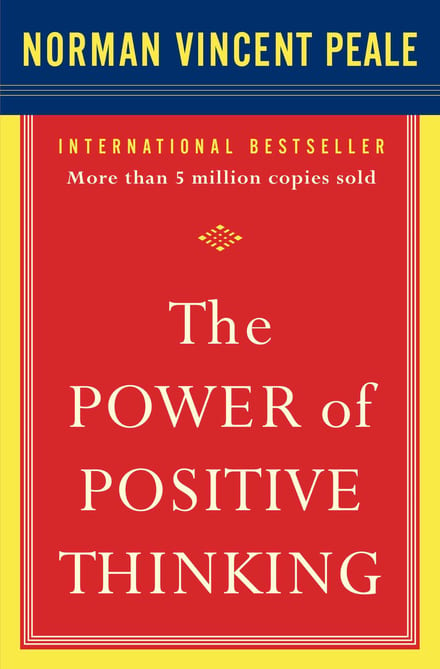
The Power of Positive Thinking
The full book runs ~276 pages — roughly 5 hours of reading. You get the key ideas here in 4 minutes.
The key ideas
- Believe in yourself to unlock hidden talent and skill.
- Cultivate calm and energy as trainable mental states.
- Visualize success vividly and expect the best outcomes.
- Pray with precision, gratitude, and persistent faith.
- Choose happiness through gratitude, kindness, and present-focus.
- Confront fears head-on and treat setbacks as stepping stones.
The summary
Norman Vincent Peale’s whole system rests on a single claim: your habitual thoughts become your character and your circumstances. The inner monologue you rehearse every day quietly decides what you’re capable of. So the work is to feed your mind deliberately — confidence, gratitude, calm, and faith — through repetition and vivid mental pictures, and let your behavior and results follow the thoughts.
Believing in yourself releases hidden reserves
The first move is confident faith in yourself. Peale argues that self-belief taps talent, skill, and power you didn’t know you had, letting you accomplish things you’d written off as beyond you. You build that faith the way you build any habit: repeated positive self-talk, and vivid images of yourself succeeding. Picture the outcome clearly and your confidence rises to meet it. Stack the deck by surrounding yourself with encouraging people whose belief in you reinforces your own, and by studying role models who overcame real obstacles through self-belief.
The mirror image is refusing to worry over what you can’t control. Accept it and spend your energy where it can actually change something. Peale offers a one-week experiment worth trying: “Keep your heart free from hate, your mind from worry. Live simply, expect little, give much. Scatter sunshine, forget self, think of others.”
Calm and energy are states you can train
Anxiety drains your vitality; inner quiet multiplies it. Peale treats energy as a mental and spiritual condition as much as a physical one, and both calm and energy can be trained. For calm, relax the body first — deep breathing, warm baths, unhurried music — then simplify your surroundings and schedule, spend time with serene people whose composure rubs off, get real rest, and stop replaying past failures or rehearsing future ones. For energy, pull the same levers of picture and repetition: see yourself radiant with strength and affirm “I am filled with energy,” “My strength is being constantly renewed.” Begin each day expecting challenges and looking forward to them, eat and exercise well, and then protect what you’ve built by tackling only what matters and cutting the time-wasters that bleed you dry.
Prayer, pictures, and expectation shape outcomes
Prayer, in Peale’s telling, isn’t only religious ritual; it’s a universal tool for connecting with a higher power that offers real psychological benefits — solace, hope, inner strength — when things are hard. Pray with precision and persistence, give thanks in advance as if the answer is already on its way, and stay humble: make requests, not ultimatums, and pray for others, not only yourself.
Beneath the prayer is a mechanism Peale returns to again and again — expectation as a self-fulfilling prophecy. “Formulate and stamp indelibly on your mind a mental picture of yourself as succeeding,” he writes. “Hold this picture tenaciously. Never permit it to fade… Do not build up obstacles in your imagination.” A positive mind, he claims, draws favorable people and circumstances toward you. But expecting the best only works if you do your part: be specific about what you want, set clear steps, affirm those expectations often to plant them deep, and when the inevitable low stretches come, keep momentum by recalling past peaks.
Happiness is a choice you keep making
You create your own happiness, Peale insists, because it’s an inner state rather than a product of your circumstances — and you can choose it. Cultivate gratitude for what you have, replace negative thoughts with optimistic ones, and stop measuring yourself against other people. Learn to genuinely like others and practice kindness; it feeds your own fulfillment. Do work that means something, set goals that stretch you, count your successes instead of your failures, live in the present, and keep your sense of humor when things go wrong. Because your mind is shaped by habitual thinking, you can remake yourself by changing what you rehearse: repeat uplifting statements, feed your mind inspirational books and talks, keep company with people who have the qualities you want, and picture yourself in detail already thinking and acting like the person you’re becoming. New thought habits take time, so be patient.
That patience matters most when difficulty hits. Worry, frustration, and anger corrode mind and body, so confront your fears instead of dodging them: name the real, specific cause and challenge it rationally, then write a detailed plan, since the act of planning is itself calming, and take it one step at a time. Share your worries with people you trust rather than carrying them alone. Treat setbacks as temporary stepping stones and meet problems with “How can I solve this?” instead of raw emotion. And when heartache comes, let go of anger for your own sake — it hurts you, not the other person — and wish them well.
The bottom line
Change the thoughts you rehearse, through deliberate repetition and vivid mental pictures, and you change what you’re capable of and what happens to you. It’s an optimistic, faith-based framework rather than a rigorous one, but its core discipline — mind your inner monologue — holds up. Read this if you’re stuck in negative patterns and want a practical, hopeful method for reshaping your inner life.
Fact check
Popular books repeat findings that later research has complicated. Where The Power of Positive Thinking makes a testable claim, here's what the evidence actually shows.
Vividly picturing yourself already succeeding, and holding that image tenaciously, makes success more likely.
Oettingen and Mayer separated two things Peale treats as one, following graduates hunting for jobs, students infatuated with a peer, undergraduates facing exams, and patients recovering from hip replacement for weeks to two years. Judging a desired future likely predicted more effort and better outcomes; vividly fantasizing about that future predicted the reverse. Later work found positive fantasies about idealized futures sap energy rather than supply it, which is the opposite of the mechanism the book relies on.
Repeating positive statements about yourself builds the self-belief the whole method depends on.
Wood, Perunovic and Lee had participants repeat "I'm a lovable person." People who already had high self-esteem felt modestly better, but people with low self-esteem — the readers Peale is writing for — ended up in a worse mood than a control group that repeated nothing. What did help the low-self-esteem group was being allowed to weigh the ways the statement was both true and false, rather than asserting it flat.
- Wood JV, Perunovic WQ, Lee JW. Positive self-statements: power for some, peril for others. Psychol Sci. 2009;20(7):860-6. PubMed
Prayer delivers real psychological benefits — solace, hope, inner strength — when life is hard.
A meta-analysis of 49 studies and 105 effect sizes found religious coping does relate to how well people adjust to stress, but the direction depends on which form it takes. Positive religious coping tracked better adjustment; negative religious coping — feeling punished or abandoned — tracked worse adjustment. Prayer as Peale describes it sits on the helpful side of that split, so the benefit is real, but it is a property of the kind of religious coping, not of prayer as such.
- Ano GG, Vasconcelles EB. Religious coping and psychological adjustment to stress: a meta-analysis. J Clin Psychol. 2005;61(4):461-80. PubMed
A positive, optimistic mind draws favorable people and circumstances toward you.
Optimism does predict better outcomes, but the association is tiny. A consortium reanalysis of 61 samples covering 221,133 people put the correlation between dispositional optimism and physical health at r = .026, and when the two poles were separated, the absence of pessimism did more of the work (r = .029) than the presence of optimism (r = .011). That is a real edge across a population, not the pull on people and events that Peale describes.
- Scheier MF, Swanson JD, Barlow MA, Greenhouse JB, Wrosch C, Tindle HA. Optimism versus pessimism as predictors of physical health: A comprehensive reanalysis of dispositional optimism research. Am Psychol. 2021;76(3):529-548. PubMed
Frequently asked questions
What is The Power of Positive Thinking about?
Its whole system rests on one claim: your habitual thoughts become your character and your circumstances, so the inner monologue you rehearse every day quietly decides what you're capable of. The work is to feed your mind deliberately, with confidence, gratitude, calm, and faith, through repetition and vivid mental pictures, and let your behavior and results follow the thoughts. Change what you rehearse and you change what happens to you.
What are the key takeaways from The Power of Positive Thinking?
Confident faith in yourself taps talent and power you didn't know you had, built through repeated positive self-talk and vivid images of succeeding, plus surrounding yourself with encouraging people. Calm and energy are states you can train by relaxing the body, simplifying your schedule, and affirming strength. Prayer and expectation act as self-fulfilling prophecies, so picture yourself succeeding and hold that picture tenaciously, while doing your part with clear steps. Happiness is an inner state you choose through gratitude and kindness rather than circumstance. And when difficulty hits, confront fears by naming the specific cause, writing a detailed plan, and taking it one step at a time.
Who should read The Power of Positive Thinking?
Read this if you're stuck in negative patterns and want a practical, hopeful method for reshaping your inner life.
Is The Power of Positive Thinking worth reading?
Its core discipline, minding your inner monologue through deliberate repetition and mental pictures, holds up and can genuinely shift someone out of negative patterns. It's an optimistic, faith-based framework rather than a rigorous one, so a reader who wants scientific backing rather than affirmation and prayer, or who is put off by the religious framing, may find it thin and prefer a more evidence-based approach.