Book summary
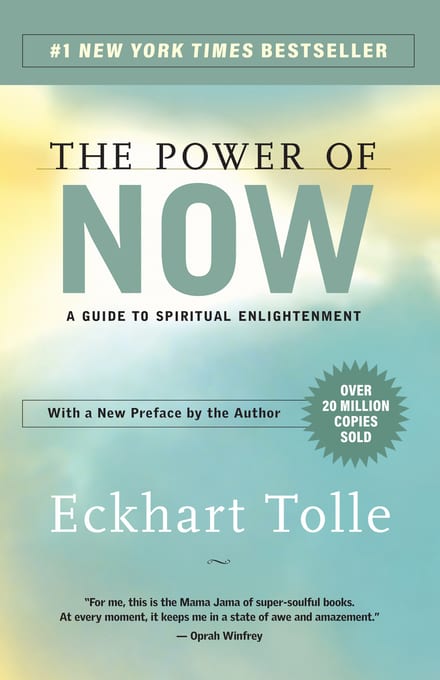
The Power of Now: A Guide to Spiritual Enlightenment
The full book runs ~224 pages — roughly 4 hours of reading. You get the key ideas here in 3 minutes.
The key ideas
- Anchor attention in the present to shrink overwhelming problems.
- Recognize the pain-body that feeds on and repeats your suffering.
- Detach from the ego that sabotages happiness and self-interest.
- Listen to your body to stay grounded in now.
- Accept feelings without judgment instead of resisting what is.
- Practice active waiting to silence past and future worries.
The summary
Most of your suffering isn’t caused by what’s actually happening to you. It’s manufactured by a mind that won’t stop replaying what already happened or rehearsing what might. The present moment is almost always manageable, so when you pull your attention back to it, problems that felt enormous shrink to something you can act on. Everything you have is now. The past is a stack of moments that were once present, the future is present moments still to come, and even your feelings about both are happening now.
The mechanics are easy to see in ordinary life. Say you’re working on a big research paper. If you dwell on the hours you wasted or panic about how much is left, you stall. But if you focus on one small thing you can do right now — write a single sentence, read one article, sketch a plan — you make progress and feel less stressed. Focusing on the present doesn’t erase your problems; it makes them smaller and lets you handle them one piece at a time.
The pain-body feeds on itself
Pain forms when you’re unhappy with your situation and feel powerless to change it, but it’s mostly self-imposed. External events don’t create the pain directly; your response to them does. Tolle names the part of you that needs pain to survive the “pain-body.” It reinforces itself every time you hurt, until the pain becomes woven into your identity and hard to shake loose.
You can watch it operate. When someone frustrates you and you get angry, that’s the pain-body at work, and the next time they frustrate you the anger comes faster. The reaction shuts down clear thinking and guarantees more pain. The ego runs a similar con, sabotaging your happiness and acting against your own interest — it’s what keeps people in destructive relationships and starts arguments over trivial things. Let go of the ego and you behave more rationally and suffer less.
Your mind is not the same as you
The mind is the source of most suffering, because it makes you agonize over a past you can’t change and stress about a future you can’t predict. To step out of that loop, shift your focus from your mind to your body, which knows what you actually need. If the urge to move rises while you’re working, get up and walk; listening to your body keeps you in the present.
You can also detach from the mind by becoming fully aware of your thoughts. Try asking yourself, over and over, what your next thought will be. You’ll notice you’ve interrupted the flow and stepped outside your own thinking, into the kind of mental stillness the Japanese call mushin. Another method is to accept thoughts without judgment: if you’re exercising instead of working and guilt shows up, register it plainly — “okay, this is the thought I’m having” — and accept it without deciding whether it’s good or bad. There’s also active waiting, staying so alert that it feels like something important could happen at any second, which forces you out of past and future. Waiting that way before and during an exam quiets the worry about being unprepared and frees you to focus on the questions in front of you.
Acceptance without going passive
Living in the present doesn’t wall you off from all pain. Some pain is unavoidable, and the answer isn’t to suppress it but to accept it. When you lose someone you love, you will mourn and grieve; if you accept the loss as something that simply is and can’t be changed, you spare yourself the needless suffering piled on top. Don’t feel guilty about negative feelings either — they’re natural. Accepting them just means seeing that things are as they are, and that wishing otherwise wastes your time.
The same acceptance steadies your relationships, even when your partner has an ego and doesn’t live in the present. They might insult you, drag up the past, or pick trivial fights to feed that ego, but the non-judgmental, accepting quality you build by staying present can break the cycle of clashes. None of this means living passively or giving up on improving your life. It means you stop creating unnecessary problems and get better at finding workable solutions to the ones that are actually here.
The bottom line
Most suffering is optional, created by a mind stuck in the past or the future instead of dealing with what’s in front of you. Move your attention to the present and problems get smaller, clearer, and easier to handle. Read this if you feel chronically anxious, caught in mental loops, or overwhelmed by problems that seem too big to face.
Fact check
Popular books repeat findings that later research has complicated. Where The Power of Now makes a testable claim, here's what the evidence actually shows.
Pulling attention back to the present shrinks suffering, because a mind replaying the past or rehearsing the future is what makes you unhappy.
The observation holds. Smartphone sampling of people's ongoing thoughts found they were thinking about something other than what was happening almost as often as they were thinking about it, and that doing so typically left them less happy. Training people to stay present pays smaller dividends than the book suggests: pooling 47 randomized trials with 3,515 participants, mindfulness meditation programs improved anxiety by an effect size of 0.38 at eight weeks and 0.22 at three to six months, depression by 0.30, and pain by 0.33, with no evidence they outperformed active alternatives such as exercise or medication.
Accepting a painful feeling without judging it works better than resisting or pushing it away.
Half of this is well supported: pushing a thought away backfires. Across 31 studies using Wegner's suppression paradigm, the rebound effect, where the unwanted thought returns more insistently once you stop suppressing, appeared regardless of how much cognitive load participants were under. Acceptance's advantage is narrower than the book implies, though. Pooling 30 experiments that pitted acceptance against suppression, distraction and reappraisal, acceptance won on pain tolerance (g = 0.43) but showed no significant edge on pain intensity or negative affect.
- Wang DA, Hagger MS, Chatzisarantis NLD. Ironic Effects of Thought Suppression: A Meta-Analysis. Perspect Psychol Sci. 2020;15(3):778-793. PubMed
- Kohl A, Rief W, Glombiewski JA. How effective are acceptance strategies? A meta-analytic review of experimental results. J Behav Ther Exp Psychiatry. 2012;43(4):988-1001. PubMed
External events do not create emotional pain directly; your response to them does, so accepting what cannot be changed spares you the suffering.
Some events leave marks that acceptance does not erase. Following more than 24,000 Germans for 15 years, unemployment produced a sharp drop in life satisfaction that never fully recovered even after people found work again, and prior experience of unemployment did not blunt the reaction to a fresh spell. Onset of long-term disability, tracked across two national panels of 39,987 and 27,406 people, was followed by drops in well-being of 0.40 to 1.27 standard deviations with little adaptation over the following years. The book is right that resistance and rumination add a second layer of suffering; the first layer is not self-generated.
- Lucas RE, Clark AE, Georgellis Y, Diener E. Unemployment alters the set point for life satisfaction. Psychol Sci. 2004;15(1):8-13. PubMed
- Lucas RE. Long-term disability is associated with lasting changes in subjective well-being: evidence from two nationally representative longitudinal studies. J Pers Soc Psychol. 2007;92(4):717-730. PubMed
Frequently asked questions
What is The Power of Now about?
It argues that most of your suffering isn't caused by what's actually happening but manufactured by a mind that won't stop replaying the past or rehearsing the future. The present moment is almost always manageable, so when you pull your attention back to it, problems that felt enormous shrink to something you can act on. Focusing on the present doesn't erase your problems; it makes them smaller and lets you handle them one piece at a time.
What are the key takeaways from The Power of Now?
When a task overwhelms you, focus on one small thing you can do right now rather than the whole mountain. Tolle names the part of you that needs pain to survive the "pain-body," which reinforces itself every time you hurt until pain becomes part of your identity, and the ego runs a similar con that sabotages your happiness. Since the mind is the source of most suffering, step out of the loop by shifting attention to your body, watching your thoughts, or practicing active waiting. And accept what can't be changed, like grief after a loss, without going passive, so you stop piling needless suffering on top of unavoidable pain.
Who should read The Power of Now?
Read this if you feel chronically anxious, caught in mental loops, or overwhelmed by problems that seem too big to face.
Is The Power of Now worth reading?
Yes if you want a practical antidote to a racing mind, since its core move, returning attention to the present, is concrete and its ordinary examples like stalling on a research paper make it usable. The framing is spiritual and uses ideas like the pain-body and ego, so a reader who wants clinical, evidence-based techniques rather than a contemplative approach, or who bristles at spiritual language, may prefer to skip it.