Book summary
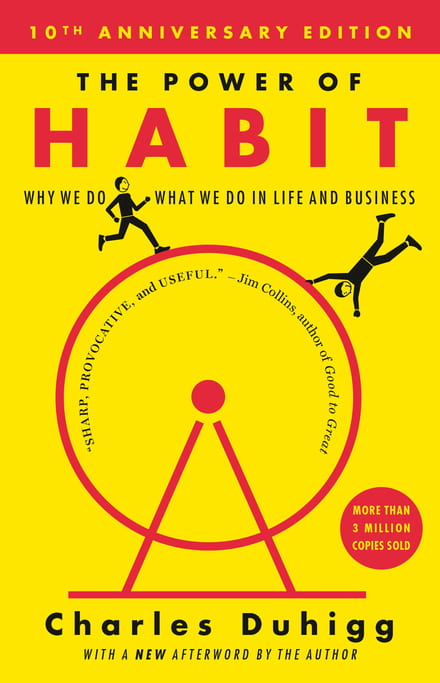
The Power of Habit: Why We Do What We Do in Life and Business
The full book runs ~400 pages — roughly 7 hours of reading. You get the key ideas here in 3 minutes.
The key ideas
- Every habit runs a loop: cue, routine, reward.
- Redirect cravings instead of erasing them—keep the bookends, swap behavior.
- Keystone habits trigger cascading wins across your life.
- Willpower works like a muscle: exhaustible, trainable, context-dependent.
- Organizational crises crack open entrenched, dangerous routines for reform.
- Social habits spread through networks of strong and weak ties.
The summary
Most of what you do all day, you don’t really decide. Charles Duhigg’s starting point is that roughly 40% of daily behavior runs on habit—automatic loops your brain builds to conserve effort. Researchers watching mice learn a maze saw brain activity fall as the route grew familiar; the animals had bundled a string of choices into a single automatic routine. Every habit, in humans too, follows the same three-part loop: a cue fires, a routine plays out, and a reward lands. Your alarm goes off (cue), you brush your teeth and brew coffee (routine), and the taste and jolt of caffeine (reward) close the circuit.
These loops are stored in the basal ganglia, a structure buried so deep that habits can survive even brain damage—which is a large part of why they’re so stubborn. Over time the brain learns to crave the reward, and the moment the cue appears it fires in anticipation of the payoff, tugging you toward the routine before you’ve consciously chosen anything. The toothpaste brand Pepsodent turned this to profit by adding a mint tingle people came to expect; the craving for that fresh sensation is what built a nation of brushers.
You can’t erase a craving, only redirect it
Because the cue and the reward are so hard to root out, willpower alone rarely kills a habit. The reliable move is to keep the two bookends and swap the routine in the middle for a new behavior that satisfies the same craving. Alcoholics Anonymous works this way: members name what drinking actually gives them—relaxation, escape, companionship—and then install new routines that deliver the same thing, like exercise or a call to a sponsor. The stressful cue and the sense of relief stay put; only the action changes. For many, a belief in a higher power adds the conviction that change is even possible when a hard week threatens to pull them back.
Keystone habits and the willpower muscle
Some habits matter far more than others because they set off a chain reaction. Duhigg calls these keystone habits. Making your bed each morning correlates with better productivity and well-being; keeping a food journal improves your whole diet. Their real power is psychological—each small win builds the belief that you can change other things too.
The most important keystone habit is willpower. The Stanford marshmallow experiment offered children one treat now or two if they could wait fifteen minutes; only about 30% held out, and years later the waiters were doing better in school, were more popular, and were less prone to addiction. Willpower behaves like a muscle: spend it hard on one task and it’s depleted for the next, but train it regularly and it grows. It’s also context-sensitive—people summon less of it when a task is forced on them than when they choose it, and having a plan strengthens it. Starbucks found that a single difficult customer could exhaust an employee’s patience, so it gave staff a script, the LATTE method (Listen, Acknowledge, Take action, Thank, Explain), that preserved their composure under pressure by turning a hard moment into a practiced routine.
Habits scale up to companies and crowds
Organizations run on habits too, and some of them turn lethal. At London’s King’s Cross station, responsibility for safety was scattered across departments, so when a fire broke out no one had clear authority to act and thirty-one people died. The disaster forced reform, putting one manager in charge of passenger safety at every station—proof that a crisis can crack open routines that would otherwise never budge. Retailers, meanwhile, quietly exploit your habits: supermarkets place fresh produce by the entrance so that buying something virtuous first loosens your resistance to junk later, and they stock the most profitable goods to the right of the door because most of us turn right on the way in.
Habits even move through whole communities. Rosa Parks and Martin Luther King, Jr. helped ignite a movement partly because they sat at the center of unusually rich networks—strong ties of close friends and weak ties of acquaintances. When Parks was arrested, those overlapping relationships pulled both her inner circle and the wider community into the new habit of activism. The lesson running under all of it is that we aren’t merely victims of our routines; once you can see the loop, you carry the responsibility to change it.
The bottom line
Habits are durable because they’re wired into the brain’s reward system, but you can rewrite almost any of them by diagnosing the cue and the reward, then slotting in a new routine that scratches the same itch. Start with keystone habits—especially willpower—and the change tends to spread. Read this if you want a practical, evidence-based way to shift behavior in yourself, your team, or your company.
Fact check
Popular books repeat findings that later research has complicated. Where The Power of Habit makes a testable claim, here's what the evidence actually shows.
Roughly 40% of what people do on a given day is habit rather than a fresh decision.
The figure traces to a pair of hourly-diary studies by Wood, Quinn and Kashy, in which 35% of logged behaviors in the first study and 43% in the second met the authors' definition of a habit. That definition was a behavior performed "just about every day" and "usually in the same location" — a count of repetition in a stable context, not a direct measure of automaticity. Both samples were undergraduates at a single university (209 students in the larger study), whose days are more routinized than most people's. The rough magnitude is defensible; the tidy precision of "40% of daily behavior" is not.
- Wood W, Quinn JM, Kashy DA. Habits in everyday life: thought, emotion, and action. J Pers Soc Psychol. 2002;83(6):1281-97. PubMed
Willpower works like a muscle: spend it hard on one task and less is available for the next.
Two large preregistered multi-lab tests failed to find the depletion effect. A 2016 replication across 23 labs and 2,141 participants estimated it at d = 0.04, with a 95% confidence interval of [-0.07, 0.15]. A 2021 test across 36 labs and 3,531 participants found d = 0.06 and nonsignificant, with the data about four times more likely under the null than under an informed-prior effect. Duhigg was reporting the consensus that stood when the book was written in 2012; the separate idea that self-control strengthens with practice is not what these studies tested.
- Hagger MS, Chatzisarantis NLD, Alberts H, et al. A multilab preregistered replication of the ego-depletion effect. Perspect Psychol Sci. 2016;11(4):546-73. PubMed
- Vohs KD, Schmeichel BJ, Lohmann S, et al. A multisite preregistered paradigmatic test of the ego-depletion effect. Psychol Sci. 2021;32(10):1566-1581. PubMed
Children who held out for a second marshmallow went on to do better in school, be more popular, and be less prone to addiction.
A conceptual replication using a larger and more diverse sample found the link between waiting at age 4 and achievement at age 15 was about half the size reported in the original studies, and shrank by roughly two-thirds once family background, early cognitive ability and home environment were controlled; associations with behavioral outcomes were much smaller and rarely statistically significant. A 2024 follow-up that tracked 702 children to age 26 found the test did not reliably predict adult achievement, health or behavior — correlations with educational attainment (r = .17) and body mass index (r = -.17) were modest, and almost all regression-adjusted coefficients were nonsignificant. Waiting longer at four does track something real, but much of what looked like willpower turns out to be family circumstance.
- Watts TW, Duncan GJ, Quan H. Revisiting the marshmallow test: a conceptual replication investigating links between early delay of gratification and later outcomes. Psychol Sci. 2018;29(7):1159-1177. PubMed
- Sperber JF, Vandell DL, Duncan GJ, Watts TW. Delay of gratification and adult outcomes: the Marshmallow Test does not reliably predict adult functioning. Child Dev. 2024;95(6):2015-2029. PubMed
A few high-leverage "keystone" habits set off a chain reaction that improves other, unrelated areas of life.
Duhigg's headline example holds up better than the general rule. A systematic review of 22 weight-loss studies found a consistent association between food-diary self-monitoring and weight loss, though the reviewers rated the evidence weak because of methodological limits. Spillover from one behavior to another is much harder to detect: a meta-analysis of 22 experiments yielding 77 effect sizes found a small positive spillover onto the intention to perform a second pro-environmental behavior (d = 0.17) but essentially none onto actual behavior (d = -0.03). Keystone habits are a useful way to choose where to start, not a demonstrated cascade.
- Burke LE, Wang J, Sevick MA. Self-monitoring in weight loss: a systematic review of the literature. J Am Diet Assoc. 2011;111(1):92-102. PubMed
- Maki A, Carrico AR, Raimi KT, Truelove HB, Araujo B, Yeung KL. Meta-analysis of pro-environmental behaviour spillover. Nat Sustain. 2019;2(4):307-315. Source
Frequently asked questions
What is The Power of Habit about?
It shows that roughly 40% of daily behavior runs on habit, automatic loops your brain builds to conserve effort, so most of what you do all day you don't really decide. Every habit follows the same three-part loop: a cue fires, a routine plays out, and a reward lands. Once you can see that loop, Duhigg argues, you can rewrite almost any habit in yourself, your team, or your company.
What are the key takeaways from The Power of Habit?
You can't erase a craving by willpower alone, so the reliable move is to keep the cue and reward but swap the routine in the middle, which is how Alcoholics Anonymous works. Some habits are keystone habits that set off a chain reaction, like making your bed or keeping a food journal, and the most important is willpower, which behaves like a muscle you can train, as the marshmallow experiment and Starbucks' LATTE method show. Organizations run on habits too, sometimes lethally, as the King's Cross fire revealed, and habits even move through communities through the networks of strong and weak ties behind the Montgomery bus boycott.
Who should read The Power of Habit?
Read this if you want a practical, evidence-based way to shift behavior in yourself, your team, or your company.
Is The Power of Habit worth reading?
Yes if you want the mechanics of behavior change grounded in real research, since the cue-routine-reward loop is simple enough to apply immediately and the keystone-habit idea gives you a place to start. It ranges widely from individuals to companies to social movements, so a reader who only wants a personal how-to guide may find the corporate and civic stories a detour, and anyone seeking a rigid step-by-step program will get a framework more than a script.