
Book summary
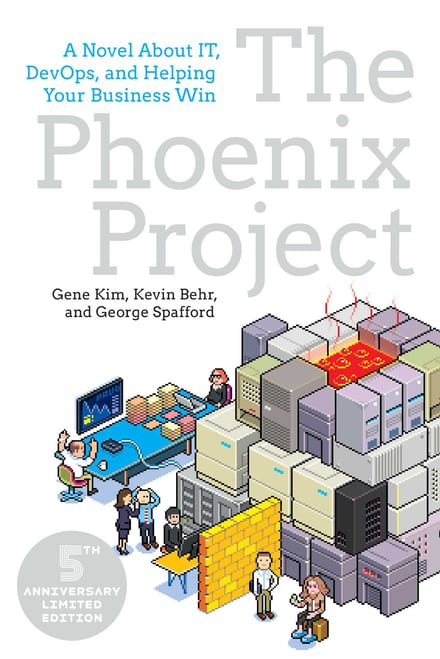
The Phoenix Project: A Novel About IT, DevOps, and Helping Your Business Win
A Novel About IT, DevOps, and Helping Your Business Win
The full book runs ~432 pages — roughly 8 hours of reading. You get the key ideas here in 5 minutes.
The key ideas
- Treat IT as a factory floor with visible work queues
- Sort work into projects, internal, changes, and unplanned
- Unplanned work is the bill for doing things badly
- Protect the constraint; stop booking heroism as capacity
- Follow the Three Ways: flow, feedback, continual learning
- DORA's 2019 data: speed and stability enable each other
The summary
The argument the novel exists to smuggle past your defenses is that IT is manufacturing. Not like manufacturing — a plant, with a floor, work stacking up between stations, and one machine whose pace quietly sets everyone else’s. On Kim, Behr and Spafford’s premise, technology work feels ungovernable mostly because that floor is invisible. Nobody can point at the pile.
So they borrowed the form along with the argument. Bill Palmer, freshly promoted to VP of IT Operations at an automotive parts company called Parts Unlimited, inherits a flagship project the publisher describes as “massively over budget and behind schedule”, and gets ninety days before his department is outsourced. Alex Rogo gets three months to save his plant in The Goal. Gene Kim has never been coy about the debt: “Without a doubt, we wrote The Phoenix Project as an homage to The Goal,” he wrote in the afterword to the fifth-anniversary edition, noting that Goldratt made time to talk with him and Behr in 2004.
Fiction was deliberate, because the conclusions sound wrong stated flat. Kim poses one of them as a question: “If production deployments are problematic, how on earth can deploying more frequently be a good idea?” A character can be argued out of a wrong belief. A bullet point can’t.
Four kinds of work, and one of them eats the others
IT Revolution sorts the book’s taxonomy into business projects, internal IT projects, changes, and unplanned work. The first three are work. The fourth, in the publisher’s phrasing, is urgent reactive work that disrupts planned work and impedes progress — not output at all, but the bill for the other three having been done badly.
The novel’s first disaster is a payroll run that fails because of an unauthorized change, and on the book’s reading the fault isn’t carelessness: unplanned work has no queue, no owner and no budget line, so it stays invisible until it has already eaten the week. Bill’s first serious move isn’t a fix but an inventory. Get the work onto a board where people can see it, and the plant acquires a floor.
Brent is the constraint, and everybody likes him
The Goldratt machinery arrives via Erik Reid, a board candidate who answers almost nothing and keeps asking Bill where his bottleneck is. It turns out to be a person: Brent Geller, the lead engineer who alone knows how several critical things work and is therefore pulled into every fire. On the book’s logic, an hour Brent spends firefighting is an hour the whole organization loses, because nothing downstream moves faster than he does.
The remedy is Goldratt’s, transposed: protect the constraint, subordinate everything else to it, stop booking heroism as capacity. Kim refuses to make Brent the villain. Brent, he wrote, is “the only character whose name we didn’t change”: a real colleague, a sharer rather than a hoarder of what he knew, “merely a victim of the system.”
Three Ways, published before the novel was
Erik’s teaching is three principles Kim had already posted on IT Revolution’s blog in August 2012, months before the book.
- Flow. The First Way “emphasizes the performance of the entire system, as opposed to the performance of a specific silo of work or department”. Its outcomes, per Kim: never pass a known defect to a downstream work center, never let a local optimization create global degradation, always seek to increase flow, always seek profound understanding of the system — the last credited to Deming.
- Feedback. The Second Way is about “the right to left feedback loops” — shortening and amplifying them so corrections happen continually rather than at the end, when they’re expensive.
- Continual learning. The Third Way pairs experimentation and deliberate risk-taking with the claim that “repetition and practice is the prerequisite to mastery.” Budget time for improving daily work, reward risk-taking as a ritual, inject faults on purpose to build resilience.
What the research behind it actually measured
The book’s claims have since been tested by survey. DORA’s 2019 Accelerate State of DevOps report drew on six years of research and over 31,000 responses, and two of its findings sit on top of the novel.
The first is the tradeoff the book denies. Six years running, the 2019 report says, “our research has consistently shown that speed and stability are outcomes that enable each other”. The gap it measured that year between elite and low clusters was enormous: 208 times more frequent deployments, 106 times faster change lead time, 2,604 times faster recovery. Read those ratios carefully: they’re computed from self-reported bands with conservative endpoints chosen by the researchers, and they belong to the 2019 data, not to DevOps as a timeless fact.
The second is awkward for Bill, who spends the novel’s first act reviving a moribund change advisory board. Testing formal external change approval, the 2019 report found respondents were 2.6 times more likely to land in the low-performing group if their organization had one; asked whether that formality bought lower change failure rates, the researchers say they “found no evidence to support this hypothesis”. Their advice: shift approval left, to peer review and automated checks. DORA has separately found that Ron Westrum’s generative culture — information actively sought, failure leading to inquiry rather than scapegoating — predicts delivery performance.
Be precise about that evidence, though. DORA models predictive relationships in survey data, not controlled experiments — good reason to think these practices travel with these outcomes, no proof that adopting one manufactures the other.
The bottom line
The book’s case is that most technology failure is a systems problem wearing a people costume: invisible work, a constraint nobody protects, feedback arriving too late to act on. Make the work visible and subordinate the rest to the bottleneck, its authors argue, and the heroics stop being load-bearing. Read it if you manage technical work and keep finding that the urgent thing ate the important thing again — then read The DevOps Handbook for the implementation detail this one leaves out on purpose.
Fact check
Popular books repeat findings that later research has complicated. Where The Phoenix Project makes a testable claim, here's what the evidence actually shows.
Deploying to production more often makes systems more stable rather than less — speed and stability are not a trade-off.
This is the book's least intuitive claim and the one the DevOps research has tested most often. DORA's 2019 Accelerate State of DevOps report, built on six years of research and over 31,000 responses, reports that speed and stability enable each other rather than trading off, with its elite cluster ahead of low performers on all four measures at once: 208 times the deployment frequency, 106 times faster change lead time, 2,604 times faster time to restore service, and a change failure rate seven times lower. Those headline ratios are softer than they look — they are arithmetic on self-reported bands using endpoints the researchers chose (1,460 deploys a year against seven; one hour to restore service against a 2,604-hour mean of one week and one month) — and they describe how two 2019 survey clusters differed, not a fixed law. Worth knowing who did the counting: DORA sits inside Google Cloud, which sells the tooling, and the 2019 report names Gene Kim, the novel's lead author, among the advisors who guided it.
The cure for unauthorized changes breaking production is a formal change approval body that signs off on changes before they ship — the change advisory board Bill rebuilds after the payroll failure.
DORA tested this directly in 2019 and found the opposite of what the practice promises. Respondents were 2.6 times more likely to fall in the low-performing cluster if their organization required approval from an external body such as a change advisory board or a senior manager, and when the researchers asked whether that formality bought lower change failure rates they found no evidence to support the hypothesis. DORA's recommendation is to shift approval left — peer review inside the team, backed by continuous testing, continuous integration and monitoring that catch bad changes earlier than a review board can. In fairness to the novel, that is roughly where its own plot lands: Bill's team finishes by building an automated deployment pipeline, not a bigger approval queue.
A culture that circulates information and treats failure as something to investigate rather than someone to blame is what makes technology teams perform — the reason the authors refuse to cast Brent as the villain.
The association is real and DORA has found it repeatedly: it reports that a high-trust, generative culture in Ron Westrum's sense — information actively sought, messengers trained rather than blamed, failure leading to inquiry — predicts both software delivery and organizational performance, and its 2019 analysis found culture optimized for information flow, trust, innovation and risk-sharing predictive of delivery performance. The evidence underneath is thinner than the phrasing suggests. Westrum set out the typology as a conceptual model in a 2004 patient-safety paper rather than deriving it from measured outcomes, and DORA's data is a cross-sectional survey in which one respondent rates both the culture and the team's performance at the same sitting — which cannot separate a good culture producing good delivery from good delivery making the culture feel better.
Running technology work the way a factory floor is run — visible work, a protected constraint, fast feedback — produces the performance gap the DevOps research reports.
The direction holds up; the causal step is not what this research can establish. DORA's own methodology section describes a cross-sectional, theory-based design it calls inferential predictive, used, in its words, when purely experimental design is not possible — no team is randomly assigned a practice, responses are self-reported, and the sample is a snowball recruited through the researchers' and sponsors' networks, which DORA acknowledges is likely limited to organizations already familiar with DevOps. That supports the claim that these practices travel with these outcomes, not the claim that adopting them will manufacture the outcomes. DORA's own framing has moved on since 2019, too: dora.dev now defines five delivery metrics rather than four, with failed deployment recovery time in place of time to restore service, and the 2025 report sorts teams into seven archetypes built from performance and well-being together.
Frequently asked questions
What is The Phoenix Project about?
The novel's argument is that IT is manufacturing, not merely like it: a plant with a floor, work stacking up between stations, and one machine whose pace quietly sets everyone else's. Technology work feels ungovernable, on its authors' premise, mostly because that floor is invisible and nobody can point at the pile. It follows Bill Palmer, freshly promoted to VP of IT Operations at an auto parts company, who gets ninety days to rescue a flagship project before his department is outsourced, in a form its authors openly call an homage to The Goal.
What are the key takeaways from The Phoenix Project?
Work sorts into four types, business projects, internal IT projects, changes, and unplanned work, and the fourth is not output at all but the bill for the other three having been done badly. Unplanned work has no queue, no owner and no budget line, so it stays invisible until it has already eaten the week, which is why Bill's first serious move is an inventory rather than a fix. The constraint turns out to be a person, the lead engineer Brent, who alone knows how several critical things work and is pulled into every fire: protect the bottleneck, subordinate everything else to it, and stop booking heroism as capacity. The teaching is the Three Ways, meaning flow across the whole system rather than one silo, shorter and louder feedback loops, and continual learning through experiment and practice.
Who should read The Phoenix Project?
Anyone who manages technical work and keeps finding that the urgent thing ate the important thing again. The DevOps Handbook covers the implementation detail this one leaves out on purpose.
Is The Phoenix Project worth reading?
The fiction earns its keep, because a character can be argued out of a belief a bullet point cannot touch, including the one Kim poses as a question: if deployments are already painful, how can deploying more often help? The research since then is supportive but bounded. DORA's 2019 report, drawing on six years of work and over 31,000 responses, found that speed and stability enable each other, but it models relationships in self-reported survey data rather than showing that adopting these practices produces those outcomes. Skip it if you would rather read the practices stated flat than dramatised through a corporate turnaround.