Book summary
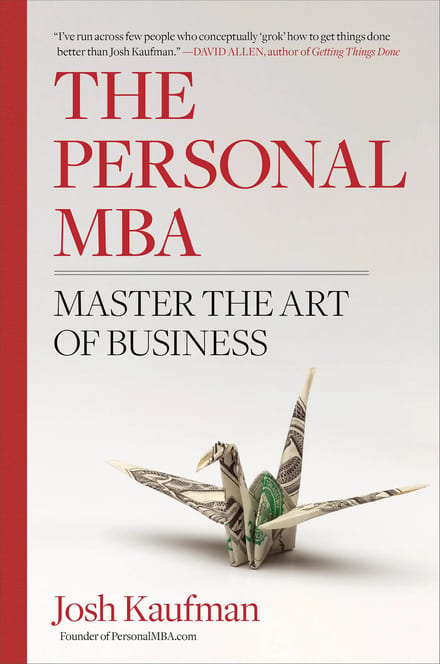
The Personal MBA: Master the Art of Business
The full book runs ~504 pages — roughly 9 hours of reading. You get the key ideas here in 4 minutes.
The key ideas
- Skip the $300K MBA; skills beat credentials with no earnings edge
- Build products that satisfy real human drives, not features
- Score ideas on ten factors before launching anything
- Treat competitors as validation and free market blueprints
- Sell by removing buyer fear and creating urgency
- Retain customers; repeat business beats constant prospecting
The summary
Every business, no matter the industry, is the same five jobs. It creates something of value, finds the people who want or need it, gets them to pay a price they’ll accept, delivers in a way that meets their expectations, and clears enough profit to make continuing worthwhile. Josh Kaufman labels these value creation, marketing, sales, value delivery, and finance, and his point is that once you actually understand them, the six-figure degree becomes optional. Business schools charge upward of $300,000 on the promise of knowledge, contacts, and prestige, yet studies find no correlation between holding an MBA and earning more or rising higher. The tuition buys a signal, not a skill you can’t get faster and cheaper through experience, targeted reading, and practice in the market itself.
Value creation starts with human drives
A well-made product is worthless if it doesn’t answer a real human need. Kaufman traces buying back to five core drives: the drive to acquire (status, power, possessions), the drive to bond (restaurants, dating sites, clubs), the drive to learn (books, courses, workshops), the drive to defend (insurance, alarms, legal help), and the drive to feel (movies, music, games, art). Your offer has to plug into at least one of these. Timing matters too, because receptiveness depends on circumstance: comfort kills the urge to change, while discomfort sends people looking for a solution. And even a receptive buyer weighs both objective qualities like cost and reliability and subjective value — how it will make them feel, how others will see them.
Before committing, pressure-test the idea. Kaufman’s market fit scorecard rates a concept from 0 to 10 across ten factors — urgency, market size, pricing potential, cost of customer acquisition, cost of value delivery, uniqueness, speed to market, up-front investment, upsell potential, and evergreen potential. Under 50 and the idea won’t work; over 75 and it’s promising. One more reassurance: finding competitors already doing what you planned isn’t a warning, it’s proof that paying customers and a working model exist. Become their customer, study their pricing, promotions, and complaints, and you’ll walk in already knowing where to offer more.
Marketing, sales, and pricing
Even a great product needs marketing to reach anyone. Keep the message clear and short, aim it at individuals rather than a faceless mass, and lead with the result the product delivers — testimonials and endorsements build trust faster than a spec sheet. Don’t waste effort on the wrong crowd; you can’t sell beef to vegans, so target people already interested in an adjacent product.
Selling is largely about dismantling fear. The biggest barrier to a purchase is the dread of choosing wrong, which you neutralize by allowing returns and shifting the risk onto yourself. Anticipate the standard objections and answer them before they harden — “my last phone only lasted a year” meets “our customers average five years of use.” Because people weigh options endlessly, tactics like limited availability and expiring discounts compress the decision and raise perceived value. Pricing itself has several bases — cost plus a margin, competitors’ rates, estimated long-term value, or subjective worth — and if you want more profit without raising prices, you either win more customers or get current ones to buy more. When it comes to real negotiation, most of the work happens beforehand: choosing who to talk to, researching their constraints, deciding your terms, and preparing the concessions you’re willing to make.
Keep the customer, and respect your own limits
The sale is the beginning, not the finish. Satisfaction after the purchase is what produces repeat business, referrals, and a reputation strong enough to fend off competitors, and it’s far cheaper than constant prospecting. A disappointed customer costs you twice, in lost revenue and in the price of repairing your name, so simplify everything else in order to pour attention into the people already paying you. Leading a team that delivers this runs on communication: explain the reasoning behind a plan so people can adapt when things shift, discuss ideas openly so colleagues feel invested, and skip the insults that only make them defensive.
Your own productivity has hard physical limits worth working with rather than against. The brain can’t truly multitask or absorb constant surprises, and energy rises and falls in roughly 90-minute cycles, so schedule demanding work for the peaks and rest through the troughs. Most people run strongest in the morning, which is the time to spend on your hardest thinking.
The bottom line
Business is five jobs done well: make something valuable, find the people who need it, get them to pay, deliver so they come back, and keep enough profit to continue. You don’t need a $300,000 credential to learn that — you need focus and a willingness to test ideas in the real market. Read this if you’re weighing business school, or already running something and want a plainspoken framework instead of jargon.
Fact check
Popular books repeat findings that later research has complicated. Where The Personal MBA makes a testable claim, here's what the evidence actually shows.
Business school costs upward of $300,000, and studies find no correlation between holding an MBA and earning more or rising higher.
The price tag is roughly right at the top end: Harvard's published cost of attendance for 2026-27 is $130,318 for a single student over the nine-month year, about $261,000 across two years before any forgone salary. The "no correlation" half is where the book overreaches. It traces to Pfeffer and Fong's 2002 review of business-school outcomes, but later work using the pre-MBA wages of GMAT registrants to control for individual fixed effects found the MBA premium shrank rather than vanished, most for top-25 programs, while for full-time students outside the top 25 the estimated return was actually higher once selection was accounted for. The honest version is that much of the raw earnings gap reflects who enrolls, not that the degree does nothing.
- Harvard Business School. MBA annual cost of attendance, 2026-27. Boston, MA: Harvard Business School. Source
- Arcidiacono P, Cooley J, Hussey A. The economic returns to an MBA. Int Econ Rev. 2008;49(3):873-899. Source
- Pfeffer J, Fong CT. The end of business schools? Less success than meets the eye. Acad Manag Learn Educ. 2002;1(1):78-95. Source
Energy rises and falls in roughly 90-minute cycles, so demanding work should be scheduled at the peaks and rest taken in the troughs.
The 90-minute figure is solid for sleep, not for waking. An analysis of 2,312 polysomnograms confirmed that NREM-REM alternation runs about four to five cycles a night at roughly 90 minutes each, with a normal distribution around that mean. The waking counterpart is far weaker: chronobiologists now classify most short-period biological events in awake humans as episodic rather than rhythmic, aperiodic and lasting anywhere from a few minutes to a few hours rather than ticking on a schedulable clock. Alternating focused work with real breaks is reasonable advice; the specific 90-minute period is borrowed from sleep physiology.
- Le Bon O, Lanquart JP, Hein M, Loas G. Sleep ultradian cycling: Statistical distribution and links with other sleep variables, depression, insomnia and sleepiness-A retrospective study on 2,312 polysomnograms. Psychiatry Res. 2019;279:140-147. PubMed
- Goh GH, Maloney SK, Mark PJ, Blache D. Episodic Ultradian Events-Ultradian Rhythms. Biology (Basel). 2019;8(1):15. PubMed
The brain cannot genuinely multitask, so juggling tasks costs you more than doing them in sequence.
Alternating between tasks carries a measurable time cost. Across four experiments, switching costs grew as the governing rules got more complex and fell when a visual cue signalled which task was coming, a pattern that fits sequential goal-shifting and rule-activation stages rather than parallel processing. The people who multitask most are not exempt: heavy media multitaskers proved more susceptible to interference from irrelevant stimuli and irrelevant memory, and switched tasks worse than light multitaskers. One caveat the book does not mention is that in a 200-person driving-simulator study, 2.5% of participants showed no dual-task decrement at all.
- Rubinstein JS, Meyer DE, Evans JE. Executive control of cognitive processes in task switching. J Exp Psychol Hum Percept Perform. 2001;27(4):763-797. PubMed
- Ophir E, Nass C, Wagner AD. Cognitive control in media multitaskers. Proc Natl Acad Sci U S A. 2009;106(37):15583-15587. PubMed
- Watson JM, Strayer DL. Supertaskers: Profiles in extraordinary multitasking ability. Psychon Bull Rev. 2010;17(4):479-485. PubMed
Keeping existing customers is far cheaper than constant prospecting, so long-standing customers are the profitable ones.
Three years of daily transaction data from a large catalogue retailer contradicted every standard assumption behind this advice at once: long-life customers were not necessarily more profitable, were not cheaper to serve, and did not pay higher prices. The authors were testing the relationship-marketing orthodoxy directly, and found it held up in contractual settings but not in noncontractual ones where buyers are free to leave without cancelling anything. Retention is still worth pursuing; which customers you retain matters more than the headline that retention is automatically cheaper.
- Reinartz WJ, Kumar V. On the profitability of long-life customers in a noncontractual setting: an empirical investigation and implications for marketing. J Mark. 2000;64(4):17-35. Source
Frequently asked questions
What is The Personal MBA about?
It argues that every business, whatever the industry, is the same five jobs: it creates something of value, finds the people who want it, gets them to pay a price they'll accept, delivers so it meets their expectations, and clears enough profit to make continuing worthwhile. Kaufman calls these value creation, marketing, sales, value delivery, and finance, and his point is that once you understand them, a six-figure degree becomes optional, since studies find no correlation between holding an MBA and earning more.
What are the key takeaways from The Personal MBA?
Value creation starts with five core human drives, to acquire, bond, learn, defend, and feel, and your offer has to plug into at least one. Pressure-test an idea with the market fit scorecard, rating it 0 to 10 across ten factors like urgency, market size, and pricing potential. Keep marketing clear and lead with the result, not a spec sheet. Selling is largely about dismantling the fear of choosing wrong, so shift the risk onto yourself with returns and answer objections before they harden. The sale is the beginning, not the finish, because satisfaction produces repeat business more cheaply than constant prospecting. And work with your own limits, scheduling hard thinking for your morning energy peak.
Who should read The Personal MBA?
Read this if you're weighing business school, or already running something and want a plainspoken framework instead of jargon.
Is The Personal MBA worth reading?
Yes if you want a broad, practical map of how a whole business fits together without paying for the degree, and its reassurance that existing competitors prove a working model is a useful counter to first-timer fear. Because it covers many topics at an introductory level, an experienced operator who already knows marketing, sales, and finance may find each section too shallow to add much, treating it more as a checklist than a deep dive.