Book summary
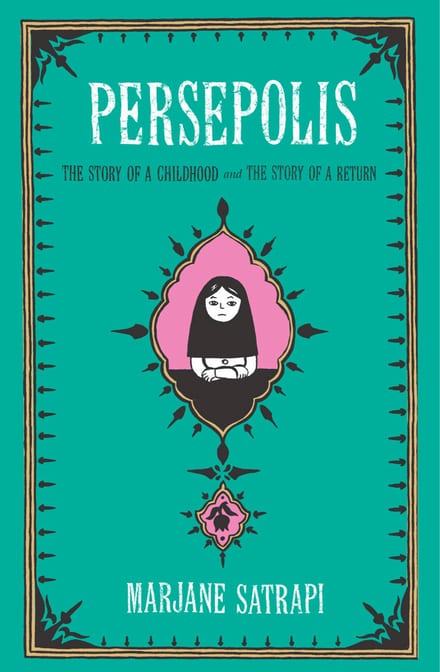
The Complete Persepolis
The full book runs ~352 pages — roughly 6 hours of reading. You get the key ideas here in 5 minutes.
The key ideas
- Judge a nation by its people, not its few extremists.
- Follow one girl through veil, war, and smuggled Iron Maiden posters.
- Notice who gets the golden keys to paradise — only poor boys.
- Black and white is a decision: simplicity lets a stranger in.
- Escape is no ending; Vienna brings drugs, homelessness, and depression.
- Testimony works at the smallest scale — one family, one street.
The summary
Satrapi’s case is that a country is not the same thing as its government, and that the way to prove it is not to argue but to draw. Writing in Paris in the late 1990s, she found Iran came up in Western conversation almost only in connection with “fundamentalism, fanaticism, and terrorism.” Her answer was a memoir in comics about one girl in Tehran: arguing with God, smuggling home a denim jacket, watching an uncle taken away. Her stated principle is that “an entire nation should not be judged by the wrongdoings of a few extremists,” and the book makes that case by declining to be about a nation at all. It is about a family. The Complete Persepolis collects both halves — The Story of a Childhood and The Story of a Return — Tehran to Vienna to Tehran to the departure that finally stuck.
The private life is the argument
The book opens in 1980, after the revolution that ended the monarchy, with the veil arriving at Marji’s school and her French co-educational classes shut down. She is ten. What Satrapi draws next is not outrage but a schoolyard: girls turning the chador into a costume and a joke, one of them announcing an execution in the name of freedom. They really did play with it that way, she later told Terry Gross. “It was not the choice of people,” she said of the veil. “That was like that.”
Her parents come back from a trip to Turkey with contraband — a denim jacket, an Iron Maiden poster, a Kim Wilde poster — and Marji is, by her own account, the coolest person in her school. Satrapi told NPR in 2003 that “the culture in general belongs to everyone. There is no frontier.” A reader who has just watched a family risk a passport for a heavy metal poster has a harder time treating Iranians as an abstraction; her hope, she told the Associated Press, was that readers would see that “this abstract thing, this Axis of Evil, is made up of individuals with lives and hopes.”
Black and white is a decision, not a style
The form is doing work here, and Satrapi was explicit about why. She kept the drawing flat, stark and simple because simplification is what lets a stranger in: “The drawing is to serve my story and not the contrary,” she said, and elsewhere that “drawing is the first language of the human being.” A photograph of Tehran, she argued, files the story under somewhere else; a cartoon of a girl in a headscarf does not. She credited German expressionism for the black and white, and she said the plainness cost her months of work.
She came to comics late and sideways, through the Paris studio around David B. and the collective L’Association, who talked her into making a book of her stories. Its editor, Jean-Christophe Menu, has said they printed two thousand copies and never imagined selling two million. Four French volumes appeared between 2000 and 2003; Pantheon’s English translation came in two parts, then as one volume in 2007.
The war hands out keys, and only to some boys
Iraq invaded in 1980, the war ground on until 1988, and the childhood volume is at its hardest here. In the book, schools hand boys plastic keys painted gold and tell them the key opens paradise if they die at the front — and, as Satrapi draws it, only the poor boys get one. When a missile lands on Marji’s street, she finds what is left of her friend Neda in the rubble. Satrapi said it changed her for good: once you have seen a thirteen-year-old die, you accept that you are already dead, and “your death doesn’t matter anymore to you, then you’re not scared.”
That fearlessness is not free: it gets her thrown out of school for shoving a headmistress, and it gets her stopped by the revolutionary guards — arrested, she recalled, for wearing makeup and for red shoes. It is also the family inheritance. Her grandfather, as the book tells it, was a Qajar prince who ended up a political prisoner; her uncle Anoosh, back from exile and promising her everything will be fine, is arrested again and, as the book tells it, executed by the new regime. Her grandmother supplies the moral spine; Satrapi’s summary of that lesson: “Choice always exists.”
Exile makes you foreign in both directions
At fourteen her parents put her on a plane to Vienna, and The Story of a Return is the volume for anyone who assumes escape is the happy ending. She lands in a boarding house run by nuns, gets expelled, drifts through drugs and a boyfriend who wrecks her, and ends up two months on the street and then in hospital. She goes home at eighteen to a country the war has emptied out, carrying guilt for having left, and falls into a depression that nearly kills her. The line the volume turns on: “I was a Westerner in Iran, an Iranian in the West. I had no identity.”
What follows is art school, a short marriage, and a last refusal: a graduation project for a theme park drawn from Persian mythology, rejected by the authorities for being Persian rather than Islamic. She divorced, left for France in 1994, and stayed.
The bottom line
Persepolis argues that testimony works best at the smallest scale, and it proves the point: the veil, the war and the executions land because they happen to a specific girl with an Iron Maiden poster. Satrapi took some pleasure in the American schools that tried to ban it — “A banned book is always a good book,” she said — and she died in June 2026 at 56, the book still required reading around the world. Read it if you want the Iranian revolution and its aftermath at eye level, from inside a living room, and read the second half too.
Fact check
Popular books repeat findings that later research has complicated. Where The Complete Persepolis makes a testable claim, here's what the evidence actually shows.
Iran sent boys to the front in the war with Iraq carrying gold-painted plastic keys they were told would open paradise, and it was poor boys who got them.
The mobilization behind the scene is documented. Encyclopaedia Iranica's account of the war, which began with Iraq's invasion on 22 September 1980, has Basij volunteer units leading the human-wave assaults that cleared the way for the Revolutionary Guards, the volunteers "for the most part badly trained, poorly equipped, and often very young or very old." The United States Institute of Peace puts it flatly: the Basij were "deployed as cannon fodder or minesweepers," the force was "often criticized for mobilizing child soldiers for the war effort and using children for 'martyrdom' operations," and some 100,000 volunteers were at the front when mobilization peaked in December 1986. The keys are the part that does not settle — they are attested in wartime Western press accounts and in memoirs like this one, but they do not appear in these histories of the mobilization, and the class pattern Satrapi draws, with the gold key offered to poor boys and not to rich ones, is her own observation rather than something the general accounts separate out.
American schools have tried to ban Persepolis.
The best-documented case is Chicago. On 14 March 2013 Chicago Public Schools emailed schools to pull the book by the next day; chief executive Barbara Byrd-Bennett said it "contains graphic language and images that are not appropriate for general use in the 7th-grade curriculum," and the district said separately that no decision had been made about grades eight to ten. Forty-two pages of internal email, released after a library-science graduate student's late-2014 public-records request, showed the order had started when an elementary network chief sent two pages to the curriculum chief asking whether she could pull the book and was told "By all means, pull them," followed by a directive to collect copies from libraries and classrooms across the district. What stopped the sweep was the librarians' own collection-development policy, not a change of mind.
Frequently asked questions
What is The Complete Persepolis about?
It's Marjane Satrapi's graphic memoir of growing up in Tehran during and after the 1979 revolution, then being sent abroad alone at fourteen. Satrapi's argument is that a country is not the same thing as its government, and she makes it by staying small: the veil arriving at her school, an uncle arrested and executed, a friend killed by a missile, a smuggled Iron Maiden poster. The single volume collects both halves — the childhood in Iran and the story of her return.
What are the key takeaways from The Complete Persepolis?
That an entire nation shouldn't be judged by the wrongdoings of a few extremists, and that the way to show it is one family rather than one country. That the stark black-and-white drawing is a decision, not a style — Satrapi kept it flat and simple because a cartoon lets a stranger in where a photograph files the story under "somewhere else." That the Iran-Iraq war handed out plastic keys to paradise only to poor boys. And that exile cuts both ways: "I was a Westerner in Iran, an Iranian in the West. I had no identity."
Who should read The Complete Persepolis?
Anyone who wants the Iranian revolution and its aftermath at eye level, from inside a living room rather than from a news desk. It also speaks directly to readers who have left a country and found themselves foreign in both places.
Is The Complete Persepolis worth reading?
Yes, and it's worth reading past the childhood volume. The first half is the famous one, but The Story of a Return — Vienna, homelessness, going home to an emptied-out country, a depression that nearly killed her — is where the book refuses to let escape be a happy ending. Readers who want a broad political history of Iran will find this deliberately narrow; that narrowness is the point.