
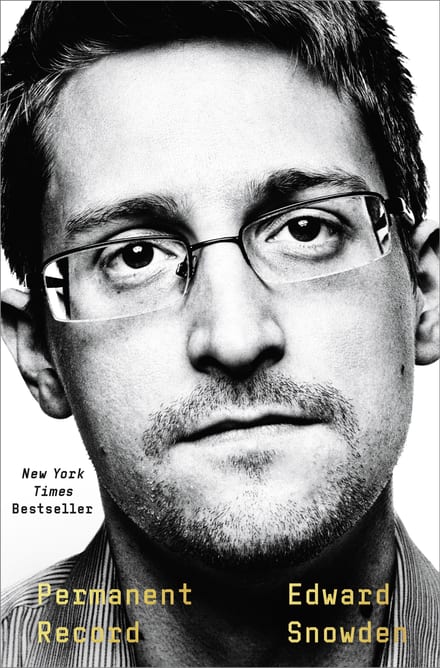
Book summary
Permanent Record
The full book runs ~352 pages — roughly 6 hours of reading. You get the key ideas here in 3 minutes.
The key ideas
- PRISM harvested user data straight from major tech companies' servers
- Upstream tapping siphoned traffic from the internet's physical cables
- XKEYSCORE let employees search anyone's history in keystrokes
- Privacy protects autonomy, not just the guilty
- Snowden smuggled proof and chose transparency over his freedom
- Freedom is measured by respect for citizens' rights
The summary
The same internet that made life convenient made it cheap to watch everyone at once. That is the discovery at the center of Edward Snowden’s memoir, and he made it from the inside, as a contractor with the keys to the United States’ surveillance machinery. Centralized servers, undersea fiber-optic cables, and quiet partnerships between the government and the biggest tech companies turned blanket, retroactive surveillance from a technical fantasy into something trivial to run by default. Snowden’s argument is that when a capability becomes that cheap, it gets used—and that a society which accepts it has quietly decided its citizens have no rights worth protecting.
From the open internet to the security state
Snowden grew up among government workers and, more formatively, on the early internet of the 1990s—an anonymous, non-commercial space where a curious kid could roam, learn to code, and find a global community. That web taught him what freedom online could feel like before corporations and states carved it up. His path was not linear: his parents divorced, mononucleosis nearly held him back in high school, and he skipped ahead to a GED and community college, where he and a classmate ran a small web-design business.
After 9/11 he wanted to serve, enlisted, and broke his ankle in basic training, so he redirected his talents to the intelligence agencies then desperate for cybersecurity skills. Without a college degree, his abilities carried him upward fast—from a security guard to government contracting to a posting with the NSA in Geneva. The turn came while he was preparing a conference on China’s surveillance methods and started to wonder whether his own government did the same thing to its own people. He got his answer almost by accident, receiving a classified report on STELLARWIND, a program collecting Americans’ phone and internet activity through telecoms like AT&T. It disturbed him so deeply that he developed dizziness and seizures and stepped back from the work.
The machine he found
Back at the NSA, now in Hawaii, he studied the programs in his own time and mapped their reach, even building a tool called Heartbeat to pull classified reports together. What he uncovered was total. PRISM collected data straight from the servers of Microsoft, Yahoo, Google, Facebook, Paltalk, YouTube, Skype, AOL, and Apple—email, photos, video and audio chats, browsing, search queries, everything in the cloud—turning those companies into partners. Upstream collection was arguably worse, tapping the physical guts of the internet itself: the switches, routers, satellites, and undersea cables that carry the world’s traffic. Between the two, information both stored and in transit was surveillable. A separate tool, XKEYSCORE, let an ordinary employee pull up almost anyone’s phone and browsing history with a few keystrokes, and some used it to snoop on ex-partners and neighbors. This was not the targeting of suspects; it was collection by default, universal and after the fact. As Snowden puts it, the fundamental rule of technological progress is that if something can be done, it probably will be done, and possibly already has been.
Why privacy is for everyone
Rereading the Fourth Amendment convinced Snowden that mass surveillance was flatly unconstitutional, but his sharper point is moral. The line “I don’t care about privacy because I have nothing to hide,” he argues, assumes no one should ever have anything to hide—not their immigration status, unemployment or financial history, health records, religious beliefs, political affiliations, or sexual life. It’s the same as saying you don’t care about free speech because you have nothing to say. Privacy isn’t a cover for guilt; it’s the basis of autonomy, and treating it as a privilege only the guilty need concedes that the right belongs to no one. A country’s freedom, he writes, can only be measured by its respect for the rights of its citizens—and since the people who write the rules have no incentive to act against themselves, those rules drift toward serving power unless someone forces the question.
The leak
He acted deliberately, not on impulse. He smuggled documents out by moving files onto unused machines, encrypting them onto SD cards tucked inside a Rubik’s cube, and passing them to journalists Laura Poitras and Glenn Greenwald over strangers’ WiFi from scattered locations. He knew he’d be identified and could have altered the files to hide his role, but he refused—their authenticity mattered more than his safety. He kept his partner Lindsay in the dark to shield her. In June 2013, working with Poitras and Greenwald in Hong Kong, he made the programs public. Within days he was charged with espionage, his passport was revoked mid-journey, and he was stranded in a Moscow airport until Russia granted temporary asylum. Lindsay joined him in 2014; they remain there, with Snowden still an activist and still hoping to come home.
The bottom line
The infrastructure that makes the internet useful is the same infrastructure that makes watching everyone, all the time, cheap enough to do by default—and privacy is a right that protects all of us, not a courtesy for the innocent. Read this if you want to know what actually happened behind the Snowden revelations, and why one person inside the system traded his freedom to make them public.
Fact check
Popular books repeat findings that later research has complicated. Where Permanent Record makes a testable claim, here's what the evidence actually shows.
PRISM collected data straight from the servers of Microsoft, Google, Apple, Facebook and other tech companies — email, photos, chats, searches, everything in the cloud.
The oversight board with classified access describes PRISM differently: the government sends a selector such as an email address to a US electronic communications service provider that has been served a Section 702 directive, and the provider is compelled to hand over communications sent to or from that selector. That is targeted compelled production, not a pipe into company servers, and it excludes telephone calls and communications merely 'about' a selector. The board also notes the government never declassified which providers received directives, so the company list comes from the leaked slides rather than any official record. The framing 'directly from the servers' is the NSA's own slide language, which the named companies disputed at the time.
- Privacy and Civil Liberties Oversight Board. Report on the Surveillance Program Operated Pursuant to Section 702 of the Foreign Intelligence Surveillance Act. Washington, DC: PCLOB; July 2, 2014. Source
Upstream collection tapped the physical guts of the internet — the switches, routers and undersea cables carrying the world's traffic — rather than individual companies.
The oversight board confirms upstream collection happens with the compelled assistance of the providers that control the telecommunications backbone, not at the local email provider or phone company the target actually uses, so it intercepts traffic in transit between carriers. It covers telephone calls as well as internet communications, and unlike PRISM it swept in 'about' communications, where the target's selector appears inside a message they are not party to, plus multi-communication transactions bundling unrelated messages. The NSA stopped 'about' collection in April 2017. The main correction to the summary is that this was legally compelled carrier cooperation rather than clandestine cable-splicing.
- Privacy and Civil Liberties Oversight Board. Report on the Surveillance Program Operated Pursuant to Section 702 of the Foreign Intelligence Surveillance Act. Washington, DC: PCLOB; July 2, 2014. Source
The bulk collection of Americans' phone records that Snowden exposed was flatly illegal and unconstitutional.
The statutory half held up. In 2020 the Ninth Circuit ruled that the NSA's bulk telephony metadata collection exceeded what Congress authorised in 50 USC 1861, which required a showing of relevance to a particular investigation before records could be collected, and therefore violated FISA. The constitutional half did not: the panel said the government 'may have violated' the Fourth Amendment but expressly declined to decide, because suppression was unwarranted either way. The oversight board reached the same statutory conclusion in 2014, adding that it could not identify a single instance in which the program made a concrete difference to the outcome of a counterterrorism investigation.
- United States v Moalin, Nos. 13-50572, 13-50578, 13-50580, 14-50051 (9th Cir, filed September 2, 2020). Source
- Privacy and Civil Liberties Oversight Board. Report on the Telephone Records Program Conducted under Section 215 of the USA PATRIOT Act and on the Operations of the Foreign Intelligence Surveillance Court. Washington, DC: PCLOB; January 23, 2014. Source
Frequently asked questions
What is Permanent Record about?
It's Edward Snowden's memoir of how the same internet that made life convenient made it cheap to watch everyone at once, told from the inside by a contractor who held the keys to the United States' surveillance machinery. Centralized servers, undersea cables, and quiet partnerships between government and big tech turned blanket, retroactive surveillance into something trivial to run by default. His argument is that when a capability becomes that cheap it gets used, and a society that accepts it has quietly decided its citizens have no rights worth protecting.
What are the key takeaways from Permanent Record?
The machine Snowden mapped was total: PRISM pulled data straight from the servers of companies like Microsoft, Google, Facebook, and Apple, Upstream tapped the physical cables and switches carrying the world's traffic, and XKEYSCORE let an ordinary employee pull up almost anyone's history with a few keystrokes. This was collection by default, not the targeting of suspects. His sharpest point is moral: "I have nothing to hide" assumes no one should ever have anything to hide, and is like saying you don't care about free speech because you have nothing to say. Privacy is the basis of autonomy, a right that protects everyone rather than a courtesy for the innocent.
Who should read Permanent Record?
Read this if you want to know what actually happened behind the Snowden revelations, and why one person inside the system traded his freedom to make them public.
Is Permanent Record worth reading?
Yes if you want the story firsthand, from Snowden's early years on the open 1990s internet through his rise in the intelligence agencies to the deliberate, risky leak in Hong Kong. It weaves personal memoir with an argument about privacy and the Fourth Amendment, so a reader who wants a neutral technical account of the programs, or who is already deeply familiar with the disclosures, may find the personal framing and moral case less new.