Book summary
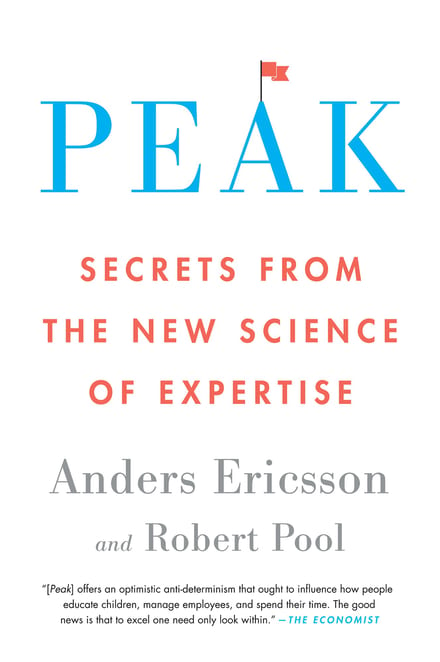
Peak
Secrets from the New Science of Expertise
The full book runs ~336 pages — roughly 6 hours of reading. You get the key ideas here in 4 minutes.
The key ideas
- Reject naive repetition; practice with goals, focus, and feedback
- Push past your comfort zone to force brain adaptation
- Build mental representations that let experts perceive patterns instantly
- Attack plateaus by isolating weaknesses, not adding hours
- Master existing techniques before attempting creative breakthroughs
- Debunk innate talent; hidden practice explains every prodigy
The summary
Your ceiling is not fixed. That’s the claim at the heart of Anders Ericsson’s research, and it inverts how most people think about talent: learning isn’t a way of reaching your potential, it’s the way you build potential in the first place. The human brain is plastic — it physically rewires itself in response to the right kind of training — and that adaptability, not any inborn gift, is what separates experts from everyone else.
The catch is that most practice doesn’t build anything. People do “naive practice”: they repeat an activity over and over and expect improvement to arrive on its own. It doesn’t. What works is purposeful practice — a specific, well-defined goal, full focus, immediate feedback, and constant work just past the edge of your comfort zone. “If you never push yourself beyond your comfort zone, you will never improve.” The reason is biological. Your body and brain default to homeostasis, and only sustained discomfort disturbs that stability enough to force an upgrade. London taxi drivers show it physically: mastering the city’s maze enlarges the posterior hippocampus, the region behind spatial navigation, and it keeps growing the longer they drive. At Tokyo’s Ichionkai Music School, 24 children trained to identify chords all developed perfect pitch — a trait once assumed to be genetic.
Experts don’t just know more, they see differently
The engine of expertise is what Ericsson calls mental representations — patterns stored in long-term memory that let experts process huge amounts of information fast, sidestepping the tiny capacity of short-term memory. A chess grandmaster doesn’t memorize the board square by square; they perceive meaningful chunks, which is exactly what makes blindfold chess possible. A surgeon runs an entire operation in their mind’s eye, anticipating the pitfalls before the first incision. An expert climber looks at a wall and instantly reads the grip each hold demands.
These representations are domain-specific — being a brilliant surgeon does nothing for your chess — but within a field they’re everything, powering planning, split-second decisions, and self-correction. Building them, not logging raw hours, is what actual training is for.
Deliberate practice, not just time
Deliberate practice is the sharpest version of this: purposeful practice in a well-developed field, guided by a teacher, using techniques others have already proven and aimed at skills others have already mastered. “Deliberate practice is purposeful practice that knows where it is going and how to get there.” It also punctures the famous 10,000-hour rule. In the Berlin violin study, the best students had averaged 7,410 hours by age eighteen and the merely good ones 3,420 — but 10,000 is an average, not a magic threshold, and none of them had maxed out; improvement keeps going well beyond it. The hours only count if they’re high quality.
That’s why training should target skill rather than knowledge. Traditional professional education front-loads information and assumes competence will follow, but the Navy’s Top Gun school lifted pilot performance by simulating real combat with relentless feedback instead of more theory — because what matters is what you can do, not what you know. And feedback is the ingredient that quietly decides whether experience helps at all. Radiologists often don’t get better with years on the job, because they rarely learn whether a diagnosis was right. Without a feedback loop, experience stagnates or even declines.
Attack plateaus by changing your method
When you stall, the problem is almost always one specific component holding the rest back — and grinding harder won’t move it. You have to change the approach. Steve Faloon broke through a wall in memorizing digits only by regrouping how he chunked them. The writer Josh Foer raised his typing speed not by typing more but by isolating the exact letter combinations that slowed him and drilling those. Working without a coach, Ericsson prescribes the three Fs: Focus on a weakness, get Feedback, and Fix it. Benjamin Franklin taught himself to write by reconstructing essays from The Spectator, comparing his versions to the originals to expose his flaws, then inventing exercises to correct them.
The same logic reframes creativity. Innovation follows mastery rather than replacing it: people who break new ground first absorb their field’s existing techniques and representations, then modify and recombine them over a long iterative process — the arc the Japanese call shuhari, from mastering the established forms to eventually transcending them. Picasso mastered classical painting before he invented anything, and progress comes from those already working at the frontier of the known, not those still hiking toward it. Which is why “innate talent” is largely a myth that hides the practice. There’s no chess gene or music gene; prodigies always turn out to have long, sometimes hidden, training histories. The Bahamian high jumper Donald Thomas looked like a pure natural, but he’d spent years working the mechanics while trying to dunk. At elite levels IQ stops mattering — one study of young chess players found the lower-IQ ones slightly outperformed the higher-IQ ones, because they practiced more to compensate. In the long run, the people who practice more win.
The bottom line
Expertise is built, not born: the right practice — specific, uncomfortable, saturated with feedback — physically reshapes your brain and lays down the mental representations that make high performance possible. It scales beyond individuals, too; a University of British Columbia physics class redesigned around active practice had students learning roughly twice as much as a standard lecture. Read this if you want to understand how skill really develops, or if you’re serious about getting dramatically better at something you care about.
Fact check
Popular books repeat findings that later research has complicated. Where Peak makes a testable claim, here's what the evidence actually shows.
Accumulated practice hours cleanly separate skill levels — the best Berlin violin students had logged 7,410 hours by age eighteen against 3,420 for the merely good ones.
Those hour totals are Ericsson's own from the 1993 violinist study, but a 2019 double-blind reproduction of that study did not replicate the core finding that accumulated deliberate practice corresponded to each skill level; the effect was still substantial but considerably smaller than the original. A meta-analysis across domains put deliberate practice at 21% of the variance in music performance, 26% for games and 18% for sports. Practice clearly matters and the retrospective hour estimates are real, but they do not sort performers as tidily as the two headline numbers suggest.
- Macnamara BN, Maitra M. The role of deliberate practice in expert performance: revisiting Ericsson, Krampe & Tesch-Römer (1993). R Soc Open Sci. 2019;6(8):190327. PubMed
- Macnamara BN, Hambrick DZ, Oswald FL. Deliberate practice and performance in music, games, sports, education, and professions: a meta-analysis. Psychol Sci. 2014;25(8):1608-18. PubMed
Innate talent is largely a myth — there is no music gene or chess gene, and every prodigy turns out to have a long, sometimes hidden, practice history.
In a study of 10,500 Swedish twins, how much someone practised music was itself 40-70% heritable, and within identical twin pairs the twin who had practised more was no better at rhythm, melody or pitch discrimination. The association between practice and ability was predominantly genetic, with no contribution from non-shared environment — the opposite of what a pure practice account predicts. The same meta-analysis that credits deliberate practice with 21% of the variance in music leaves the remaining ~79% to everything else, including genes. Ericsson is right that measurable practice histories exist behind prodigies; he is wrong that heritable differences do not.
- Mosing MA, Madison G, Pedersen NL, Kuja-Halkola R, Ullén F. Practice does not make perfect: no causal effect of music practice on music ability. Psychol Sci. 2014;25(9):1795-803. PubMed
- Macnamara BN, Hambrick DZ, Oswald FL. Deliberate practice and performance in music, games, sports, education, and professions: a meta-analysis. Psychol Sci. 2014;25(8):1608-18. PubMed
Mastering London's street layout physically enlarges a taxi driver's posterior hippocampus, and it keeps growing the longer they drive.
Licensed London taxi drivers had significantly larger posterior hippocampi than controls, and the volume correlated positively with years spent driving a cab. A four-year longitudinal follow-up settled the direction of causation: grey matter in the posterior hippocampus increased only in trainees who passed the Knowledge, not in those who failed or in controls. The summary leaves out the trade-off — the anterior hippocampus was smaller in drivers and shrank with years on the job, and the qualifiers' memory profile changed alongside the growth, so the brain reallocated rather than simply expanded.
- Maguire EA, Gadian DG, Johnsrude IS, Good CD, Ashburner J, Frackowiak RS, Frith CD. Navigation-related structural change in the hippocampi of taxi drivers. Proc Natl Acad Sci U S A. 2000;97(8):4398-403. PubMed
- Woollett K, Maguire EA. Acquiring "the Knowledge" of London's layout drives structural brain changes. Curr Biol. 2011;21(24):2109-14. PubMed
A University of British Columbia physics class redesigned around active practice had students learning roughly twice as much as a standard lecture.
The study is real and the number is reported accurately: two introductory physics sections of 267 and 271 students each received three hours of instruction, and the section taught with research-based active methods showed more than twice the learning of the section taught by an experienced lecturer. But that was three hours of one topic, and Science published two critical comments on it. Across the wider literature the effect is consistent yet much smaller — a meta-analysis of 225 STEM studies found active learning raised exam and concept-inventory scores by 0.47 SD, about 6%, and left students 1.5 times less likely to fail. Active practice beats lecturing; it does not routinely double learning.
- Deslauriers L, Schelew E, Wieman C. Improved learning in a large-enrollment physics class. Science. 2011;332(6031):862-4. PubMed
- Freeman S, Eddy SL, McDonough M, Smith MK, Okoroafor N, Jordt H, Wenderoth MP. Active learning increases student performance in science, engineering, and mathematics. Proc Natl Acad Sci U S A. 2014;111(23):8410-5. PubMed
Frequently asked questions
What is Peak about?
It argues that your ceiling is not fixed: learning isn't a way of reaching your potential, it's the way you build potential in the first place. The brain is plastic and physically rewires itself in response to the right kind of training, and that adaptability, not any inborn gift, is what separates experts from everyone else. The catch is that most repetition builds nothing; only a specific kind of practice does.
What are the key takeaways from Peak?
Naive practice, repeating something and hoping improvement arrives, doesn't work. Purposeful practice does: a specific goal, full focus, immediate feedback, and constant work just past your comfort zone, because only sustained discomfort forces the brain to upgrade. Experts run on mental representations, patterns stored in long-term memory that let them process information fast. Deliberate practice adds a teacher and proven techniques, and it punctures the 10,000-hour rule, since that number is an average and the hours only count if they're high quality. Attack plateaus by changing method rather than grinding harder, using the three Fs: Focus on a weakness, get Feedback, and Fix it. And innate talent is largely a myth that hides a long training history.
Who should read Peak?
Read this if you want to understand how skill really develops, or if you're serious about getting dramatically better at something you care about.
Is Peak worth reading?
Yes if you want the research behind expertise from the person who did much of it, with memorable cases like the Berlin violin study, London taxi drivers, and Top Gun making the method stick. Because its answer is that improvement takes structured, uncomfortable, feedback-heavy work, a reader hoping for shortcuts or an easier route to mastery won't find one, and some may find the repeated emphasis on deliberate practice more demanding than motivating.