Book summary
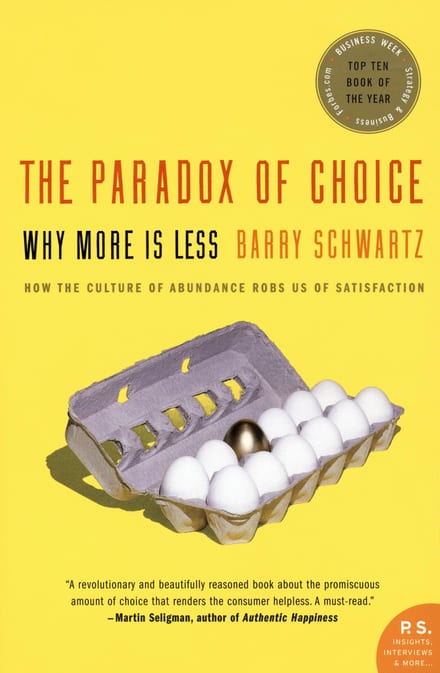
The Paradox of Choice: Why More Is Less
Why More Is Less
The full book runs ~269 pages — roughly 5 hours of reading. You get the key ideas here in 5 minutes.
The key ideas
- Remember the jam table: six varieties outsold twenty-four ten to one.
- Satisfice on purpose — chasing the best never lets the search close.
- Count the options you rejected; each one subtracts from what you chose.
- Make big decisions nonreversible — the escape hatch is what breeds regret.
- Fence off small decisions with rules, defaults and standards.
- List five things you're grateful for; gratitude is the direct lever.
The summary
Barry Schwartz walked into the Gap for a pair of jeans and got a question back: slim fit, easy fit, relaxed fit, baggy, or extra baggy? Stonewashed, acid-washed, or distressed? Button-fly or zipper? He carried one of each into the dressing room and finally picked easy fit, because “relaxed” sounded like an admission he was going soft in the middle. The jeans fit better than any he had owned. Buying them had also eaten most of a day and come with a side of dread. That gap — better result, worse experience — is the argument. Some choice is essential. More choice is not automatically better. Past a certain point, added options stop liberating you and start grinding you down.
The evidence that more options leave people worse off
Schwartz counted what one supermarket asked him to sort through: 285 varieties of cookies, 175 salad dressings, 275 cereals, 360 kinds of shampoo, conditioner, gel and mousse. A typical store carries more than 30,000 items. The economist’s reply is that if you don’t care, you can ignore the extras. The evidence says otherwise. At a gourmet food store, researchers set out a tasting table of exotic jams. When six were on display, 30 percent of the people who stopped bought a jar. When twenty-four were on display, 3 percent did. Students offered thirty essay topics for extra credit wrote fewer essays than students offered six — and worse ones.
Maximizers pay for their standards
The people who suffer most are the ones chasing the best. Schwartz calls them maximizers, and their problem is structural: to know a sweater is the best sweater you would have to see every sweater, so the search never really closes. A satisficer has standards too, often high ones, but stops when something meets them. Schwartz and his colleagues built a thirteen-item scale to tell them apart — Do you keep an eye out for a better job no matter how satisfied you are? — and gave it to several thousand people. Maximizers took longer to decide, compared more, regretted more, savored good events less, and took longer to recover from bad ones. They scored lower on happiness, optimism and satisfaction with life, and the most extreme scorers landed in the borderline clinical depression range. He calls this a correlation, not a cause. And nobody maximizes everywhere: he picked his phone plan the way he picked a toaster, then falls apart at a buffet.
Every option you turn down charges you rent
The alternatives you reject don’t vanish. Each carries an opportunity cost, and its attractive features get subtracted from whatever you chose. Trade-offs sharpen it. Offered a $99 Sony CD player on sale, 66 percent of people said they would buy it; add an equally attractive $169 Aiwa and only 27 percent took the Sony while 46 percent decided to keep looking. Conflict makes every option look worse, and enough of it makes people stop choosing.
Then the thing you chose stops feeling good
Regret needs responsibility. Ask who feels worse — the man who held a stock that underperformed, or the man who switched into it — and 92 percent name the switcher, because he acted. The more an outcome is yours, the more regret is on the table. Adaptation takes what regret leaves. People who had won between $50,000 and $1 million in state lotteries rated themselves no happier than people in general, and rated everyday pleasures lower than everyone else did. Pleasure decays into comfort, and comfort isn’t pleasure. Expectations ratchet up to match the options: in a small Oregon store with a dozen wines, Schwartz bought a mediocre bottle and was satisfied, because he hadn’t expected better. In a store with a thousand, it would have been a letdown.
Whose fault is it
Here the book stops being about shopping. American GDP more than doubled over thirty years while the share of people calling themselves very happy fell about 5 percent — roughly 14 million people. By some estimates depression was ten times as common in 2000 as in 1900. That should be impossible: Martin Seligman showed that helplessness breeds depression, and Americans have never had more control. Schwartz’s answer is that expectations of control ran ahead of control itself, and a culture this individualistic hands you the bill when perfection fails to arrive. With unlimited options, a disappointing result has nobody else to belong to. Depression among the Amish of Lancaster County — dense social ties, meager choices — runs under a fifth of the national rate.
The cure is giving choice away on purpose
Decide in advance which decisions deserve your attention, then fence off the rest with rules, defaults and standards — the second-order decisions Cass Sunstein and Edna Ullmann-Margalit describe. Satisfice on purpose rather than as a defeat. Make the big decisions nonreversible: in one study, people who could swap the photograph they’d chosen liked it less than people who couldn’t, and almost none of them swapped. Keep a notepad by the bed and list five things from yesterday you’re grateful for; gratitude is the one lever here you can pull directly. And learn to love constraints — Schwartz closes on a cartoon of a fish telling its offspring, “You can be anything you want to be — no limits.” Outside the bowl there really are no limits, and the fish would spend all its time staying alive.
The bottom line
Having enough choice and having more choice are different things; only the first is worth chasing. The way to feel better about your life isn’t to get better at picking; it’s to pick carefully in the few places that matter, accept good enough everywhere else, and stop auditing what you passed up. Read it if decisions wear you out, or if you’ve noticed you can never quite enjoy the thing you finally chose.
Fact check
Popular books repeat findings that later research has complicated. Where The Paradox of Choice makes a testable claim, here's what the evidence actually shows.
Past a handful of options, adding more makes people less likely to choose at all and less satisfied with what they pick — the six-versus-twenty-four jam display is the demonstration.
The original field study is real and well known: 30% of shoppers who stopped at the six-jam tasting table bought a jar, against 3% at the twenty-four-jam table (coded d = 0.77, N = 249). It has not held up as a general law. A direct replication in a German supermarket found no effect at all (d = 0.02, N = 504), and a meta-analysis of 63 conditions from 50 published and unpublished experiments (N = 5,036) put the average choice-overload effect at d = 0.02, 95% CI -0.09 to 0.12. A second meta-analysis of 99 observations (N = 7,202) recovered a reliable effect once moderators were modelled: too much choice bites when the assortment is complex, the task is hard, or the chooser has no settled preference, and reverses to more-is-better when those conditions are absent.
- Iyengar SS, Lepper MR. When choice is demotivating: can one desire too much of a good thing? J Pers Soc Psychol. 2000;79(6):995-1006. PubMed
- Scheibehenne B, Greifeneder R, Todd PM. Can there ever be too many options? A meta-analytic review of choice overload. J Consum Res. 2010;37(3):409-425. Source
- Chernev A, Böckenholt U, Goodman J. Choice overload: a conceptual review and meta-analysis. J Consum Psychol. 2015;25(2):333-358. Source
People who score high on the maximizing scale are measurably less happy, more regretful and more depressed than satisficers.
The correlations are real but modest, and Schwartz says plainly they are correlations. Across seven samples (combined n = 1,747), maximizing scores correlated r = .34 with Beck Depression Inventory scores, r = -.25 with subjective happiness and r = .52 with regret. What is contested is the scale. A later study measuring maximizing with a purpose-built nine-item scale aimed squarely at pursuit of the best option found no relationship with life satisfaction, neuroticism, indecisiveness or avoidance, leaving only a correlation with regret (r = .27), while the original thirteen-item scale reproduced the whole cluster (life satisfaction r = -.24, indecisiveness r = .30). The reading those authors take is that a good share of maximizer unhappiness tracks difficulty deciding rather than high standards.
- Schwartz B, Ward A, Monterosso J, Lyubomirsky S, White K, Lehman DR. Maximizing versus satisficing: happiness is a matter of choice. J Pers Soc Psychol. 2002;83(5):1178-97. PubMed
- Diab DL, Gillespie MA, Highhouse S. Are maximizers really unhappy? The measurement of maximizing tendency. Judgm Decis Mak. 2008;3(5):364-370. Source
Affluence rose steeply over the twentieth century without happiness following, and depression became roughly ten times as common as it was in 1900.
The first half holds. Over spans of ten years or more, growth in a country's income shows no relationship with average happiness — a pattern that now covers developed countries, developing countries and the post-socialist transition economies. The tenfold depression figure is the weaker half. It comes from cross-sectional surveys that ask people to recall a lifetime of episodes, and a simulation showed that small, constant annual rates of forgetting, of a size already documented in test-retest studies, reproduce exactly the pattern of younger cohorts looking more depressed with no real change underneath. Where prevalence is measured consistently rather than recalled, it is flat: a Bayesian meta-regression of global data put major depressive disorder at 4.4% in 1990 and 4.4% in 2010, with the rising case count explained by population growth.
- Easterlin RA, McVey LA, Switek M, Sawangfa O, Zweig JS. The happiness-income paradox revisited. Proc Natl Acad Sci U S A. 2010;107(52):22463-8. PubMed
- Giuffra LA, Risch N. Diminished recall and the cohort effect of major depression: a simulation study. Psychol Med. 1994;24(2):375-83. PubMed
- Baxter AJ, Scott KM, Ferrari AJ, Norman RE, Vos T, Whiteford HA. Challenging the myth of an "epidemic" of common mental disorders: trends in the global prevalence of anxiety and depression between 1990 and 2010. Depress Anxiety. 2014;31(6):506-16. PubMed
Adaptation cancels out good fortune, so big lottery winners end up no happier than everyone else.
The study behind it is small: 22 major winners rated themselves no happier than 22 controls and took significantly less pleasure in mundane events. A pre-registered survey of Swedish lottery players 5 to 22 years after their draw tells a different story on the broader measure — large-prize winners reported sustained gains in overall life satisfaction relative to matched controls, with no sign of the effect fading over more than a decade, and financial life satisfaction carrying most of it. The book's version survives on the narrower measure: estimated effects on happiness and mental health were much smaller, so adaptation does seem to eat the emotional gain even where it leaves the evaluative one standing.
- Brickman P, Coates D, Janoff-Bulman R. Lottery winners and accident victims: is happiness relative? J Pers Soc Psychol. 1978;36(8):917-27. PubMed
- Lindqvist E, Östling R, Cesarini D. Long-run effects of lottery wealth on psychological well-being. NBER Working Paper No. 24667; published in Rev Econ Stud. 2020;87(6):2703-2726. Source
Frequently asked questions
What is The Paradox of Choice about?
Barry Schwartz argues that some choice is essential but more choice is not automatically better. Past a certain point, extra options stop liberating you and start grinding you down — decisions take longer, and you enjoy the result less. His own trip to the Gap for jeans is the opening example: a better fit, bought at the cost of most of a day and a side of dread.
What are the key takeaways from The Paradox of Choice?
Four ideas carry the book. The evidence: at a tasting table, 30 percent of shoppers bought a jar when six jams were on display, and only 3 percent when twenty-four were. The personality split: maximizers, who need to know they got the best, decide slower, regret more, and score lower on happiness than satisficers, who stop when something meets their standards. The mechanism: every option you reject charges you an opportunity cost, and adaptation then erodes whatever pleasure the winner gave you. The fix: hand choice away on purpose — rules, defaults and standards for the small decisions, nonreversible commitments for the big ones, and a nightly list of five things you're grateful for.
Who should read The Paradox of Choice?
Read it if decisions wear you out, or if you've noticed you can never quite enjoy the thing you finally chose. It also speaks to anyone puzzled by why rising affluence and control haven't made people happier.
Is The Paradox of Choice worth reading?
Yes, if you want the research behind a feeling you already have — the jam study, the maximizer scale, the Sony and Aiwa CD players, the lottery winners who ended up no happier than anyone else. Schwartz is careful with his own claims, calling the maximizer–depression link a correlation rather than a cause. Skip it if you only want the tactics; the practical advice is concentrated in the final chapter, and the rest is the case for taking it seriously.