Book summary
Outwitting the Devil: The Secret to Freedom and Success
The Secret to Freedom and Success
The full book runs ~288 pages — roughly 5 hours of reading. You get the key ideas here in 5 minutes.
The key ideas
- Drifting means reacting to life instead of directing it
- Hill's hypnotic rhythm: repetition hardens a habit past consent
- Fear of poverty, criticism, and death keeps people trapped
- Seven principles start with definiteness of purpose and self-mastery
- Devil interview is Hill's argument in costume, not theology
- Hill's Carnegie origin story has no supporting historical record
The summary
Hill’s explanation for why most people never get anywhere isn’t bad luck or thin talent. It’s drifting: moving through life reacting, taking whatever arrives, never deciding what you want. Rather than argue that in his own voice, he stages it as an interrogation — an interview in which he claims to have broken what the jacket copy calls the Devil’s Code, forcing a confession about how the Devil keeps hold of people who drift. Be clear what kind of object this is: not reportage and not a treatise, but a dialogue with an invented interlocutor whose answers are Hill’s own arguments in costume.
The Devil is a mouthpiece, not a theology
The interviewee is vain and talkative. In its 2011 review, Publishers Weekly notes that he wants to be addressed as “Your Majesty” and claims to control 98% of all people, while conceding that his opponent holds the positive forces — love, faith, hope, optimism. Asked about churches, he answers: “Do you think I am a fool? Who would keep alive the fear of the Devil if I subdued the churches?”
That line shows what the device is for. Read as demonology it’s odd; read as rhetoric it’s efficient. Hill gets to make claims about institutions, fear and habit that would land differently over his own byline, plus a villain who narrates his own methods. The cost is plain: a confession you wrote yourself confesses exactly what you need it to.
Drifting, and the rhythm Hill says locks it in
Sharon Lechter, who annotated the published edition, describes the drifter as someone who reacts to life as it comes — no plan, no focus of their own, easily swayed because other people’s opinions fill the space where a purpose should be. On her account of the book, that covers 98% of people; the other 2% consciously direct their own thinking.
His mechanism for how drifting hardens is what he calls hypnotic rhythm: repeat a pattern long enough and it stops needing your consent. The Foundation’s unedited edition, published by Sound Wisdom, promises “a natural law as significant as the law of gravity”. Treat that as Hill’s framing rather than a finding — a 1938 metaphor for habit, not a law anyone has demonstrated. The six fears he blames for keeping people stuck (poverty, criticism, ill health, loss of love, old age, death) are the same six he had already laid out in Think and Grow Rich.
Against drifting he sets seven principles, which Lechter summarizes as:
- Definiteness of purpose — a mission specific enough to check today’s actions against
- Mastery over self — self-discipline, holding yourself to what you said you’d do
- Learning from adversity — on Hill’s premise that every setback carries an equivalent advantage
- Controlling environmental influence — choosing the people and inputs that shape how you think
- Time — the multiplier that hardens whichever habits you feed
- Harmony — keeping the mental, physical and spiritual sides of your life aligned
- Caution — thinking before acting, so the action is one you chose deliberately
Strip the cosmology and a plain argument about attention and repetition is left: decide what you’re for, guard what reaches your head, and expect whatever you do daily to get easier to keep doing.
Who decided what you’re reading
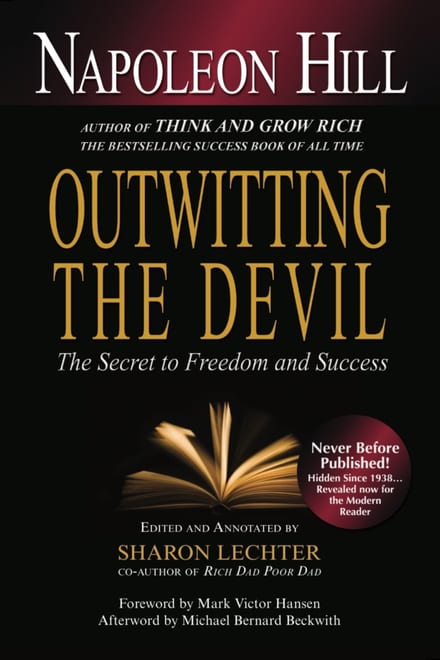
Hill wrote the manuscript in 1938, the year after Think and Grow Rich, and it sat unpublished for 73 years. Publishers Weekly reports that Hill’s wife feared how organized religion would react to a book consisting of an interview with the Devil, and that the state of the world in the late 1930s weighed on the decision; the Napoleon Hill Foundation says more broadly that his family and friends considered it too controversial. Lechter says the Foundation approached her to annotate it for a modern audience more than 70 years after Hill wrote it, and Sterling published that version in June 2011 — 288 pages, with a foreword by Mark Victor Hansen and an afterword by Michael Bernard Beckwith.
In 2020 the Foundation published the manuscript again through Sound Wisdom, billed as the complete text reproduced from Hill’s original manuscript including never-before-published content, running 320 pages. That second edition is a useful fact about the first: the widely read 2011 book is edited and annotated, not all of what Hill typed. If you want his version without a modern editor in the margins, the 2020 one is the edition to buy.
The book’s own opening is its shakiest passage
Outwitting the Devil opens, per that same Publishers Weekly review, with Hill’s account of being commissioned by Andrew Carnegie to interview leading businessmen and distill a philosophy of achievement. That origin story carries his authority, and it does not survive scrutiny.
Journalist Matt Novak, working through newspaper archives and court records, reported that Hill only began telling the Carnegie story long after Carnegie died in 1919. Carnegie’s biographer David Nasaw told him he “found no evidence of any sort that Carnegie and Hill ever met”, and, asked whether the book Hill produced from those alleged conversations could be authentic, replied: “I found no evidence that the book was authentic.” Even Hill’s official 1995 biography concedes that the Carnegie book used “a somewhat contrived conversational format featuring Hill and Andrew Carnegie.” Novak also documents what Hill was doing in 1908, the year of the supposed meeting: divorce proceedings, a May arrest for altering checks that ended in acquittal, and a lumber-credit fraud that had him fleeing his Mobile, Alabama office that September. Mitch Horowitz, who edits editions of Hill’s books and says he is agnostic on whether the meeting happened, arrives at the same record independently: Carnegie left no mention of Hill in his own writings, and no Carnegie interview by Hill ever ran in the magazine Hill was writing for that year. Novak reports that Hill’s personal archive, held by the Foundation, remains off limits to journalists and the public.
The bottom line
The argument holds up better than the narrator does. Naming a purpose, guarding your inputs and interrupting habits that run without you is sound enough advice, and the interview format makes it stick where a plain essay wouldn’t — but as testimony about how the world works it rests on the word of a man whose central claim about himself has no supporting record. Read it for the strangest object in the self-help canon, if you can keep the frame and the facts apart.
Fact check
Popular books repeat findings that later research has complicated. Where Outwitting the Devil makes a testable claim, here's what the evidence actually shows.
The origin story the book opens with is true: Andrew Carnegie commissioned Hill in 1908 to interview leading businessmen and build a philosophy of achievement from what they told him.
No contemporary record supports the meeting. Carnegie's biographer David Nasaw, asked directly, said he "found no evidence of any sort that Carnegie and Hill ever met", and Carnegie left no mention of Hill anywhere in his own writings. Hill did not begin telling the story until roughly a decade after Carnegie died in 1919, and Hill's own official 1995 biography grants that the book built from those alleged conversations used "a somewhat contrived conversational format". Mitch Horowitz, who edits editions of Hill's books and calls himself agnostic on whether the meeting happened, records the same gaps in the record.
The Outwitting the Devil you can buy is Hill's 1938 manuscript, published as he wrote it.
The manuscript is genuinely Hill's, but the edition that made the book famous is not all of it. Publishers Weekly reviewed the Sterling hardcover in April 2011 at 288 pages, annotated and edited by Sharon Lechter for a contemporary audience. The Napoleon Hill Foundation later reissued the same manuscript through Sound Wisdom as the complete text reproduced from Hill's original, including never-before-published content; the Library of Congress catalogues that edition as Sound Wisdom, 2020. A reader who wants the unedited typescript needs the second one.
- Outwitting the Devil: The Secret to Freedom and Success. Publishers Weekly review, April 25, 2011. Sterling, 288p, ISBN 978-1-4027-8453-8. Source
- Outwitting the Devil: The Complete Text, Reproduced from Napoleon Hill's Original Manuscript, Including Never-Before Published Content. The Napoleon Hill Foundation. Source
- Outwitting the devil / Napoleon Hill. Shippensburg: Sound Wisdom, 2020. Library of Congress catalog record, LCCN 2020938348, ISBN 9781640951815. Source
Repeat a pattern long enough and what Hill calls hypnotic rhythm locks it in — a natural law as fixed as gravity, which makes a drifting life effectively permanent.
Repetition does automate behaviour, but not on a fixed schedule and not beyond reach. In a field study of people adding a single new daily behaviour, automaticity plateaued on average around 66 days after the first performance, with considerable variation across participants and behaviours — an average, not a threshold. Habit researchers describe habits as context-cued defaults that run alongside deliberate goal pursuit rather than overriding it, which is why interventions that change the cue or the setting can undo them.
Frequently asked questions
What is Outwitting the Devil about?
Napoleon Hill's explanation for why most people never get anywhere is drifting: moving through life reacting, taking whatever arrives, never deciding what you want. He stages that argument as an interview in which the Devil confesses how he keeps hold of people who drift. The interlocutor is invented, and his answers are Hill's own arguments in costume rather than reportage or theology.
What are the key takeaways from Outwitting the Devil?
Drifting means having no plan of your own, so other people's opinions fill the space where a purpose should be; on the book's count that describes 98% of people, with the other 2% consciously directing their own thinking. Hypnotic rhythm is Hill's mechanism for how drifting sets: repeat a pattern long enough and it stops needing your consent. It is billed as a natural law, but treat it as a 1938 metaphor for habit rather than something anyone has demonstrated. He blames six fears for keeping people stuck, the same six he had already laid out in Think and Grow Rich, and against drifting he sets seven principles: definiteness of purpose, mastery over self, learning from adversity, controlling environmental influence, time, harmony, and caution.
Who should read Outwitting the Devil?
Readers who already know the self-help canon and want its strangest object, and who can keep Hill's frame and Hill's facts apart.
Is Outwitting the Devil worth reading?
Strip the cosmology and the plain argument underneath is sound enough, that you should decide what you are for, guard what reaches your head, and expect whatever you do daily to get easier to keep doing, and the interview format makes it stick where an essay would not. As testimony about how the world works it is much shakier: the book opens with Hill being commissioned by Andrew Carnegie, and Carnegie's biographer David Nasaw found no evidence of any sort that the two ever met. Skip it if you need the narrator to be reliable, and if you do read it, note that the popular 2011 edition is edited and annotated while the Foundation's 2020 edition prints the fuller manuscript.