Book summary
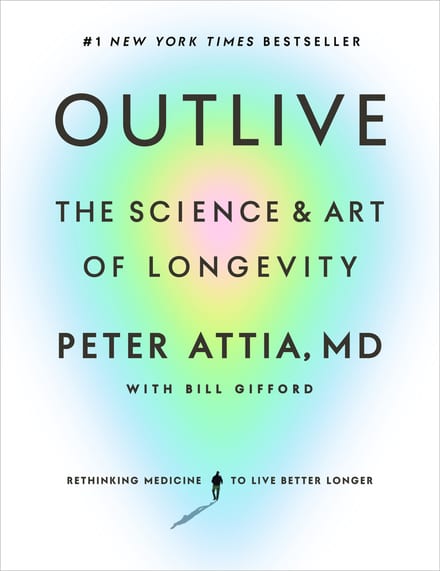
Outlive: The Science and Art of Longevity
The full book runs ~448 pages — roughly 8 hours of reading. You get the key ideas here in 3 minutes.
The key ideas
- Train for the body you'll need at ninety
- Build three fitness dimensions: endurance, strength, and stability
- Combine Zone 2 cardio with high-intensity VO2 max intervals
- Eat one gram of protein per pound; prioritize omega-3 fats
- Sleep seven-plus hours or raise your death risk
- Guard emotional health, or extra years aren't worth living
The summary
Most people picture longevity as adding a few years at the end. Peter Attia flips that: the goal isn’t to avoid death so much as to avoid spending your last decades unable to climb stairs, carry groceries, or get down on the floor to play with your grandchildren. He calls the difference healthspan versus lifespan, and the single most powerful lever on it is what you do right now — above all, how you train your body for the demands of being ninety.
Train for the body you’ll need at ninety
No intervention we have rivals exercise. Going from doing nothing to just ninety minutes of movement a week cuts your mortality risk by 14%, and beyond that it strengthens the heart, improves circulation, slows cognitive decline, delays chronic disease, and sharpens memory. Attia’s frame is to become an “athlete of life”: name ten physical tasks you want to still manage at a hundred — climbing stairs, lifting a suitcase, hiking with family — and start training for them today.
That means building three dimensions of fitness. Aerobic work comes in two flavors: Zone 2 cardio, sustained effort at 60–70% of your maximum heart rate — a brisk half-hour walk where you can still hold a conversation — which builds endurance and wards off chronic disease; and VO2 max intervals, high-intensity bursts that push your body’s oxygen use to its ceiling and track closely with a long life. Do both. Strength comes from heavy resistance training, lifting weights around four times a week, to preserve muscle mass and bone density; grip strength in particular signals overall strength and is inversely linked to dementia, so farmer’s carries, dead hangs, and pulling movements earn their place. The third dimension, stability, is the one people skip and later regret. Balance and mobility work a couple of times a week is what keeps an eighty-year-old from a fall that breaks a hip.
Eat for abundance you weren’t built for
Human bodies spent millennia adapting to scarcity; the modern problem is the reverse. Overnourishment shows up in the numbers — the average American man weighed about 173 pounds in the late 1970s and now sits near 200 — and the Standard American Diet of sugar, refined carbs, and processed oils drives it. The fix isn’t a single miracle plan but a sustainable way to eat less while protecting muscle, whether through counting calories, cutting certain foods, or time-restricted eating. Whatever route you choose, keep protein high: aim for at least a gram per pound of body weight to hold onto muscle, and lean on animal proteins, which are more effective and more filling than plant sources. Fats should be a mix weighted toward omega-3s for the brain and heart — extra virgin olive oil, avocados, nuts — while butter, lard, and high-omega-6 oils like corn and soybean are worth avoiding. Dietary cholesterol, it turns out, isn’t the villain it was made out to be; there’s no real link between the cholesterol you eat and the cholesterol in your blood. What you should actually monitor is Apo B, a blood test that gauges your risk for cardiovascular disease, the leading cause of death. Two blunt verdicts round it out: no amount of alcohol is healthy, and a smoker is 40% more likely to die at any given moment than a non-smoker — so cutting calories and quitting cigarettes are the low-hanging fruit of cancer prevention.
Treat sleep as medicine
Skimping on sleep quietly raises your risk of heart disease, diabetes, accidents, and early death. People who sleep under seven hours a night carry a 12% higher risk of dying prematurely, and a fifth of car crashes trace back to sleep deprivation — Attia nearly died in one himself. Good sleep does the opposite work, improving mental and physical performance, memory, and metabolism. The tools are unglamorous: cut screens and blue light before bed, keep the room dark and cool around 65°F, go easy on caffeine and alcohol, build a routine, and remember that caffeine lingers with a half-life of up to six hours. Prescription sedatives like Ambien and Valium are a false friend — they actually degrade sleep quality.
Protect the reason to live longer
Attia asks a question that reframes the whole project: “Why do you want to live longer if you’re so unhappy?” Emotional health isn’t a soft add-on; it shapes physical health and decides whether the extra years are worth having. Catch problems early and get professional help for depression or trauma rather than letting them fester into addiction, damaged attachments, or a hunger for external validation. He points to dialectical behavior therapy, a mindfulness-based approach, as a proven way to regulate emotion and build resilience, and to daily practices like meditation for the long haul. And he offers some perspective: losing your car keys doesn’t mean Alzheimer’s is coming, just that you’re busy and distracted. You get old, he suggests, when you stop thinking about the future.
The bottom line
How you train, eat, and sleep in your thirties, forties, and fifties largely decides whether your final decades are active or helpless — so train now for the body you’ll need at ninety, eat enough protein, sleep seriously, and don’t neglect your mind. Read this if you want to add life to your years, not just years to your life.
Fact check
Popular books repeat findings that later research has complicated. Where Outlive makes a testable claim, here's what the evidence actually shows.
Going from no exercise at all to about ninety minutes of movement a week cuts your risk of dying by 14%.
The number traces to a real study and is quoted accurately. A Taiwanese cohort of 416,175 adults followed for an average of eight years found that people doing 15 minutes a day of moderate activity — about 92 minutes a week — had 14% lower all-cause mortality than the inactive group, and lived about three years longer. Each additional 15 minutes a day cut mortality risk by a further 4%, and the benefit held across age, sex, and people with cardiovascular risk factors. It is observational, so some of the gap reflects healthier people being able to exercise rather than exercise alone, but the size and consistency of the effect are among the better-supported findings in the book.
- Wen CP, Wai JP, Tsai MK, et al. Minimum amount of physical activity for reduced mortality and extended life expectancy: a prospective cohort study. Lancet. 2011;378(9798):1244-1253. PubMed
Eat at least one gram of protein per pound of body weight, and favor animal protein because it builds muscle more effectively than plant protein.
One gram per pound is roughly 2.2 g/kg — well past the point where more protein does anything. A meta-analysis of 49 trials in 1,863 people found gains in fat-free mass stopped increasing beyond a total intake of 1.62 g/kg/day, about 0.73 g per pound, and that ceiling is measured in people actively resistance training. The animal-versus-plant gap is smaller than the book suggests: a meta-analysis of randomized trials found protein source made no difference to absolute lean mass or muscle strength, with a modest edge for animal protein on relative lean mass and a 0.41 kg advantage confined to adults under 50. Higher protein is not harmful for healthy people, but the extra gram per pound buys less than the target implies.
- Morton RW, Murphy KT, McKellar SR, et al. A systematic review, meta-analysis and meta-regression of the effect of protein supplementation on resistance training-induced gains in muscle mass and strength in healthy adults. Br J Sports Med. 2018;52(6):376-384. PubMed
- Lim MT, Pan BJ, Toh DWK, Sutanto CN, Kim JE. Animal Protein versus Plant Protein in Supporting Lean Mass and Muscle Strength: A Systematic Review and Meta-Analysis of Randomized Controlled Trials. Nutrients. 2021;13(2):661. PubMed
There is no real link between the cholesterol you eat and the cholesterol in your blood.
There is a link; it is just small. A meta-regression of 55 randomized feeding trials in 2,652 people found that each extra 100 mg of dietary cholesterol per day raised LDL cholesterol by 1.9 to 4.6 mg/dL depending on the model, with the effect flattening at higher intakes. The book is right that dietary cholesterol matters far less than saturated fat or genetics, and a separate systematic review found the evidence tying dietary cholesterol to actual cardiovascular events too inconsistent to support a firm conclusion either way. "No real link" overshoots what is a real but modest effect on blood lipids.
- Vincent MJ, Allen B, Palacios OM, Haber LT, Maki KC. Meta-regression analysis of the effects of dietary cholesterol intake on LDL and HDL cholesterol. Am J Clin Nutr. 2019;109(1):7-16. PubMed
- Berger S, Raman G, Vishwanathan R, Jacques PF, Johnson EJ. Dietary cholesterol and cardiovascular disease: a systematic review and meta-analysis. Am J Clin Nutr. 2015;102(2):276-294. PubMed
Sleeping under seven hours a night raises your risk of dying early by 12%, and a fifth of car crashes trace back to sleep deprivation.
The 12% is quoted correctly: a meta-analysis of 16 studies covering 1.3 million people and 112,566 deaths put the relative risk of death at 1.12 for short sleepers. Two things complicate it. The same analysis found long sleep carried a larger risk (1.30), which points to illness driving sleep duration as much as the reverse — these are observational data, not a demonstration that adding hours adds years. The crash figure applies to a narrower category than the summary suggests: naturalistic-video analysis estimated drowsy drivers in 21% of crashes where someone was killed, but only about 6% of all crashes serious enough to tow a vehicle, against official government statistics of 1-3%.
- Cappuccio FP, D'Elia L, Strazzullo P, Miller MA. Sleep duration and all-cause mortality: a systematic review and meta-analysis of prospective studies. Sleep. 2010;33(5):585-592. PubMed
- Tefft BC. Prevalence of Motor Vehicle Crashes Involving Drowsy Drivers, United States, 2009-2013. Washington, DC: AAA Foundation for Traffic Safety; 2014. Source
Frequently asked questions
What is Outlive about?
It reframes longevity around healthspan rather than lifespan: the goal isn't just to avoid death but to avoid spending your last decades unable to climb stairs, carry groceries, or get on the floor with your grandchildren. Attia's core point is that how you train, eat, and sleep in your thirties, forties, and fifties largely decides whether your final decades are active or helpless, so you should train now for the body you'll need at ninety.
What are the key takeaways from Outlive?
Exercise is the most powerful lever, built across three dimensions: Zone 2 cardio for endurance, VO2 max intervals that track closely with a long life, heavy strength training about four times a week to hold muscle and bone, and stability work to prevent the fall that breaks a hip. Eat to protect muscle by keeping protein high, aiming for at least a gram per pound, weighting fats toward omega-3s, and monitoring Apo B for cardiovascular risk. Treat sleep as medicine, since under seven hours a night raises the risk of dying prematurely. And protect emotional health, because it decides whether the extra years are worth having.
Who should read Outlive?
Read this if you want to add life to your years, not just years to your life, and you're willing to act on it while you're still healthy.
Is Outlive worth reading?
Yes for anyone who wants a concrete, science-based plan for aging well rather than vague wellness advice, since it names specific targets across exercise, nutrition, sleep, and mental health. Its emphasis is prevention decades ahead, so a reader looking for a quick fix or a single miracle diet will be disappointed, and the detail on things like Apo B and heart-rate zones is more than a casual reader may want.