Book summary
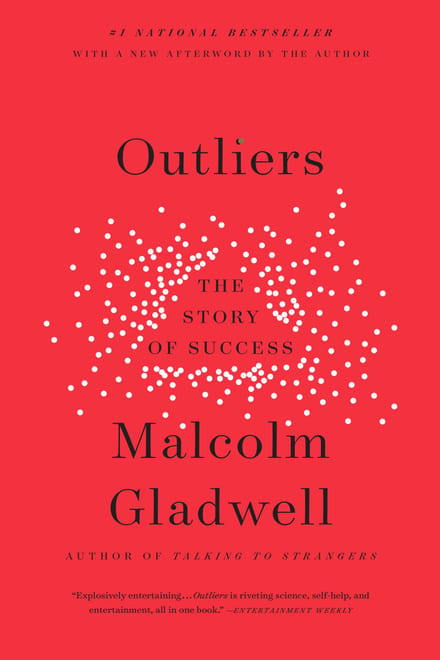
Outliers: The Story of Success
The full book runs ~320 pages — roughly 6 hours of reading. You get the key ideas here in 3 minutes.
The key ideas
- Master any field with 10,000 hours—but those hours require rare access
- Birth dates and arbitrary cutoffs snowball into massive outcome gaps
- Practical intelligence, not raw IQ, turns talent into opportunity
- Culture shapes your work ethic and willingness to persist
- Redesign systems so talent stops going to waste
The summary
We love the story of the self-made success — the person who rose on raw talent and grit alone. Malcolm Gladwell’s argument is that this story is mostly a flattering fiction. Politicians like Jeb Bush trade on “self-made man” imagery despite starting from enormous privilege, and genuine self-made outliers are statistically rare. Once you clear a basic threshold of ability, what actually separates the great from the merely good isn’t more talent. It’s accumulated advantage: the timing of your birth, the culture you inherit, and the rare chance to log thousands of hours of practice.
Ability is the foundation, but past a certain point it stops predicting much. A towering IQ won’t win you a Nobel Prize; beyond a threshold, social skills, connections, and luck do more of the deciding. That’s the uncomfortable premise beneath every success story we tell.
Ten thousand hours is also a privilege
World-class mastery of almost anything takes roughly 10,000 hours of practice. That part is well known. What Gladwell adds is that getting the chance to log those hours is itself a privilege. You need early exposure, access to the right resources and equipment, and support from family and friends — a combination most people never get. Bill Gates was one of the few who did, landing at the very birth of personal computing with the access and backing to practice relentlessly while almost everyone else was shut out.
Timing compounds the effect. Being born in the right place at the right moment can matter as much as any personal quality. Gates, Steve Jobs, and a striking number of other software tycoons were born between 1954 and 1956 — old enough to seize the personal-computer revolution when it arrived, young enough to have nothing holding them back. Ambition and intelligence were necessary, but the window they walked through opened only briefly.
Your birthday can be luck or bad luck
The clearest illustration comes from Canadian youth hockey, where the age-group cutoff falls on January 1. A boy born in January competes against teammates born as late as December, nearly a year younger — and at that age, a year is enormous. Coaches read the bigger, more coordinated January kids as more talented and give them the elite teams, better coaching, and more ice time. The early edge snowballs, which is why the NHL is crowded with players born in January, February, and March.
This cumulative advantage runs well beyond sports. In school, a six-year-old grouped with seven-year-olds can be discouraged early, and that lost confidence trails her for years. Small, often arbitrary head starts harden into permanent gaps.
Practical intelligence beats raw IQ
Past a certain level of skill, what matters most isn’t natural ability but practical intelligence — knowing how to read a situation, deal with authority, and make things work in your favor. And this, too, is unevenly distributed. Wealthier parents tend to cultivate it, teaching their children to speak up, negotiate, and expect to be accommodated, while filling their days with enriching activities. Poorer parents are less likely to pass on those unwritten rules. The children may be equally bright, but without the social toolkit to turn intelligence into opportunity, they face a much steeper climb.
Culture shapes how hard you’ll push
Your cultural inheritance shapes achievement in ways that are easy to miss. There’s real substance behind the stereotype that Asian students excel at math: in many Asian languages, the number system is built so that math skills develop earlier, and centuries of rice farming — far more demanding than Western crops — left a legacy of persistence. Studies find that students in Eastern countries stay with a hard math problem much longer than Western students before giving up. The advantage isn’t in the genes; it’s in the culture of effort.
Culture can also be dangerous. Korean Air once suffered an abnormally high crash rate, traced in part to a strong cultural deference to authority that made first officers reluctant to challenge a captain, even mid-emergency. Once the airline addressed that communication pattern, its crash rate returned to normal — proof that a cultural legacy can be recognized and rewired.
The bottom line
Success looks like a personal triumph, but it rests on a scaffold of timing, opportunity, and cultural advantage most winners never had to earn. The hopeful flip side is that these are systems we can redesign — narrower age brackets, programs for low-income kids, teaching practical intelligence — so that far less talent goes to waste. Read this if you want to see past the myth of pure meritocracy.
Fact check
Popular books repeat findings that later research has complicated. Where Outliers makes a testable claim, here's what the evidence actually shows.
World-class mastery of almost any field takes roughly 10,000 hours of practice.
Practice matters a great deal, but the evidence points to no threshold at 10,000 hours or anywhere else. A meta-analysis of 88 studies found deliberate practice accounted for 26% of the variance in performance in games, 21% in music, 18% in sports, 4% in education and under 1% in professions. A 2019 double-blind replication of the violinist study the rule was drawn from failed to reproduce its central result: accumulated practice did not line up with skill level the way the original reported, and the effect was considerably smaller.
- Macnamara BN, Hambrick DZ, Oswald FL. Deliberate practice and performance in music, games, sports, education, and professions: a meta-analysis. Psychol Sci. 2014;25(8):1608-1618. PubMed
- Macnamara BN, Maitra M. The role of deliberate practice in expert performance: revisiting Ericsson, Krampe & Tesch-Römer (1993). R Soc Open Sci. 2019;6(8):190327. PubMed
Because youth hockey groups players by a January 1 cutoff, the relatively older boys get funnelled into elite development, and the advantage snowballs until the NHL is crowded with players born in January, February and March.
The selection bias is real and well documented: a meta-analysis of 38 studies covering 253 samples, 14 sports and 16 countries confirms relative age effects, strongest among adolescent boys competing at regional and national level, though the overall effect size is small. Across NHL drafts from 1980 to 2006, players born in the third and fourth quarters were picked more than 40 slots later than their later productivity warranted, and were about twice as likely to reach benchmarks like 400 games played. What does not hold is the snowball: among NHL players from 2008 to 2016 the pattern reverses, with late-born players outscoring and outearning early-born ones — roughly nine more points a season and about 51% higher salaries at the top of the scoring distribution.
- Cobley S, Baker J, Wattie N, McKenna J. Annual age-grouping and athlete development: a meta-analytical review of relative age effects in sport. Sports Med. 2009;39(3):235-256. PubMed
- Deaner RO, Lowen A, Cobley S. Born at the wrong time: selection bias in the NHL draft. PLoS One. 2013;8(2):e57753. PubMed
- Fumarco L, Gibbs BG, Jarvis JA, Rossi G. The relative age effect reversal among the National Hockey League elite. PLoS One. 2017;12(8):e0182827. PubMed
Past a threshold level of intelligence, extra IQ stops predicting achievement and social skills, connections and luck take over.
Four longitudinal cohort studies covering 48,558 people in the US and UK found no such threshold: ability measured in youth kept predicting occupational, educational, health and social outcomes across the whole range, and nonlinear terms added a mean of only 0.001 to R-squared. Ability differences still discriminate inside the extreme upper tail — a follow-up of 320 people identified before age 13 in the top 1 in 10,000 found their ability profiles forecast who later reached tenure, patents and senior leadership by age 38. The returns do flatten as ability rises, and the book is right that ability alone does not decide outcomes, but there is no point above which it stops mattering.
- Brown MI, Wai J, Chabris CF. Can you ever be too smart for your own good? Comparing linear and nonlinear effects of cognitive ability on life outcomes. Perspect Psychol Sci. 2021;16(6):1337-1359. PubMed
- Kell HJ, Lubinski D, Benbow CP. Who rises to the top? Early indicators. Psychol Sci. 2013;24(5):648-659. PubMed
Korean Air's unusually high crash rate came in large part from a cultural deference to authority that kept first officers from challenging captains, and the record normalised once that communication pattern was addressed.
The cockpit breakdown itself is documented: the NTSB's probable cause for the 1997 Guam crash names the captain's failure to brief and execute the approach together with the first officer's and flight engineer's failure to monitor and cross-check him. But the contributing factors the NTSB identified were the captain's fatigue and Korean Air's inadequate crew training, not national culture. Cross-country analysis does find power distance associated with more accidents after controlling for GDP, flight volume and weather, while a 2025 systematic review of 35 studies cautions that this work sits almost entirely at the population level and has yet to identify the behavioural markers that would link a cultural dimension to a particular crash.
- National Transportation Safety Board. Controlled Flight Into Terrain, Korean Air Flight 801, Boeing 747-300, HL7468, Nimitz Hill, Guam, August 6, 1997. Aircraft Accident Report NTSB/AAR-00/01. Washington, DC: National Transportation Safety Board; 2000. Source
- Enomoto CE, Geisler KR. Culture and plane crashes: a cross-country test of the Gladwell hypothesis. Econ Sociol. 2017;10(3):281-293. Source
- Pratama GB, Caponecchia C. Examining the influence of national culture on aviation safety: a systematic review. J Safety Res. 2025;92:317-330. PubMed
Frequently asked questions
What is Outliers about?
It takes apart the flattering story of the self-made success who rose on raw talent and grit alone. Gladwell's argument is that once you clear a basic threshold of ability, what separates the great from the merely good isn't more talent but accumulated advantage: the timing of your birth, the culture you inherit, and the rare chance to log thousands of hours of practice. Success looks like a personal triumph but rests on a scaffold most winners never had to earn.
What are the key takeaways from Outliers?
World-class mastery takes roughly 10,000 hours of practice, but getting the chance to log them is itself a privilege of exposure, resources, and support, which is how Bill Gates landed at the birth of personal computing. Timing compounds it: a striking number of software tycoons were born between 1954 and 1956. The relative-age effect shows up in Canadian hockey, where players born just after the January cutoff get read as more talented and the edge snowballs. Practical intelligence, knowing how to read a situation and deal with authority, is unevenly taught by wealthier parents. And culture shapes effort, from math built into Asian number systems to Korean Air rewiring a deference that once raised its crash rate.
Who should read Outliers?
Read this if you want to see past the myth of pure meritocracy and understand the timing, opportunity, and cultural advantage hiding behind success stories.
Is Outliers worth reading?
Yes if you enjoy a strong, story-driven argument that reframes how you read achievement, and its hopeful flip side is that these are systems we can redesign so less talent goes to waste. Because it leans on vivid case studies to make its point, a reader who wants rigorous statistical proof rather than persuasive examples, or who already accepts that luck and timing matter, may find it more provocation than revelation.