Book summary
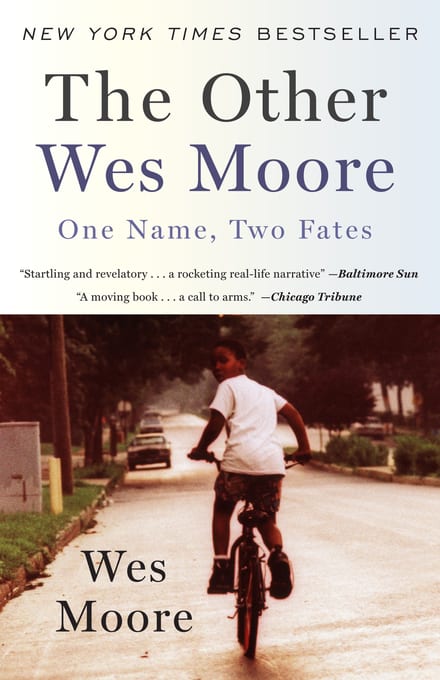
The Other Wes Moore: One Name, Two Fates
One Name, Two Fates
The full book runs ~272 pages — roughly 5 hours of reading. You get the key ideas here in 5 minutes.
The key ideas
- Expectations, not choices, are the book's explanation for the divergence
- Absence differs: one father couldn't be there, one chose not to be
- Moore's own story is a catalogue of interventions and second chances
- A lost Pell Grant, a mortgaged house — small hinges, opposite lives
- The two-boys frame is the book's engine and its softest joint
The summary
In 2000 the Baltimore Sun carried two stories about men named Wes Moore. One, that December, was a short item on a Johns Hopkins senior who had just won a Rhodes Scholarship. The other, ten months earlier, was a manhunt: four men had robbed a Pikesville jewelry store, the off-duty police sergeant working its floor had been shot dead, and one of the four shared the scholar’s name. Nine years later the scholar wrote a book about the coincidence. Moore’s argument is not that one man chose well and the other chose badly. It’s that both arrived at roughly the same forks, and what differed was how many adults were standing at each one.
Moore doesn’t treat the crime as background. On February 7, 2000, four men robbed J. Brown Jewelers on Reisterstown Road, taking more than $400,000 in watches. Sergeant Bruce A. Prothero, thirty-five, a twelve-year veteran of the Baltimore County police and a father of five including triplets, was moonlighting as the store’s security guard. He chased the robbers into the parking lot and was shot three times. Richard Antonio Moore, whom prosecutors accused of firing, pleaded guilty to first-degree murder for life plus forty years, avoiding a death sentence. His half-brother Wesley Moore — prosecutors said the two held staff and customers at gunpoint while their accomplices smashed the cases with maul hammers — was convicted of first-degree felony murder in April 2001 and sentenced that June to life without parole; a judge denied him a new trial in 2013. Donald White and Troy White are serving life too. Moore writes at the outset: “Let me be clear. The only victims that day were Sergeant Bruce Prothero and his family.”
Absence is not one thing
Moore sent a letter to Jessup Correctional Institution and got one back a month later. Over years of letters and visits they traded their lives. On an early visit Moore pressed on the subject of fathers. In his account, the other Wes told him: “Your father wasn’t there because he couldn’t be, my father wasn’t there because he chose not to be. We’re going to mourn their absence in different ways.”
Moore’s own father, a radio journalist in Washington, died of acute epiglottitis — a rare respiratory infection — when his son was three; the family raised the boy on his memory. The other Wes Moore’s father, on the book’s telling, was alive and had decided not to be there.
The book’s answer is expectations, not choices
Eventually Moore asked the question the project circles: are we all just products of our environment? The answer he records from the other Wes is “maybe products of our expectations” — other people’s, taken on as your own. Moore’s gloss: “The expectations that others place on us help us form our expectations of ourselves.”
The other Wes Moore’s life, as Moore tells it, reads less like a run of bad decisions than like a series of rooms in which nothing else was expected of him. It started with wanting what other boys on the block had, and a lookout job. He broke out once — Job Corps, a GED, real momentum — and Moore’s account has him leaving that program excited, then finding the corner’s pull stronger than anything on the other side.
What Moore inherited was second chances
Moore’s account of himself is mostly a catalogue of interventions. His widowed mother, Joy, moved her three children into her parents’ house in the Bronx and enrolled him at the elite Riverdale Country School, where his grades collapsed; police cuffed him once for tagging a wall alongside a young dealer. Her answer was to send him to Valley Forge Military Academy, paid for by grandparents who mortgaged their home — and then to ask a cadet captain there to keep an eye on him. Valley Forge led to Johns Hopkins, Phi Beta Kappa, a Rhodes Scholarship, Oxford, and Afghanistan with the 82nd Airborne.
The other Wes Moore’s mother had a version of that story that ended differently. In the book’s account she earned an associate’s degree at the Community College of Baltimore and was accepted to Johns Hopkins, then lost a promised Pell Grant before she could enroll. When the robbery happened, her son was twenty-four and living in Baltimore, ten months before the Baltimore Sun would carry his namesake’s Rhodes.
Where the symmetry breaks down
The frame — two boys, one name, one city — is the book’s engine and its softest joint. Moore was born in the Washington suburbs and raised in the Bronx, then at military school in Pennsylvania; the Baltimore he writes about, he first lived in at twenty, as a Hopkins undergraduate. During his 2022 run for governor, Baltimore’s Fox45 reported that Random House acknowledged some versions of the book’s synopsis had wrongly called him Baltimore-born. And the other Wes Moore has maintained throughout that he was not in the store — a denial the jury rejected when it convicted him in 2001.
The Prothero family objects too. Fox45 reported in April 2022 that Moore, promoting the book on ABC’s The View in 2010, had said he reached out to the family and that directing proceeds to two nonprofits was their choice; the sergeant’s brother, Rick Prothero, told the station the family had directed no donations anywhere, and that Prothero’s widow had never received compensation or directed proceeds.
The bottom line
Moore’s case is that the distance between a Rhodes Scholarship and a life sentence was carved not by character but by how many adults intervened, and how many second chances followed the first real mistake — “The chilling truth is that his story could have been mine. The tragedy is that my story could have been his.” Read it beside the objections it has drawn: reporting that found the two childhoods less alike than the frame implies, and a victim’s family disputing how their loss has been handled. For anyone who works with young people, or who wants the mentoring case made as a story rather than a policy brief.
Fact check
Popular books repeat findings that later research has complicated. Where The Other Wes Moore makes a testable claim, here's what the evidence actually shows.
The book's two subjects started from near-identical positions: born blocks apart in Baltimore, within a year of each other.
The author was not born in Baltimore. The Maryland State Archives records his birth in Takoma Park, a Washington suburb about thirty miles from the city, on October 15, 1978, and he first lived in Baltimore as a Johns Hopkins undergraduate. Fox45 found no evidence he was born or grew up in Baltimore, and Random House told the station that some versions of the book's synopsis "inaccurately identified Wes Moore as born in Baltimore" and that it corrected all subsequent print runs. Nor were the two near-contemporaries: the imprisoned Wes Moore was 25 when he was convicted in 2001 and 37 in June 2013, putting his birth around 1975, roughly three years before the author's. The framing is jacket and synopsis copy rather than a claim the book's text makes.
- Maryland State Archives. Wes Moore, Maryland Governor. Maryland Manual On-Line. Source
- Wes Moore's upbringing story called into question as he requests investigation. FOX45 News (WBFF), Baltimore. April 14, 2022. Source
- Anderson J. No new trial for man convicted in killing of Balto. Co. officer. The Baltimore Sun. June 18, 2013. Source
Where a child grows up causally shapes their adult prospects, rather than merely marking the family they were born into.
The Moving to Opportunity experiment assigned housing vouchers at random, so its comparison is causal rather than correlational. Children whose families used an experimental voucher to move to a lower-poverty neighbourhood before age 13 earned $3,477 more a year in their mid-twenties, 31% above the $11,270 control-group mean, and were likelier to attend college and less likely to become single parents. Age at the move did most of the work: the same moves had, if anything, slightly negative effects on children older than 13, which matches Moore's emphasis on how early and how long a child is exposed to an environment. These are averages over thousands of families and settle nothing about any individual case.
- Chetty R, Hendren N, Katz LF. The effects of exposure to better neighborhoods on children: new evidence from the Moving to Opportunity experiment. Am Econ Rev. 2016;106(4):855-902. Source
Other people's expectations are taken on as our own and largely set what we go on to achieve.
Expectancy effects are real but smaller than the book's version. A review of 35 years of teacher-expectation research concluded that self-fulfilling prophecies in the classroom do occur, but that the effects are typically small and do not accumulate greatly across teachers or over time, and that teacher expectations predict student outcomes more because those expectations are accurate than because they are self-fulfilling. One finding cuts the book's way: powerful self-fulfilling prophecies may occur selectively among students from stigmatised social groups, which is the population Moore is writing about.
- Jussim L, Harber KD. Teacher expectations and self-fulfilling prophecies: knowns and unknowns, resolved and unresolved controversies. Pers Soc Psychol Rev. 2005;9(2):131-55. PubMed
Frequently asked questions
What is The Other Wes Moore about?
In 2000 the Baltimore Sun carried two stories about men named Wes Moore — one a Johns Hopkins senior who had just won a Rhodes Scholarship, the other one of four men involved in a jewelry-store robbery in which an off-duty police sergeant was shot dead. The scholar wrote to the man serving life, and years of letters and visits became this book. His argument is not that one chose well and the other badly, but that both reached similar forks with very different numbers of adults standing at them.
What are the key takeaways from The Other Wes Moore?
The book's answer is expectations rather than choices — other people's expectations taken on as your own. Absence is not one thing: one father died, the other was alive and stayed away, and the book insists those are mourned differently. Moore's own story is largely a catalogue of interventions — a mother who moved the family, grandparents who mortgaged their house for military school, a cadet captain asked to keep an eye on him. And small hinges swing the other way: the other Wes Moore's mother lost a promised Pell Grant before she could enroll at Johns Hopkins.
Who should read The Other Wes Moore?
Anyone who works with young people, and anyone who wants the case for mentoring and intervention made as a story rather than a policy brief.
Is The Other Wes Moore worth reading?
It's a compelling book and a widely assigned one, and Moore is honest that he can't prove his own thesis. Read it alongside the objections it has drawn: reporting during his 2022 run for governor found the two childhoods less alike than the frame implies — Random House acknowledged some versions of the synopsis wrongly called him Baltimore-born — and Sergeant Prothero's family has disputed how their loss has been handled. The frame is the book's engine and also its softest joint.