Book summary
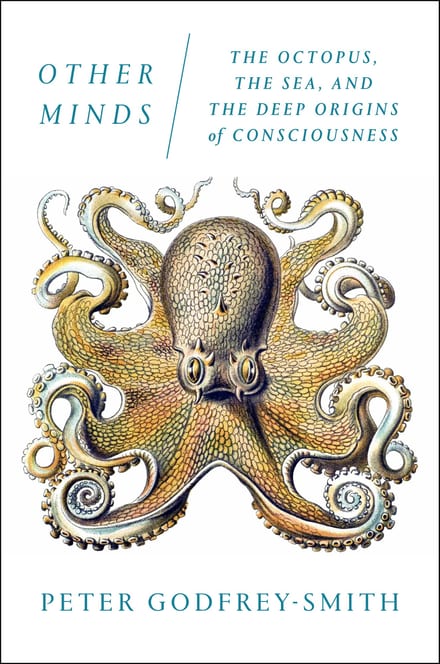
Other Minds
The Octopus, the Sea, and the Deep Origins of Consciousness
The full book runs ~272 pages — roughly 5 hours of reading. You get the key ideas here in 2 minutes.
The key ideas
- Split: octopus minds evolved separately 600 million years ago
- Distributed: cephalopod cognition spreads through arms, not just brain
- Gradient: sensing gradually transformed into rich subjective experience
- Wordless: cephalopods are conscious without inner speech or language
- Trade-off: shell-shedding forced brilliant minds into brief lifespans
- Alien: sophisticated intelligence needs no human brain architecture
The summary
The octopus is the closest thing to an intelligent alien we’re ever likely to meet, and it grew its mind almost entirely apart from ours. Six hundred million years ago the lineage that leads to us and the lineage that leads to cephalopods split off from a shared ancestor barely more sophisticated than a worm. From that near-nothing, two utterly different body plans arrived at genuine cognition — proof, Peter Godfrey-Smith argues, that a mind is not a one-time invention. Awareness evolved more than once, and it did so along a gradient rather than switching on at some magic threshold.
Intelligence with no shared blueprint
Complex minds have appeared in two great groups of animals: the vertebrates, which include us and the birds, and the cephalopods, which include octopuses, cuttlefish, and squid. Because our common ancestor had little more than a nerve net, whatever intelligence these two groups share they built independently — the same destination reached by separate roads. And cephalopods show behaviors once thought to belong to vertebrates alone. Octopuses carry coconut shells to use as portable shelter. They play with objects in a tank for no obvious payoff. At a site off Australia nicknamed Octopolis, these normally solitary animals were found living in a dense settlement, which hints that even social intelligence can evolve when circumstances call for it.
What pushed both lineages toward complexity was the Cambrian explosion, when animals first began interacting in earnest — hunting, fleeing, competing. Predation sets off an arms race: better senses to catch a threat, better memory to recall a hiding place, better planning to set an ambush. A complex mind is expensive to grow and run, but it earns its keep when survival hinges on outmaneuvering other creatures.
A mind spread through the body
Here the two designs diverge sharply. Vertebrates centralized control in a brain. The octopus did close to the opposite, distributing its nervous system throughout its body so that the arms hold real autonomy — an arm can taste, touch, and move somewhat on its own. This is intelligence organized on a completely different plan from ours, and it’s the clearest sign that sophisticated cognition doesn’t require the particular architecture we happen to have.
Awareness as a spectrum
Consciousness, in this telling, never flips on like a light. Even single-celled life shows a trace of it: E. coli has something like a sense of taste or smell, detecting welcome and unwelcome chemicals and moving toward or away from them. Bees remember. But asking whether a bacterium “really” perceives, or a bee “really” remembers, assumes a sharp dividing line that isn’t there. There’s a smooth slope from minimal sensitivity to elaborate subjective experience, with no clean break anywhere along it.
Two rival views try to explain how experience arose. The Latecomer view holds that consciousness showed up recently, only in complex brains. The Transformation view — which fits the evidence better — holds that plain sensing gradually turned into something richer. Early experience was probably closer to raw static, a chaotic dump of sensory data that evolution slowly organized and filtered. Subjective experience, Godfrey-Smith writes, arises not from a system merely running but from its registering things that matter.
A mind without inner speech
Cephalopods make their nervous systems visible on their skin. Cuttlefish flash shifting color patterns for camouflage and communication, a display driven by the nervous system rather than the brain — in effect a screen broadcasting their internal state. Oddly, they appear to be colorblind, yet they somehow match complex backgrounds through mechanisms still not fully understood, possibly sensing light through the skin itself.
Human consciousness, by contrast, is soaked in language. We narrate our thoughts, argue with ourselves, plan in words, and that inner speech makes our experience reflective and self-aware in a specific way. Cephalopods almost certainly lack it. Their experience is likely more direct and less filtered — intelligent without being verbal, conscious without the running commentary. Which tells us language is not a prerequisite for a complex mind, only one route among several.
The cost of brilliance
For all that intelligence, octopuses live only a year or two — shorter than many houseplants. The explanation lies in an ancient trade-off. Ancestral cephalopods gave up their protective shells to become fast, agile predators, and that new vulnerability pushed them toward living fast: grow quickly, reproduce early, die young. Natural selection favors mutations that help early in life even if they cause harm later, because reaching reproduction matters more than thriving in old age. Humans carry a version of the same bargain, accumulating late-life damage that makes aging look almost preprogrammed.
The bottom line
Consciousness isn’t a single invention but a spectrum that evolution has climbed more than once, in more than one way. The octopus proves a mind can be radically unlike ours and still be rich, flexible, and aware. Read this if you want to understand what consciousness actually is — not as a human-shaped trait, but as a biological answer to the problem of moving through a complex world.
Fact check
Popular books repeat findings that later research has complicated. Where Other Minds makes a testable claim, here's what the evidence actually shows.
The lineages leading to humans and to cephalopods split roughly 600 million years ago, from a common ancestor barely more complex than a worm.
The split is real and ancient, but the round number hides wide error bars. Molecular-clock work places the diversification of crown bilaterian phyla in the Ediacaran (635-541 million years ago), with the underlying developmental toolkit assembled during the Cryogenian (850-635 million years ago) — so 600 million sits inside the mainstream range rather than being a settled figure. A 2015 analysis found that different clock models, calibrations and data partitions shift the estimates so much that the divergences cannot be pinpointed with current data, and warned against evolutionary narratives built on precise dates. The characterization of the shared ancestor as a small, simple bilaterian is standard.
- dos Reis M, Thawornwattana Y, Angelis K, Telford MJ, Donoghue PC, Yang Z. Uncertainty in the Timing of Origin of Animals and the Limits of Precision in Molecular Timescales. Curr Biol. 2015;25(22):2939-2950. PubMed
- Erwin DH, Laflamme M, Tweedt SM, Sperling EA, Pisani D, Peterson KJ. The Cambrian conundrum: early divergence and later ecological success in the early history of animals. Science. 2011;334(6059):1091-1097. PubMed
Octopuses live only a year or two, a brief life that is the price of having shed their protective shells.
For the shallow-water species most people encounter, this is accurate: the entire lifespan of most shallow-water cephalopods runs under two years. The deep sea breaks the pattern. Researchers watching a single female Graneledone boreopacifica off California recorded her brooding one clutch of eggs for 53 months without ever leaving them — by itself more than double the lifespan the book quotes, and the longest egg-brooding period documented in any animal. Cold water, not the loss of the shell, appears to set the pace, so the short-life rule holds for warm shallow species rather than for the group as a whole.
- Robison B, Seibel B, Drazen J. Deep-sea octopus (Graneledone boreopacifica) conducts the longest-known egg-brooding period of any animal. PLoS One. 2014;9(7):e103437. PubMed
Cuttlefish are colorblind yet still match complex colored backgrounds, possibly by sensing light through their skin.
Both halves hold up. A sensorimotor assay confirmed that Sepia officinalis has a single visual pigment and cannot discriminate colors, matching backgrounds by brightness contrast instead — yet the animals still produce camouflage that reads as chromatically appropriate to human eyes. The skin-sensing explanation has direct evidence behind it: isolated skin from Octopus bimaculoides expands its chromatophores in response to light with no eye involved, and that skin expresses the same phototransduction genes as the retina. A competing 2016 model argues cephalopods could instead extract color information from chromatic aberration using their odd U- and W-shaped pupils, so the mechanism remains open even though the phenomenon is well established.
- Mäthger LM, Barbosa A, Miner S, Hanlon RT. Color blindness and contrast perception in cuttlefish (Sepia officinalis) determined by a visual sensorimotor assay. Vision Res. 2006;46(11):1746-1753. PubMed
- Ramirez MD, Oakley TH. Eye-independent, light-activated chromatophore expansion (LACE) and expression of phototransduction genes in the skin of Octopus bimaculoides. J Exp Biol. 2015;218(Pt 10):1513-1520. PubMed
- Stubbs AL, Stubbs CW. Spectral discrimination in color blind animals via chromatic aberration and pupil shape. Proc Natl Acad Sci U S A. 2016;113(29):8206-8211. PubMed
Octopuses carry coconut shells around as portable shelter, and at a site called Octopolis normally solitary octopuses live packed together.
Both observations come from the published field record. Veined octopuses were filmed in Indonesia collecting discarded coconut half-shells, carrying them across open seabed in an awkward stilt-walk, then assembling them into a shelter — the case that established tool use in an invertebrate, since the shells carry a cost while being transported and pay off only later. The Octopolis site off eastern Australia is documented too: Octopus tetricus occupied a small patch of seabed at high density over years, and follow-up field observation there recorded a repertoire of visible displays during aggressive encounters, with the displays predicting who backed down. Godfrey-Smith co-authored both Octopolis papers, so the summary reports his own fieldwork.
- Finn JK, Tregenza T, Norman MD. Defensive tool use in a coconut-carrying octopus. Curr Biol. 2009;19(23):R1069-R1070. PubMed
- Scheel D, Godfrey-Smith P, Lawrence M. Signal Use by Octopuses in Agonistic Interactions. Curr Biol. 2016;26(3):377-382. PubMed
- Godfrey-Smith P, Lawrence M. Long-term high-density occupation of a site by Octopus tetricus and possible site modification due to foraging behavior. Mar Freshw Behav Physiol. 2012;45(4). Source
Frequently asked questions
What is Other Minds about?
It uses the octopus as the closest thing to an intelligent alien we're likely to meet to argue that a mind is not a one-time invention. Our lineage and the cephalopods' split from a shared ancestor barely more than a worm 600 million years ago, yet both arrived at genuine cognition independently. From that, Godfrey-Smith makes the case that awareness evolved more than once and did so along a gradient rather than switching on at some magic threshold.
What are the key takeaways from Other Minds?
Complex minds appeared in two great groups, vertebrates and cephalopods, and because their common ancestor had little more than a nerve net, they built intelligence by separate roads. The octopus organized its nervous system on a completely different plan, distributing it so the arms hold real autonomy. Consciousness is a spectrum with no clean break, and the Transformation view, that plain sensing gradually turned into something richer, fits the evidence better than the Latecomer view. Language is only one route to a complex mind, not a prerequisite. And the octopus's short life traces to an ancient trade-off: giving up its shell for speed pushed it toward living fast and dying young.
Who should read Other Minds?
Read this if you want to understand what consciousness actually is, not as a human-shaped trait but as a biological answer to the problem of moving through a complex world.
Is Other Minds worth reading?
Yes if you're drawn to big questions about the mind grounded in real biology, since it makes consciousness concrete through octopuses, cuttlefish, and even single-celled life rather than abstraction. It moves between evolutionary history, animal behavior, and philosophy of mind, so a reader who wants a straight octopus natural-history book or firm, settled answers may find its comfort with open questions and gradients less tidy than expected.