Book summary
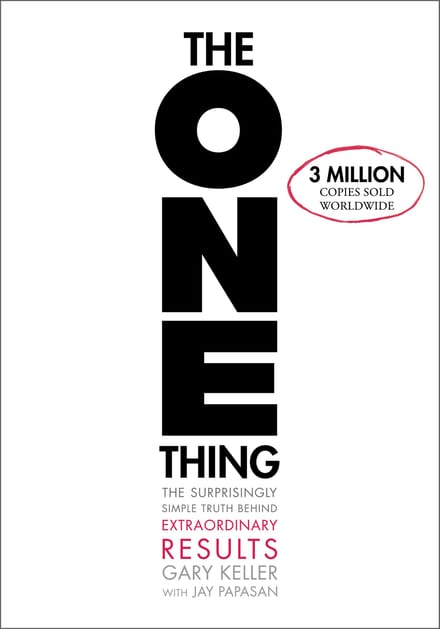
The ONE Thing: The Surprisingly Simple Truth Behind Extraordinary Results
The full book runs ~296 pages — roughly 5 hours of reading. You get the key ideas here in 5 minutes.
The key ideas
- Success is sequential, not simultaneous: one domino can topple another 50 percent larger.
- Six lies mislead us: equality of tasks, multitasking, a disciplined life, on-demand willpower, a balanced life, and the fear that big is bad.
- Ask the Focusing Question: "What's the ONE Thing I can do such that by doing it everything else will be easier or unnecessary?"
- Time block four hours a day for your ONE Thing early, while willpower is still full, and defend it.
- Four thieves steal that time: an inability to say no, fear of chaos, poor health habits, and an unsupportive environment.
The summary
In 1983, physicist Lorne Whitehead showed that one domino can knock over another 50 percent larger. Carry the progression out and the 23rd overshadows the Eiffel Tower, the 31st looms above Mount Everest, the 57th nearly reaches the moon. Gary Keller’s argument is that extraordinary results work this way — sequentially, not simultaneously. You do the right thing, then the next right thing, and what starts out linear turns geometric. Everything follows from one job: find the lead domino and hit it until it falls.
Not everything matters equally
Keller found his own first domino at the worst moment of his career. He had built a company with international ambitions and his life was in turmoil, so he hired a coach, who put the org chart on the wall and said there was only one thing to do: fill 14 key positions with the right people. “Jesus needed 12, but you’ll need 14.” Keller fired himself as CEO to go find them, and within three years the company began almost a decade of growth averaging 40 percent a year.
That sent him back to Joseph Juran, who saw that a handful of flaws produce most defects, matched it to Vilfredo Pareto’s finding that 20 percent of Italians owned 80 percent of the land, and named the result Pareto’s Principle. Keller wants you past 80/20: take the vital 20 percent, find the vital few inside it, and keep cutting until one is left. In 2001 his executive team brainstormed 100 ways to earn respect from the top people in their industry, cut the list to ten, then to one — he would write a book on elite performance. It became a series that sold over a million copies.
This is why a raw to-do list is really a survival list: the first item on it is just the first thing you thought of.
Six lies that keep you scattered
- Everything matters equally
- Multitasking
- A disciplined life
- Willpower is always on will-call
- A balanced life
- Big is bad
Clifford Nass expected his 262 Stanford subjects to reveal some secret multitasking ability. The heavy multitaskers lost on every measure: “multitaskers were just lousy at everything.” Researchers put the cost of the switching at 28 percent of an average workday. Nor do you need a disciplined life, only enough discipline to install one habit — an average of 66 days, per University College London. Michael Phelps, whose kindergarten teacher told his mother he would “never be able to focus on anything,” swam seven days a week, 365 days a year.
Willpower runs down like a phone battery. Eight Israeli parole judges granted release around 65 percent of the time just after a break and close to zero by the end of each stretch: a spent mind falls back on its default, and a parole judge’s default is no. Do your ONE Thing early, while the charge is full.
Balance is a verb, not a state. A ballerina en pointe looks weightless; her toe shoes are vibrating. Go long professionally, where one thing demands months out of balance; go short personally, where nothing survives neglect. James Patterson’s line finishes it: work is a rubber ball, and family, health, friends, and integrity are glass.
The question that does the work
“What’s the ONE Thing I can do such that by doing it everything else will be easier or unnecessary?” Every clause pulls weight. “ONE Thing” forbids hedging. “Can do” points at action actually available, not what you should or would do. And “everything else will be easier or unnecessary” is the test that separates a load-bearing action from a merely good task. Andrew Carnegie said it bluntly in 1885: “put all your eggs in one basket, and then watch that basket.”
Asked big, the question is a compass for a life. Asked small — what’s my ONE Thing right now? — it names your next move. Keller links the two with Goal Setting to the Now: a someday goal nested inside a five-year goal, inside this year, this month, this week, today, right now — a matryoshka doll. Skip the middle steps and it fails; the moment sits too far from the future to see the priority. Then write it down: Gail Matthews found people who wrote their goals were 39.5 percent likelier to reach them.
Give it four hours, then defend them
Purpose sets priority and priority drives productivity — the visible tip of an iceberg. Which makes productivity a calendar decision, not a character trait. Block your time off first, then your ONE Thing, then time to plan. Keller’s number is four hours a day, early, before the day’s requests arrive: be a maker in the morning and a manager after lunch. Jerry Seinfeld’s version was a wall calendar and a red X for every day he wrote jokes — don’t break the chain.
Blocking is the easy half. Keller taped up a sign — “Until my ONE Thing is done, everything else is a distraction” — and still had to fight four thieves: an inability to say no, fear of the mess focus leaves behind, poor health habits, an environment that doesn’t back your goals. Steve Jobs cut Apple from 350 products to ten in two years after his return: “focusing is about saying no.” Chaos comes with anything built at scale; make peace with the loose ends.
The bottom line
Almost nothing on your list will move your life, and effort spread across everything is no substitute for the one action that makes the rest easier or moot. Ask the Focusing Question, give the answer your first and best hours, and let the rest pile up — the pile is the price, not the problem. Read it if your calendar is full while your progress isn’t.
Fact check
Popular books repeat findings that later research has complicated. Where The ONE Thing makes a testable claim, here's what the evidence actually shows.
Israeli parole judges granted release about 65 percent of the time right after a break and close to zero by the end of each stretch, because a tired mind falls back on its default.
The published pattern is exactly as described — favourable rulings fell from roughly 65% to near zero within each session and jumped back after a food break. But the cases were not heard in random order: prisoners without legal representation, who are far less likely to be released, were clustered at the ends of sessions, and prisoners from the same prison were grouped together. A later reanalysis found the drop is far larger than any plausible fatigue effect could produce and can be reproduced by judges simply declining to start a case they cannot finish before the break.
- Danziger S, Levav J, Avnaim-Pesso L. Extraneous factors in judicial decisions. Proc Natl Acad Sci U S A. 2011;108(17):6889-92. PubMed
- Weinshall-Margel K, Shapard J. Overlooked factors in the analysis of parole decisions. Proc Natl Acad Sci U S A. 2011;108(42):E833-4. PubMed
- Glöckner A. The irrational hungry judge effect revisited. Judgm Decis Mak. 2016;11(6):601-610. Source
Willpower is a finite daily charge that runs down like a phone battery, so the most important work has to happen early.
Ego depletion has not survived large pre-registered testing at anything like the strength the book assumes. A 23-lab replication found an effect of d = 0.04 with a confidence interval spanning zero, and a later 12-lab replication with 1,775 participants found d = 0.10 (0.16 after excluding random responders) — real but very small, against the d ≈ 0.6 the earlier literature reported. Doing your hardest work early is still reasonable scheduling advice for other reasons, but the depleting-battery mechanism is far weaker and shakier than the metaphor suggests.
- Hagger MS, Chatzisarantis NLD, Alberts H, et al. A multilab preregistered replication of the ego-depletion effect. Perspect Psychol Sci. 2016;11(4):546-573. PubMed
- Dang J, Barker P, Baumert A, et al. A multilab replication of the ego depletion effect. Soc Psychol Personal Sci. 2021;12(1):14-24. PubMed
Installing a single new habit takes an average of 66 days.
The 66-day figure is a median from one study of simple daily health behaviours, and medians hide enormous spread. A 2024 systematic review of 20 studies covering 2,601 people found medians of 59–66 days but means of 106–154 days, with individuals ranging from 4 to 335 days. So 66 days is a fair midpoint, not a schedule — roughly half of people take longer than two months, and some take the better part of a year. Morning timing and self-chosen behaviours came out as the factors that speed it up, which is consistent with the book's advice even where the number is not.
- Lally P, van Jaarsveld CHM, Potts HWW, Wardle J. How are habits formed: modelling habit formation in the real world. Eur J Soc Psychol. 2010;40(6):998-1009. Source
- Singh B, Murphy A, Maher C, Smith AE. Time to form a habit: a systematic review and meta-analysis of health behaviour habit formation and its determinants. Healthcare (Basel). 2024;12(23):2488. PubMed
Clifford Nass's Stanford study showed heavy multitaskers were worse on every measure of cognitive control.
The original study did report that heavy media multitaskers were more easily derailed by irrelevant stimuli, by irrelevant memories, and by task-switching demands. It has replicated poorly since: two later studies found only 5 of 14 tests significant, with just 2 surviving Bayesian analysis, and an accompanying meta-analysis of 39 effect sizes found the link between media multitasking and distractibility went non-significant once small-study bias was corrected for. "Lousy at everything" describes one study's result rather than the state of the evidence.
Frequently asked questions
What is The ONE Thing about?
Gary Keller's case that extraordinary results are sequential, not simultaneous. One domino can topple another 50 percent larger, so the job is to find the lead domino — the single action that makes everything else easier or unnecessary — and hit it until it falls. Everything in the book follows from that: the Focusing Question, the lies that keep you scattered, and blocking hours to protect the answer.
What are the key takeaways from The ONE Thing?
Ask the Focusing Question — "What's the ONE Thing I can do such that by doing it everything else will be easier or unnecessary?" — big for a life and small for your next move, and link the two with Goal Setting to the Now. Get past 80/20: keep cutting the vital few until one is left. Six lies do the damage, including that everything matters equally and that willpower is always available; it runs down like a phone battery, so take your ONE Thing early. Then block four hours for it and expect four thieves — saying yes too easily, fear of the mess focus leaves, poor health habits, an unsupportive environment.
Who should read The ONE Thing?
Read it if your calendar is full while your progress isn't. It's for people whose to-do list has quietly become a survival list of whatever came to mind first.
Is The ONE Thing worth reading?
Yes, if you want one idea argued hard rather than a system to install. The evidence is memorable — Nass's Stanford multitaskers who "were just lousy at everything," the Israeli parole judges granting release 65 percent of the time after a break and near zero before it, Jobs cutting Apple from 350 products to ten. It is a single argument stretched across a book, so if you already defend your mornings for one priority you'll mostly find confirmation.