Book summary
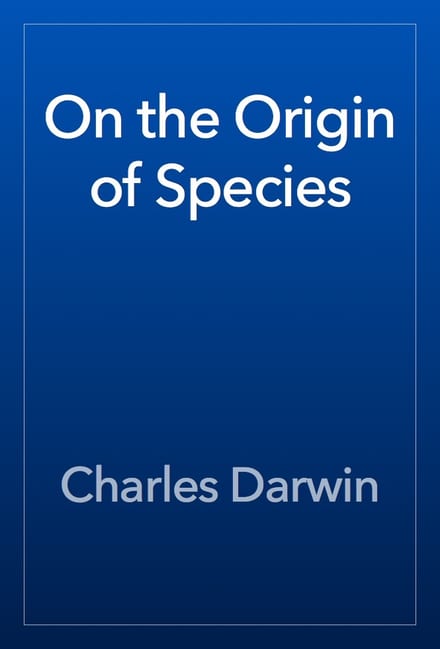
On the Origin of Species
The full book runs ~502 pages — roughly 9 hours of reading. You get the key ideas here in 4 minutes.
The key ideas
- Overproduction forces a relentless struggle for scarce resources.
- Individuals vary, and useful traits pass to offspring.
- Tiny inherited advantages compound into entirely new species.
- Selective breeding proves how fast heritable change happens.
- Fossils, geography, and shared anatomy all confirm common descent.
- Even complex organs like the eye evolve through gradual steps.
The summary
Every species produces far more offspring than can ever survive. Pair that with two more facts — individuals within a population vary slightly, and they pass their traits to their young — and you have the engine that built the living world. Across immense stretches of time, tiny inherited advantages accumulate, generation after generation, until they add up to new species, to organs as intricate as the eye, and to the deep anatomical kinship running through all life. Darwin called this process natural selection, and his argument is that it accounts for the diversity and fit of living things without any need for separate acts of creation.
What breeders already proved
Darwin starts with something his readers could see for themselves: what humans have done through selective breeding. By choosing which animals and plants reproduce, breeders have spun wildly different pigeons, dogs, and crops out of common stock, which shows how plastic a species really is. His favorite example is a pair of Leicester sheep flocks, both bred from the same original stock of Mr. Bakewell for over fifty years, that had drifted so far apart “they have the appearance of being quite different varieties.” If deliberate human selection can remake a breed in a few decades, nature — working on far more variation, over far more time — can do incomparably more. He notes too that larger genera, groups with more species in them, tend to show a wider spread of differences, as if more room to vary had produced more divergence.
The struggle for existence
The force that does nature’s selecting is competition, and it follows directly from overproduction. Because resources — food, mates, territory — are always finite, more individuals are born than can live, and a struggle for existence is the result. That struggle is fiercest not between distant species but among members of the same one, since they need exactly the same things. In that contest, small edges decide everything: a beetle better camouflaged from birds, a plant whose seeds travel a little farther, a predator with slightly sharper senses lives to reproduce while its rivals don’t. The variation these edges draw on isn’t pure noise, either. It’s shaped by an organism’s environment and history, subtle and gradual, and offspring inherit a blend of both parents’ traits, some of which dominate. Let favorable variations pile up and unfavorable ones vanish, add time and some isolation, and a population can change enough to become a species of its own.
The evidence is everywhere you look
Darwin’s case rests less on any single proof than on how many independent lines of evidence point the same way. The fossil record shows a progression from simpler organisms in older rock to more complex forms in younger layers, exactly what descent from earlier forms would predict, along with the extinction of countless species that lost their competition for resources. Its gaps aren’t a refutation but a reflection of how rarely anything fossilizes at all. Geography tells the same story: species aren’t scattered at random but cluster with their relatives in neighboring regions, and barriers like oceans, mountains, and deserts strand populations that then diverge — which is why isolated islands brim with creatures found nowhere else, and why freshwater and land species spread differently from marine ones.
The most quietly damning evidence is anatomy. The same bones arranged the same way appear in a human hand, a whale’s flipper, and a bat’s wing — not because those jobs demand that layout, but because all three inherited it from a shared ancestor. Embryos of very different animals look strikingly alike in their early stages, hinting at a common blueprint, and rudimentary organs like the stunted wings of flightless birds are leftovers of structures that once worked in ancestral forms. Instincts fall under the same law: the cuckoo’s habit of laying its eggs in other birds’ nests is inherited rather than learned, and it persists because it helps the cuckoo’s young. Even the sterility of many hybrids fits, tracking the evolutionary distance between the parent species and marking the line where one species has finished splitting into two.
Answering the hard objections
Darwin was honest about what could sink him. The obvious challenge is complexity — how could something like an eye arise by slight steps? His answer is to break it into a staircase. A patch of light-sensitive cells beats no light detection at all; a slight cupping of that patch gives a sense of direction; a transparent layer over it adds protection. Each small improvement is useful on its own and can be selected for, so the finished eye is just the sum of many such gains. He stakes the whole theory on it: “If it could be demonstrated that any complex organ existed, which could not possibly have been formed by numerous, successive, slight modifications, my theory would absolutely break down. But I can find out no such case.” The idea overturns the old belief in fixed, separately created species, but it earns its keep by explaining the patterns nature actually shows us rather than declaring them beyond understanding.
The bottom line
The diversity of life comes from a process almost embarrassingly simple: more offspring than can survive, variation among them, and the steady preservation of whatever helps, compounded over enormous time. “There is grandeur in this view of life,” Darwin closes — that from so simple a beginning “endless forms most beautiful and most wonderful have been, and are being, evolved.” Read it if you want to watch, in the naturalist’s own patient reasoning, how the living world actually works.
Fact check
Popular books repeat findings that later research has complicated. Where On the Origin of Species makes a testable claim, here's what the evidence actually shows.
Offspring inherit a blend of their two parents' traits, with some of the blended characteristics dominating.
Inheritance is particulate, not blending — genes pass on intact rather than averaging, which is why variation persists instead of being halved every generation. This was the weakest joint in Darwin's argument: under blending, the differences selection acts on would wash out faster than selection could act, an objection Fleeming Jenkin pressed in 1867 and Darwin never answered. Once Mendel's work was recovered after 1900, the particulate account removed the problem and made natural selection mathematically coherent, so the gap cost Darwin the mechanism rather than the theory.
- Charlesworth B, Charlesworth D. Darwin and genetics. Genetics. 2009;183(3):757-66. PubMed
Species change only through numerous, successive, slight modifications accumulating steadily over vast time.
The fossil record more often shows long stretches of stasis broken by geologically rapid bursts of change than the even, gradual creep Darwin described. Eldredge and Gould called this punctuated equilibrium, and by their 1993 review they argued it had matured into an extension of evolutionary theory rather than a rival — stasis is a real pattern needing explanation, and macroevolution partly reflects differential success among species, not just gradual change within them. The underlying mechanism is still selection on heritable variation; what shifts is the tempo, which can be fast enough that intermediate stages rarely fossilise.
- Gould SJ, Eldredge N. Punctuated equilibrium comes of age. Nature. 1993;366(6452):223-7. PubMed
Gaps in the fossil record reflect how rarely anything fossilises at all, not missing transitions between forms.
Predicted transitional forms keep turning up in the rock layers where the theory says they should be. Tiktaalik roseae, found in Late Devonian Arctic Canada in rock targeted precisely because of its age, is a fish that keeps scales and fin rays while already showing a shortened skull roof, a mobile neck, a modified ear region and a functional wrist joint. Fossils like it fill exactly the intervals critics once pointed to as absences, which is what a patchy record rather than a discontinuous history predicts.
- Daeschler EB, Shubin NH, Jenkins FA Jr. A Devonian tetrapod-like fish and the evolution of the tetrapod body plan. Nature. 2006;440(7085):757-63. PubMed
An organ as complex as the eye could be built by a staircase of small changes, each one useful on its own.
Modelling the optics step by step, Nilsson and Pelger found that selection favours a gain in detectable spatial information at every stage from a flat light-sensitive patch to a focused lens eye, and that even on deliberately pessimistic assumptions the whole sequence takes only a few hundred thousand years. Comparative work since has filled in the actual intermediates, tracing opsins, photoreceptors, retina and eye cup across chordates to the camera eye of jawed vertebrates. Darwin's staircase is the part of the argument that has held up best.
Frequently asked questions
What is On the Origin of Species about?
It lays out natural selection: every species produces far more offspring than can survive, individuals vary slightly, and they pass their traits to their young. Over enormous stretches of time, tiny inherited advantages accumulate until they add up to new species, organs as intricate as the eye, and the deep kinship running through all life. Darwin's case is that this simple process accounts for the diversity and fit of living things without any need for separate acts of creation.
What are the key takeaways from On the Origin of Species?
A few ideas do the heavy lifting. Selective breeding proves how plastic a species is, so nature, working on more variation over more time, can do far more. Because resources are finite, more individuals are born than can live, and the resulting struggle for existence is fiercest among members of the same species. The theory earns its keep through many independent lines of evidence pointing the same way: the fossil record's progression from simpler to complex forms, species clustering with their relatives by geography, and the same bones arranged the same way in a human hand, a whale's flipper, and a bat's wing. Even a complex organ like the eye can arise by slight useful steps, from a patch of light-sensitive cells to a cupped, protected one.
Who should read On the Origin of Species?
Read it if you want to watch, in the naturalist's own patient reasoning, how the living world actually works, rather than take the idea of evolution secondhand.
Is On the Origin of Species worth reading?
Yes, if you value seeing an argument built rather than asserted. Its strength is breadth: no single proof carries it, but fossils, geography, anatomy, embryos, and instincts all converge, and Darwin is honest about the hardest objections, staking the whole theory on whether a complex organ could form by successive small steps. Readers who only want the modern textbook summary of evolution may find the period detail and slow accumulation of examples heavier going than a quick recap.