Book summary
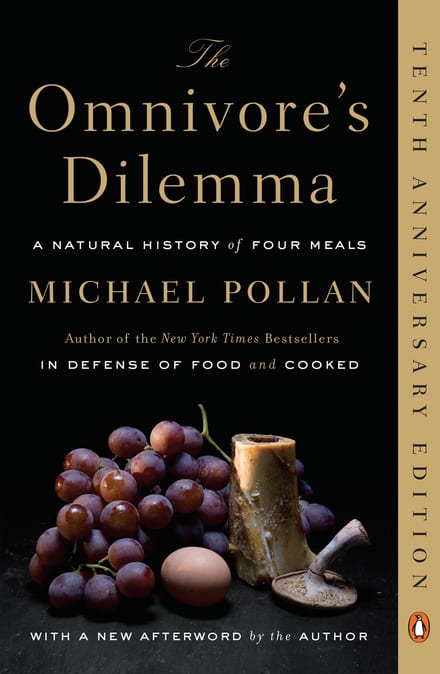
The Omnivore's Dilemma: A Natural History of Four Meals
The key ideas
- Corn hides in one in four supermarket products
- Subsidies drive overproduction, making cheap corn fill everything
- Factory farms sicken animals, requiring constant antibiotics
- Industrial organic avoids chemicals but keeps the wasteful model
- Pasture farming feeds animals naturally and improves the soil
- America lacks food culture to answer what we should eat
The summary
The 99-cent hamburger is not actually cheap. It only looks cheap at the register, because its real price gets paid somewhere else—in polluted water, in rising rates of obesity and diabetes, and in tax dollars quietly funneled to industrial farms. That is the argument at the center of Pollan’s book, and the reason it holds together is a single crop. Corn is the hidden ingredient in most of what Americans eat. One in four supermarket items contains a corn derivative, and corn turns up everywhere from chicken nuggets to the high-fructose corn syrup that sweetens processed food. This didn’t happen because we love corn. It happened because farm policy encourages overproduction, which drives prices so low that corn becomes the cheapest possible way to add calories to anything. Pollan puts it bluntly: the price of a fast-food hamburger “simply doesn’t take account of that meal’s true cost—to soil, oil, public health, the public purse,” costs charged invisibly to the taxpayer through subsidies, to the health care system through illness, and to the environment through pollution.
The industrial food chain runs on subsidized corn
American agricultural policy favors giant corn monocultures run for big business, and the result is a glut. Farmers overproduce, prices collapse, and they survive only on government subsidies, while synthetic fertilizers and pesticides keep yields high at the cost of polluted groundwater and public health. Automation strips out the jobs, hollowing out Midwestern towns. All that surplus corn has to go somewhere, and much of it goes into animals. Cheap corn is what makes concentrated animal feeding operations, or CAFOs, possible—overcrowded, unsanitary places that feed corn to animals built for other diets. Cattle evolved to eat grass, so a corn diet makes them sick, and keeping them alive requires a steady stream of antibiotics that end up in us. Even carnivorous salmon get fed corn. Pollan notes that “a growing body of research suggests that many of the health problems associated with eating beef are really problems with corn-fed beef,” and the whole system runs on fossil fuels at every stage, from fertilizer to refrigeration to transport, making each meal a small nudge to the climate. What keeps it running is that we can’t see it. “Were the walls of our meat industry to become transparent, literally or even figuratively,” he writes, “we would not long continue to raise, kill, and eat animals the way we do.”
Industrial organic is better, but not by much
When Whole Foods and other big retailers moved into the organic market, they produced a hybrid Pollan calls industrial organic. It drops the synthetic pesticides, antibiotics, and fertilizers, which is a genuine improvement, but it keeps the rest of the industrial model intact. The food still travels long distances, still leans on energy-hungry processing and refrigeration, and still uses synthetic additives to prolong shelf life. You avoid some chemicals, but you don’t escape the scale, the fuel use, or the basic priority of convenience over nutrition and environment.
True organic works with nature, not against it
Pasture-based farming is a different thing entirely, and its foundation is grass. Here the plants, the soil, and the animals all feed one another: cattle graze, chickens follow to eat the insects and parasites out of the manure, and the manure enriches the soil that grows the next round of grass. The animals stay healthy without antibiotics, and the soil improves rather than depletes. The food is measurably better, too—pastured meat and eggs carry more of the healthy fats found in the wild game humans evolved eating, along with more vitamin E. And the price gap is smaller than it looks. Measured by the price per unit of omega-3 and vitamin E, organic eggs are actually cheaper than conventional ones. The higher sticker price simply reflects the true cost of production, with no subsidies hiding the expense and no pollution or illness deferred onto everyone else. Pasture farming costs more because it conceals less.
What we should eat, and the culture we lost
Underneath all of this is the dilemma of the title: with infinite options and no idea what’s really in our food, what should we have for dinner? Pollan blames part of the confusion on the fact that America, a nation of immigrants, never built a strong food culture to steer us, so we lurch between fad diets, shifting guidelines, and marketing that obscures more than it explains. To feel the alternative, he built a fourth food chain by hand—foraging, harvesting, and killing his own food. The ethics of that are complicated; he concludes that humans are biologically designed to eat meat but that this is no excuse for factory farming’s cruelty, which needs to be exposed and reformed. The experiment cost him little but time, and it taught him the lesson he found the whole industrial system hides. “The single greatest lesson the garden teaches,” he writes, “is that our relationship to the planet need not be zero-sum, and that as long as the sun still shines and people still can plan and plant, think and do, we can, if we bother to try, find ways to provide for ourselves without diminishing the world.”
The bottom line
Cheap industrial food isn’t really cheap; you just pay for it in ways you can’t see at the checkout—polluted water, sicker people, subsidized farms. Real food costs more precisely because it hides less of its true price. Anyone who eats should read this book, if only to understand what’s actually on the plate.
Fact check
Popular books repeat findings that later research has complicated. Where The Omnivore's Dilemma makes a testable claim, here's what the evidence actually shows.
Corn is the hidden base of the American food supply, turning up in one in four supermarket items.
The corn-everywhere thesis holds up when the food itself is tested, though the isotope evidence measures what animals ate rather than counting supermarket shelves. Researchers bought more than 480 servings of hamburgers, chicken sandwiches and fries from McDonald's, Burger King and Wendy's across six cities and ran carbon and nitrogen isotope analysis on them. Only 12 beef servings in the entire set had a carbon-13 signature low enough to permit any feed source other than corn; nitrogen values were near-identical across animals, indicating uniform confinement and heavily fertilised feed. The authors concluded corn is of overwhelming importance in virtually every aspect of fast-food manufacture — the one-in-four shelf figure is Pollan's own estimate, not a measured audit.
- Jahren AH, Kraft RA. Carbon and nitrogen stable isotopes in fast food: signatures of corn and confinement. Proc Natl Acad Sci U S A. 2008;105(46):17855-17860. PubMed
Most of the health problems blamed on eating beef are really problems with corn-fed beef.
Grass-fed beef does have the better fat profile, but the gap is measured in nutrient ratios, not in anyone's health. A review of three decades of research found grass finishing raises conjugated linoleic acid, trans-vaccenic acid and omega-3 fatty acids on a gram-per-gram-of-fat basis, shifts saturated fat toward cholesterol-neutral stearic acid rather than myristic and palmitic, and lifts vitamin A and E precursors. Total saturated fat did not differ between the two feeding regimes. That review reports composition only — the argument that corn feeding is the culprit behind beef's disease associations rests on those ratios, with no outcome data behind it.
- Daley CA, Abbott A, Doyle PS, Nader GA, Larson S. A review of fatty acid profiles and antioxidant content in grass-fed and grain-fed beef. Nutr J. 2010;9:10. PubMed
The routine antibiotics that keep animals alive in confined feeding operations breed resistant bacteria that end up in humans.
Cutting antibiotic use in livestock measurably cuts resistance, in the animals and in people. A systematic review of 181 studies found that interventions restricting antibiotic use in food-producing animals lowered the prevalence of resistant bacteria in those animals by roughly 10 to 15 percentage points, and across the 13 human studies pooled, resistance prevalence was 24 percent lower in intervention groups than controls. The association was strongest in people with direct contact with the animals, and the authors were explicit that implications for the general population are less clear because so few studies examined it. WHO drew on these findings to write its guidelines on antibiotic use in food-producing animals.
- Tang KL, Caffrey NP, Nóbrega DB, et al. Restricting the use of antibiotics in food-producing animals and its associations with antibiotic resistance in food-producing animals and human beings: a systematic review and meta-analysis. Lancet Planet Health. 2017;1(8):e316-e327. PubMed
Pastured eggs carry so much more omega-3 and vitamin E than conventional ones that organic eggs work out cheaper per unit of those nutrients.
The nutrient gap is real and measured; the price-per-nutrient conclusion is Pollan's own arithmetic on top of it. A Penn State comparison found eggs from pastured hens carried twice the vitamin E, twice the long-chain omega-3 fats, 2.5 times the total omega-3 and less than half the omega-6 to omega-3 ratio of caged hens' eggs. Vitamin A ran 38 percent higher by concentration but was identical per egg, because pastured hens weighed less and laid fewer eggs unless well supplemented — the same productivity gap that drives the price. The study also compared pastured with caged hens, which is not the organic-versus-conventional comparison a shopper faces at the register.
- Karsten HD, Patterson PH, Stout R, Crews G. Vitamins A, E and fatty acid composition of the eggs of caged hens and pastured hens. Renew Agric Food Syst. 2010;25(1):45-54. Source
Frequently asked questions
What is The Omnivore's Dilemma about?
Michael Pollan's argument is that the 99-cent hamburger only looks cheap at the register, because its real price gets paid elsewhere, in polluted water, rising obesity and diabetes, and tax dollars funneled to industrial farms. Holding it all together is a single crop: corn is the hidden ingredient in most of what Americans eat, not because we love it but because farm policy encourages overproduction that makes corn the cheapest way to add calories to anything. The book traces four food chains to ask what we should actually have for dinner.
What are the key takeaways from The Omnivore's Dilemma?
The industrial food chain runs on subsidized corn, which props up concentrated animal feeding operations where cattle built to eat grass get sick on corn and are kept alive with antibiotics, all fueled by fossil fuels at every stage. "Industrial organic," the version sold by big retailers, drops synthetic chemicals but keeps the long-distance, energy-hungry model largely intact. True pasture-based farming works with nature instead of against it, as grass, soil, and animals feed one another, producing measurably better food whose higher price simply reflects costs the industrial system hides. And underneath sits the title's dilemma: with infinite options and a weak food culture, we lurch between fads, while the garden teaches that our relationship to the planet need not be zero-sum.
Who should read The Omnivore's Dilemma?
Anyone who eats should read this book, if only to understand what's actually on the plate and what it truly costs.
Is The Omnivore's Dilemma worth reading?
The reporting is genuinely eye-opening, following corn from field to fast-food counter and making the hidden costs of cheap food impossible to ignore. It's a long book, and the closing section where Pollan forages and hunts his own meal wanders into philosophy that some readers will find slower than the industrial exposé. But its central point, that real food costs more precisely because it hides less of its true price, reshapes how you read a menu.