Book summary
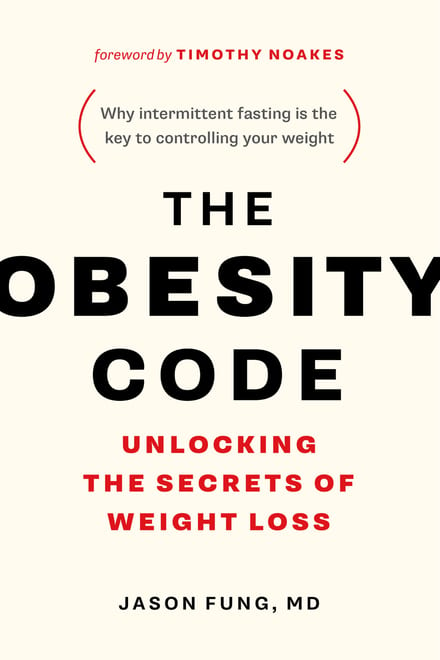
The Obesity Code: Unlocking the Secrets of Weight Loss
The full book runs ~326 pages — roughly 6 hours of reading. You get the key ideas here in 5 minutes.
The key ideas
- Obesity is a hormonal disorder driven by insulin, not a matter of calories in versus calories out.
- Cutting calories backfires: the body slows its metabolism to match, so the lost weight returns.
- Sugar's fructose overloads the liver and creates the insulin resistance that keeps fat locked in.
- All-day snacking keeps insulin high; fasting and a nightly low-insulin window break the cycle.
- Eat real food — less sugar and refined grain, more natural fat and fiber — and fast to lower insulin.
The summary
For thirty years the advice never changed: eat less, move more. Count your calories, cut your fat, and the weight will come off. It didn’t. Jason Fung’s argument is that this failed because the premise itself is wrong. Obesity is not a problem of too many calories and too little willpower. It is a hormonal disorder, and the hormone that runs it is insulin. Insulin is your body’s fat-storage signal. When it stays high, your body locks fat away and keeps it there, no matter how carefully you ration your plate. The way out is not to eat less of everything. It is to lower insulin, mainly by cutting the refined carbohydrates and sugar that spike it, and by giving your body long stretches with no food at all.
Why “eat less, move more” fails
The calorie model rests on a tidy equation: Calories In minus Calories Out equals body fat. Fung’s objection is that it treats the two sides as independent when they are tightly linked. Cut what you eat, and your body simply spends less. You don’t keep burning 3,000 calories a day while taking in 1,500 — you burn less.
The proof is grim and old. In the Minnesota Starvation Experiment, published in 1950, thirty-six healthy young men had their intake cut from about 3,200 calories a day to roughly 1,570. Their resting metabolic rate fell by 40 percent. They were cold all the time. Their heart rate dropped from 55 beats a minute to 35. They became obsessed with food, hoarding cookbooks, unable to concentrate. Their bodies were not failing; they were defending themselves, throttling every function that costs energy so the numbers would balance.
That defense is the real obstacle. Fung describes a “body set weight,” a kind of internal thermostat the body protects. Diet below it and metabolism slows, hunger climbs, and you drift back up. In obesity the set point itself sits too high, and cutting calories does nothing to lower it — it just triggers the counterattack. This is why the Minnesota men, and nearly every dieter since, regain what they lose.
Insulin is the hormone that makes you fat
If calories don’t explain it, what does? Fung’s test is direct: give people insulin and watch what happens. The answer is unambiguous. In the 1993 Diabetes Control and Complications Trial, diabetics on high-dose insulin gained nearly ten pounds more than those on a standard dose. Any doctor who prescribes insulin already knows this pattern — the more you give, the more weight the patient gains. Insulin causes fat storage. That is its job.
The hormone leptin fills out the picture. Fat cells release leptin to signal fullness, so you would expect heavy people to have low leptin. They don’t; theirs runs high. Obesity turns out to be a state of leptin resistance, not deficiency, and dosing people with extra leptin does not slim them down. Insulin and leptin pull in opposite directions, and when insulin stays high it drowns out leptin’s satiety signal.
Worse, high insulin feeds on itself. Keep levels elevated long enough and the body grows resistant, which pushes insulin higher still — a loop Fung calls the hidden driver of the whole disease. Breaking that loop is the entire game.
Why sugar and refined carbs hit hardest
Not all foods move insulin the same way, and sugar is the worst offender — specifically its fructose half. Unlike glucose, which nearly every cell can burn, fructose can only be processed by the liver. Fung compares it to a guided missile aimed at one organ. Overload the liver and it turns the excess into fat, producing a fatty liver, and fatty liver is central to insulin resistance. This isn’t slow. In a 1980 study, extra fructose worsened insulin sensitivity by 25 percent in a single week. A 2009 study pushed healthy volunteers into pre-diabetes in eight weeks on fructose; glucose did neither.
Refined grains do their own damage. Milling strips away the fiber, fat, and protein and leaves concentrated starch that spikes insulin fast. Fiber, Fung argues, is partly nature’s antidote, blunting the surge — which is why a whole food behaves so differently from the processed version made from it.
When you eat matters as much as what
Here is the point most diets miss. Insulin resistance needs one thing to take hold: persistently high insulin. Think of America in the 1960s, eating white bread, sugar, and Oreos, yet far leaner than today. People ate three meals a day and nothing between — roughly ten hours of eating balanced by fourteen hours of fasting. That nightly low-insulin window kept resistance from setting in. We erased it by snacking from morning to night, told that grazing was healthy, and left insulin high around the clock.
The fix follows from the diagnosis. Fasting — voluntary, and nothing like starvation — drives insulin down further than any diet, letting the body finally reach for its fat stores, and it does this without the metabolic slowdown that sinks calorie-cutting. Fung rounds it out with a short list of what to eat: cut added sugar, cut refined grains, keep protein moderate, add natural fats, and eat more fiber. Because the stress hormone cortisol also raises insulin, he folds in sleep and stress management too.
The bottom line
Weight is controlled by the hormone insulin, not by a simple surplus of calories, so the lasting fix is to lower insulin — cut sugar and refined carbs, stop constant snacking, and use fasting to open long low-insulin stretches. Read it if you have dieted by the calorie and watched the weight crawl back, or if you have type 2 diabetes or insulin resistance and want to understand the cause instead of managing the symptom.
Fact check
Popular books repeat findings that later research has complicated. Where The Obesity Code makes a testable claim, here's what the evidence actually shows.
Body fat is controlled by the hormone insulin rather than by calorie balance, so lowering insulin — mainly by cutting carbohydrates — is what actually drives fat loss.
When calories are held identical, cutting carbohydrate loses less fat, not more. In a metabolic-ward study of 19 adults with obesity eating isocaloric diets, six days of carbohydrate restriction produced 53 g/day of body fat loss against 89 g/day for fat restriction, despite the lower insulin. The 609-person DIETFITS trial then found a healthy low-fat and a healthy low-carbohydrate diet gave statistically indistinguishable 12-month weight loss (-5.3 vs -6.0 kg), and baseline insulin secretion did not predict who did better on which (P = .47). Insulin's role in storing fat is undisputed physiology; what these trials reject is the stronger claim that it overrides energy balance.
- Hall KD, Bemis T, Brychta R, et al. Calorie for calorie, dietary fat restriction results in more body fat loss than carbohydrate restriction in people with obesity. Cell Metab. 2015;22(3):427-436. PubMed
- Gardner CD, Trepanowski JF, Del Gobbo LC, et al. Effect of low-fat vs low-carbohydrate diet on 12-month weight loss in overweight adults and the association with genotype pattern or insulin secretion: the DIETFITS randomized clinical trial. JAMA. 2018;319(7):667-679. PubMed
Cutting calories triggers a metabolic slowdown big enough to defeat the diet, as the Minnesota Starvation Experiment's 40 percent fall in resting metabolism showed.
Metabolic slowdown is real, but much of the raw drop is simply less body left to fuel. A reanalysis of the individual Minnesota data for the 32 men found the genuinely adaptive share only appears once basal rate is adjusted for lost fat and fat-free mass, and it tracked how depleted the fat stores were (r = 0.5). The link to regain is where the argument weakens: 'Biggest Loser' contestants six years on still carried a 499 kcal/day adaptation, yet it bore no relationship to how much weight they had regained (r = -0.1, P = 0.75), and the contestants who kept the most weight off showed the most slowing. In a separate 71-person trial the adaptation more than halved once dieters stopped losing and stabilised, and was gone at one year.
- Dulloo AG, Jacquet J. Adaptive reduction in basal metabolic rate in response to food deprivation in humans: a role for feedback signals from fat stores. Am J Clin Nutr. 1998;68(3):599-606. PubMed
- Fothergill E, Guo J, Howard L, et al. Persistent metabolic adaptation 6 years after "The Biggest Loser" competition. Obesity (Silver Spring). 2016;24(8):1612-1619. PubMed
- Martins C, Roekenes J, Salamati S, Gower BA, Hunter GR. Metabolic adaptation is an illusion, only present when participants are in negative energy balance. Am J Clin Nutr. 2020;112(5):1212-1218. PubMed
Giving people insulin makes them fat: in the Diabetes Control and Complications Trial, patients on high-dose insulin gained nearly ten pounds more than those on standard doses.
The number holds. Across an average six years, the 1,246 DCCT adults on intensive insulin therapy gained 4.75 kg — about 10.5 pounds — more than those on conventional therapy, and the gain was fastest in the first year. What it demonstrates is narrower than fat storage on command: the same analysis found the extra weight included lean tissue as well as fat, and among patients without major weight gain, intensive therapy produced greater fat-free mass with no difference in adiposity at all. These were also people with type 1 diabetes, whose tighter glucose control stopped them shedding calories as sugar in the urine.
- The Diabetes Control and Complications Trial Research Group. Influence of intensive diabetes treatment on body weight and composition of adults with type 1 diabetes in the Diabetes Control and Complications Trial. Diabetes Care. 2001;24(10):1711-1721. PubMed
Fructose specifically wrecks insulin sensitivity — a 1980 study cut it 25 percent in a week, and a 2009 study pushed healthy volunteers into pre-diabetes in eight weeks while glucose did neither.
Fructose does impair insulin sensitivity where glucose does not, but at doses no ordinary diet delivers and with details that differ from this retelling. The 1980 study added 1,000 kcal/day of pure fructose to the diets of 8 subjects for one week and found a significant fall in both insulin sensitivity and cellular insulin binding, with no change in the 7-subject glucose arm — a real result from 15 people. The 2009 study ran 10 weeks rather than 8, in overweight and obese adults rather than healthy volunteers, at 25 percent of energy from fructose, and reported reduced insulin sensitivity and increased visceral fat, not a pre-diabetes diagnosis. Glucose was not inert either: fasting triglycerides rose roughly 10 percent in the glucose arm and not the fructose one.
- Beck-Nielsen H, Pedersen O, Lindskov HO. Impaired cellular insulin binding and insulin sensitivity induced by high-fructose feeding in normal subjects. Am J Clin Nutr. 1980;33(2):273-278. PubMed
- Stanhope KL, Schwarz JM, Keim NL, et al. Consuming fructose-sweetened, not glucose-sweetened, beverages increases visceral adiposity and lipids and decreases insulin sensitivity in overweight/obese humans. J Clin Invest. 2009;119(5):1322-1334. PubMed
Frequently asked questions
What is The Obesity Code about?
The book argues that obesity is a hormonal problem, not a failure of willpower. Jason Fung makes the case that the hormone insulin drives fat storage, so the real fix is lowering insulin rather than counting calories. Cut sugar and refined carbs and use fasting, and the body starts letting go of fat.
What are the main lessons in The Obesity Code?
Calorie-cutting fails because the body slows its metabolism to match and defends a set weight. Insulin is the hormone that stores fat, and persistently high insulin — from sugar, refined grains, and constant snacking — leads to insulin resistance. The remedy is to lower insulin: reduce added sugar and refined grains, eat more natural fat and fiber, and give the body long fasting periods.
Who should read The Obesity Code?
Anyone who has lost weight on a calorie-restricted diet only to gain it all back, and anyone with type 2 diabetes or insulin resistance who wants to understand the root cause instead of just managing symptoms.
Is The Obesity Code worth reading?
Yes, if you want a clear, evidence-based theory of why diets fail and a concrete plan built around fasting and cutting sugar. The book leans repetitive and its confident, single-cause framing can feel strong, so readers who prefer a cautious, hedged overview — or who can't fast for medical reasons — may get less from it.