Book summary
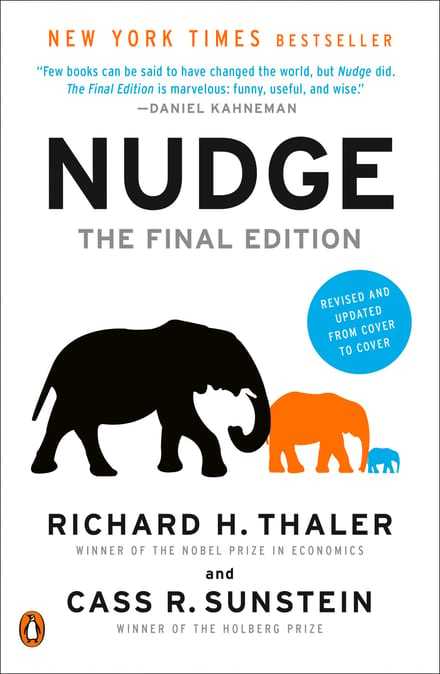
Nudge: Improving Decisions About Health, Wealth, and Happiness
The full book runs ~312 pages — roughly 6 hours of reading. You get the key ideas here in 4 minutes.
The key ideas
- Accept choice architecture is unavoidable, so design it deliberately
- Recognize the automatic brain that anchors, overweights vivid risks, and craves shortcuts
- Set smart defaults, the highest-leverage tool for shifting behavior
- Deploy social proof to make good behavior feel normal
- Design forgiving systems with feedback, error tolerance, and clear consequences
- Nudge beyond money into health, energy, and organ donation
The summary
No menu is neutral. The instant someone lays out options—food along a cafeteria line, funds in a retirement plan, boxes on an organ-donor form—they’ve already tilted the decision one way or another. Richard Thaler and Cass Sunstein build their whole book on that fact: since arranging choices is unavoidable, you might as well arrange them to help people, while leaving them free to go their own way. That’s a nudge—a small, cheap change to the environment that shifts behavior without banning anything or spending real money. Move the carrots to eye level and bury the fries, and kids eat up to 25% more vegetables. Etch a small fly into an airport urinal as a target, as Amsterdam’s Schiphol did, and spillage drops 80%. No lectures, no rules, just design that works with human nature instead of against it.
We run on autopilot more than we admit
The reason nudges work is that we don’t think as carefully as we imagine. Thaler and Sunstein describe two mental systems: an Automatic one that’s fast, intuitive, and effortless, and a Reflective one that’s slow and deliberate. We lean on the automatic system, which leaves us open to predictable biases. We anchor on the first number we hear, overweight whatever examples come to mind easily, feel a loss more sharply than an equal gain, and stick with whatever the current option happens to be. We’re also wildly overoptimistic: about half of marriages end in divorce, yet around the wedding almost every couple—including people who’ve already been divorced—puts their own odds at roughly zero. That’s why the author’s dinner guests thanked him for taking away a bowl of cashews. Standard economics says more choice can’t hurt, but they knew they’d mindlessly eat nuts they didn’t really want. We struggle most with temptation, inertia, and decisions whose consequences land years away, which is exactly where firms often profit from our weaknesses instead of fixing them—airlines once sold overpriced flight insurance at the gate precisely because nervous flyers would buy it.
Defaults are the strongest lever
Because people follow the path of least resistance, the default option quietly captures an enormous share of any decision—partly through inertia and loss aversion, partly because a default feels like an implicit endorsement from whoever set it. That makes defaults the most powerful tool a choice architect has. Switch a retirement plan from opt-in to automatic enrollment and participation jumps dramatically. The Save More Tomorrow program sidesteps the pain of a pay cut by having workers commit in advance to save more out of future raises. Target maturity funds, labeled with a retirement year like 2040, spare people from allocation decisions they tend to botch, automatically shifting toward safer holdings as the date nears. The counterexample is Sweden, which privatized part of its social security, offered hundreds of funds, and actively pushed people away from the sensible default; many ended up in high-fee, poorly diversified portfolios chasing advertising and hype. The rule that follows is simple: the more choices you give people, the more help you need to provide. Organ donation shows the human stakes. Under opt-in systems, inertia leaves thousands to die waiting for transplants; countries that switch to opt-out, presuming consent unless you decline, see donations climb, and even “mandated choice”—forcing a yes-or-no answer at license renewal—beats the status quo.
Make the good choice easy, and forgive mistakes
Two more principles round out good design. First, social proof: we take our cues from other people. A light eater eats more among heavy eaters; Minnesota raised tax compliance just by telling residents that most people already pay in full; “Don’t Mess with Texas” cut littering by tying it to local pride and local celebrities. Show people that others are doing the right thing and they follow. Second, design for humans who err. Good systems expect mistakes and forgive them—gas caps that tether to the car, email that warns you about the attachment you forgot, cameras that show an instant preview so you can reshoot. They also translate options into terms people actually understand: not a camera’s megapixel count but the largest sharp print it can make. The authors gather these ideas into the mnemonic NUDGES—incentives, understand mappings, defaults, give feedback, expect error, structure complex choices.
The bottom line
Someone is always arranging your choices, so the honest move is to arrange them well: set sensible defaults, give quick feedback, expect mistakes, and make consequences clear. The same tools that raise retirement savings and organ donation extend to energy use and the environment, and they cost almost nothing while leaving people free to opt out. Read this if you design anything other people use—or if you’d like to understand why you bought that extended warranty.
Fact check
Popular books repeat findings that later research has complicated. Where Nudge makes a testable claim, here's what the evidence actually shows.
Rearranging a cafeteria — carrots at eye level, fries out of easy reach — changes how much of a food children eat by as much as 25%.
Placement does move food choice, but by less than that. A meta-analysis of nudges aimed at fruit and vegetable choice found a pooled effect of d = 0.30, with placement changes the strongest single type at d = 0.39 — a real shift, well short of a dependable quarter. The book presents the 25% figure through a composite cafeteria director rather than a named trial, and much of the school-lunchroom research behind that era of the literature came from Brian Wansink's Cornell lab, whose study of vegetable intake in schools was retracted in 2018.
- Broers VJV, De Breucker C, Van den Broucke S, Luminet O. A systematic review and meta-analysis of the effectiveness of nudging to increase fruit and vegetable choice. Eur J Public Health. 2017;27(5):912-920. PubMed
- Wansink B, Just DR, Payne CR, Klinger MZ. Retraction notice to "Attractive Names Sustain Increased Vegetable Intake in Schools". Prev Med. 2018;110:116. PubMed
Switching a retirement plan from opt-in to automatic enrollment raises participation dramatically.
At the company Madrian and Shea studied, 86% of employees hired under automatic enrollment were in the 401(k), against 37% of the comparable cohort hired just before the switch at the same 3–15 months of tenure. Automatic enrollment also compressed the usual gaps: the Black–white participation difference fell from 21 percentage points (43% vs 22%) to 7 (88% vs 81%), and the pay-related spread from about 55 points to 15. The same study is the source of the book's other caution — most people then stay parked at whatever default contribution rate and fund they were given.
- Madrian BC, Shea DF. The power of suggestion: inertia in 401(k) participation and savings behavior. Q J Econ. 2001;116(4):1149-1187. Source
Nudges are a broadly effective, near-free way to shift behavior across health, money, energy and organ donation.
The headline meta-analysis is real: Mertens and colleagues pooled over 200 studies and 2,149,683 participants and reported an average effect of d = 0.45, with food choices the most responsive domain. A reanalysis of that same dataset by Maier and colleagues, using models that correct for publication bias, found no remaining evidence of an overall effect. Individual nudges with strong standalone evidence — defaults above all — still hold; it is the general claim about nudging as a category that does not survive the correction.
- Mertens S, Herberz M, Hahnel UJJ, Brosch T. The effectiveness of nudging: A meta-analysis of choice architecture interventions across behavioral domains. Proc Natl Acad Sci U S A. 2022;119(1):e2107346118. PubMed
- Maier M, Bartoš F, Stanley TD, Shanks DR, Harris AJL, Wagenmakers EJ. No evidence for nudging after adjusting for publication bias. Proc Natl Acad Sci U S A. 2022;119(31):e2200300119. PubMed
Frequently asked questions
What is Nudge about?
Thaler and Sunstein build the book on one fact: no menu is neutral, because the moment someone lays out options they've already tilted the decision one way or another. Since arranging choices is unavoidable, you might as well arrange them to help people while leaving them free to go their own way. That's a nudge, a small, cheap change to the environment that shifts behavior without banning anything, like moving carrots to eye level so kids eat more vegetables, or etching a fly into a urinal to cut spillage.
What are the key takeaways from Nudge?
We run on autopilot more than we admit, leaning on a fast Automatic mental system over the slow Reflective one, which leaves us anchoring on the first number, feeling losses more than gains, and sticking with the current option. Defaults are the strongest lever, so switching a retirement plan to automatic enrollment, or a country's organ donation to opt-out, dramatically changes participation, and Save More Tomorrow and target-date funds work the same way. Social proof matters, since telling people that most already comply raises compliance. Good systems design for humans who err, expecting mistakes and forgiving them, and translate options into terms people understand. The authors gather it into the mnemonic NUDGES.
Who should read Nudge?
Read this if you design anything other people use, or if you'd like to understand why you bought that extended warranty.
Is Nudge worth reading?
It lays out the foundational behavioral-economics ideas with vivid, sticky examples, the cashews, the urinal fly, the Swedish pension mess, that make the abstractions concrete and easy to apply. Some of the policy sections run long and dry, and a few examples now feel dated. But for anyone who shapes other people's choices, or wants to see the invisible design behind their own decisions, the core lessons about defaults and choice architecture are worth the read.