Book summary
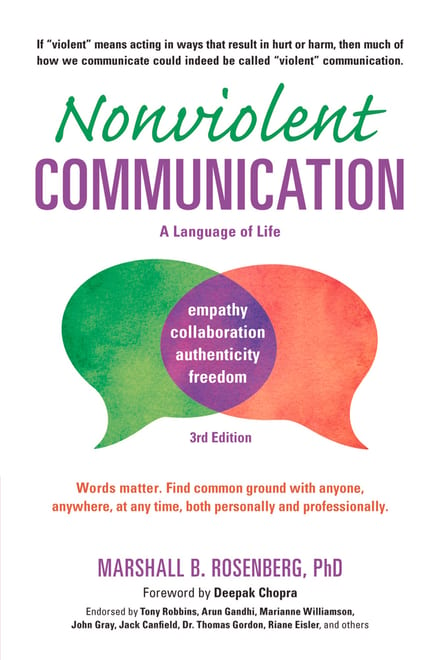
Nonviolent Communication: A Language of Life: Life-Changing Tools for Healthy Relationships
The full book runs ~227 pages — roughly 4 hours of reading. You get the key ideas here in 3 minutes.
The key ideas
- Observe facts objectively, never evaluate or label people
- Name feelings precisely with a richer emotional vocabulary
- Identify the unmet need behind every emotion
- Request action clearly using positive, specific language
- Apply the same compassion to your own self-talk
- Listen empathetically—reflect back instead of rushing to advise
The summary
Most conflict escalates for one reason: we label the person instead of naming what we lack. Call someone selfish, lazy, or stupid, and you’ve handed them a reason to defend themselves, and the real issue never gets touched. Rosenberg’s alternative, Nonviolent Communication, replaces the label with four honest pieces of information: what literally happened, the emotion it stirred in you, the need underneath that emotion, and one specific, doable request. Say those four things and the other person has nothing to defend against, because you’re describing your own experience rather than passing a verdict on theirs.
Judgment is the thing that alienates
The everyday language most of us use is what Rosenberg calls life-alienating, and moralistic judgments are its sharpest form, the critical or insulting words we reach for to mark someone as bad or wrong. He points to a striking finding: countries whose languages contain more judgmental words tend to have more violent crime. The habit of labeling and the habit of harm travel together. The way out is to look past the judgment to the need beneath your own feeling. If your child eats too many snacks at a party, “selfish” is the lazy verdict; what you actually feel is concern for her health and a wish to be fair to the others, and naming those needs, while acknowledging her own wish to enjoy the food, starts a conversation instead of a fight.
The four moves: observe, feel, need, request
The method comes down to four steps, and each one guards against a specific mistake.
- Observe without evaluating. “You didn’t take out the garbage this morning” is an observation; “you’re messy” is an evaluation, and evaluations put people on the defensive. Stay specific and present, and drop the generalizations, since “you never” and “you always” almost guarantee a defensive reply.
- Name the feeling precisely. Reach past “sad” for the exact word, whether it’s regretful, betrayed, or guilty, and expand your emotional vocabulary so you can. Vulnerability here isn’t weakness; expressing what you feel eases tension and lowers resentment.
- Identify the need behind it. This is where most people stumble, blaming others or themselves before they ever state what they need. If Bob leaves his dishes unwashed, skip “lazy” and explain the actual need: the mess adds stress to a busy day and makes you late. Other people’s actions are the stimulus of your feelings, never the cause, which means the need is yours to name.
- Make one clear request in positive language. Ask for what you do want, not for what you want stopped. “Stop spending so much time at work” is negative and easy to misread; the husband might just take Friday off to golf. Translated into a positive, specific request, it becomes “I’d like more time together as a family. Could you stay home on Friday evenings to watch movies with us?”
Put together, it sounds like this. Instead of calling a child messy and barking an order, you say: “When I see your toys in the living room, I feel frustrated, because I’d like the rooms we share to be more orderly, and I worry you might get hurt. Would you be willing to move your toys to your room once you’re done playing?” Observation, feeling, needs, request, with no label anywhere in it.
Turn the same compassion on yourself
The tools work inward as well as outward. Judgmental self-talk like “I’m so stupid” or “I failed again” is always powered by an unmet need, and finding that need turns self-hatred into self-compassion. Forget your own lunch because you were busy packing your kids’ meals, and the honest reading isn’t “I’m hopelessly forgetful,” it’s that you were so occupied caring for others that you overlooked your own need to be fed. Same facts, entirely different relationship with yourself.
Listen for feelings, and resolve conflict through needs
Half of communication is receiving, and NVC asks you to listen empathetically, actually feeling what the other person feels rather than jumping to advice. Often people don’t want to be fixed, they want to be heard, so show that you understand and confirm it by paraphrasing what they’ve said back to them. In an outright conflict, the sequence is the same. Establish a human connection first by surfacing both sides’ feelings and needs, make it sincerely clear that the aim is cooperation and not manipulation, and then work toward satisfaction, where everyone’s needs are met, rather than compromise, where some needs are quietly sacrificed. From there you make requests that are clear, specific, and reasonable with every party’s needs in view.
The bottom line
When you trade labels for observations, feelings, needs, and requests, you remove the other person’s reason to defend themselves, and the argument you keep having can finally move. It works because it’s honest without being aggressive and vulnerable without being weak. Read this if you’re tired of the same fights looping endlessly, or want to stop punishing yourself for small mistakes.
Fact check
Popular books repeat findings that later research has complicated. Where Nonviolent Communication makes a testable claim, here's what the evidence actually shows.
Naming a feeling precisely, instead of labeling the other person, lowers the emotional charge.
Putting a feeling into words does damp it down. Lieberman's imaging work found that labeling an emotion reduced amygdala response to affective images, and a follow-up study found self-reported distress dropped during affect labeling by about as much as under deliberate reappraisal or distraction. The effect is modest and blunts positive feeling along with negative, and people reliably predict labeling will make them feel worse — part of why the habit is hard to take up.
- Lieberman MD, Eisenberger NI, Crockett MJ, Tom SM, Pfeifer JH, Way BM. Putting feelings into words: affect labeling disrupts amygdala activity in response to affective stimuli. Psychol Sci. 2007;18(5):421-428. PubMed
- Lieberman MD, Inagaki TK, Tabibnia G, Crockett MJ. Subjective responses to emotional stimuli during labeling, reappraisal, and distraction. Emotion. 2011;11(3):468-480. PubMed
Other people's actions are the stimulus of your feelings but never the cause — the cause is always your own unmet need.
How you appraise an event genuinely changes what you feel: a meta-analysis of 306 experimental comparisons found cognitive reappraisal shifted emotional outcomes at d = 0.36, with perspective-taking the most effective variant. That is a small-to-medium effect, not a switch. "Never the cause" is stronger than the evidence supports — appraisal moderates an emotional response rather than fully accounting for it — though the practical half of Rosenberg's advice holds up, since the same review found that suppressing the experience of an emotion backfires while re-reading the situation helps.
- Webb TL, Miles E, Sheeran P. Dealing with feeling: a meta-analysis of the effectiveness of strategies derived from the process model of emotion regulation. Psychol Bull. 2012;138(4):775-808. PubMed
Learning the NVC sequence — observation, feeling, need, request, plus empathic listening — measurably improves how people communicate.
Training moves self-report more clearly than it moves behavior. A study of 312 French medical students (123 trained, 189 controls) found higher Jefferson Scale empathy three months after 2.5 days of NVC training, but no change on implicit cognitive measures of perspective-taking. A 2026 randomized trial of 198 medical students found the NVC group improved more on both empathy scores and observed consultation performance. The evidence base is short-term, concentrated in medical and nursing education, and measured mostly on questionnaires rather than in real disputes.
- Epinat-Duclos J, Foncelle A, Quesque F, Chabanat E, Duguet A, Van der Henst JB, Rossetti Y. Does nonviolent communication education improve empathy in French medical students? Int J Med Educ. 2021;12:205-218. PubMed
- Jiang D, Yuan X, Wang M, Qiu H, Bian T. Nonviolent communication training among undergraduate medical students in emergency medicine teaching: a randomized controlled educational trial. BMC Med Educ. 2026. PubMed
Frequently asked questions
What is Nonviolent Communication about?
Marshall Rosenberg's insight is that most conflict escalates because we label the person instead of naming what we lack, and a label like selfish or lazy just hands someone a reason to defend themselves while the real issue goes untouched. His alternative replaces the label with four honest pieces of information: what literally happened, the emotion it stirred, the need underneath, and one specific request. Say those four things and the other person has nothing to defend against, because you're describing your own experience rather than passing a verdict on theirs.
What are the key takeaways from Nonviolent Communication?
The method is four moves, each guarding against a mistake: observe without evaluating ("you didn't take out the garbage," not "you're messy"), name the feeling precisely instead of settling for "sad," identify the need behind the feeling rather than blaming, and make one clear request in positive language, asking for what you do want. Judgment is what alienates, so look past it to the need beneath your own feeling. The same tools turn inward, converting self-hatred like "I'm so stupid" into self-compassion by finding the unmet need. And half of communication is receiving, so listen empathetically and paraphrase, then resolve conflict by satisfying everyone's needs rather than settling for compromise where some needs get quietly sacrificed.
Who should read Nonviolent Communication?
Read this if you're tired of the same fights looping endlessly, or want to stop punishing yourself for small mistakes.
Is Nonviolent Communication worth reading?
The four-step framework is clear and genuinely portable, working on other people and on your own harsh self-talk, and it's honest without being aggressive. The scripted phrasing can feel stilted or formulaic when you first try it aloud, and it takes real practice before the words stop sounding rehearsed. If you push through that awkward stage, it gives you a reliable way to move a conversation that keeps looping.