Book summary
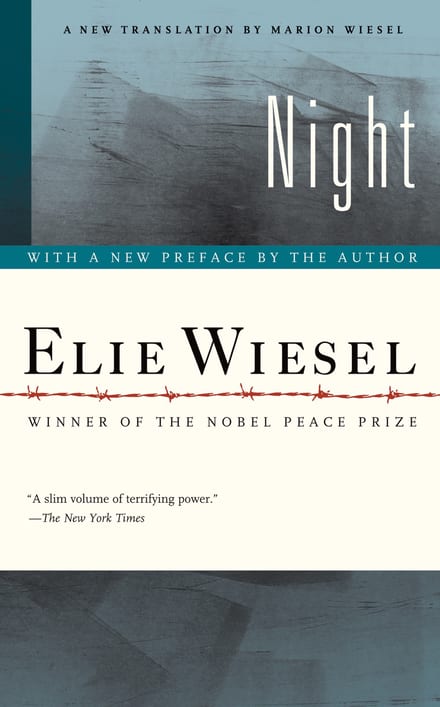
Night
The full book runs ~152 pages — roughly 3 hours of reading. You get the key ideas here in 5 minutes.
The key ideas
- Moishe the Beadle escaped a Gestapo massacre and walked back to Sighet to warn his neighbors; they decided he was mad.
- Eight words on the Birkenau platform — "Men to the left! Women to the right!" — took his mother and little sister forever.
- The camps did not end his belief in God but put God on trial: "I was the accuser, God the accused."
- Hunger dismantled the bond between fathers and sons, and Wiesel indicts himself too, resenting his father for drawing a Kapo's blows.
- On his father's last night he heard his name called from the bunk below and, fearing the SS club, said nothing.
The summary
Moishe the Beadle came back to Sighet in 1942 to describe his own death. Deported with the town’s foreign Jews, he had been driven into a forest near Kolomay and made to dig a trench; then the Gestapo shot the deportees one by one as they offered their necks, tossing infants in the air for machine-gun practice. A bullet caught his leg and he was left for dead. He walked back to Transylvania and went from house to house: “Jews, listen to me! That’s all I ask of you. No money. No pity. Just listen to me!” The town decided he had lost his mind. Elie Wiesel, then a boy who studied Talmud by day and Kabbalah at night, listened often and felt only pity. Eighteen months later the yellow star came, then the ghetto, then the cattle cars, and the boy who had not believed the witness became one.
Delusion outlasts the evidence
Every stage of the destruction arrived with a reassuring interpretation attached. A German officer billeted across the street brought Mrs. Kahn a box of chocolates, and the optimists were jubilant. “The yellow star? So what? It’s not lethal,” said Wiesel’s father, whom the whole community consulted. “The ghetto was ruled by neither German nor Jew,” Wiesel writes; “it was ruled by delusion.” The night the transports were announced, someone knocked at the sealed-over window — a Hungarian police inspector, a friend with a warning. By the time they got it open there was nobody outside. In the cattle car, Mrs. Schachter screamed for three nights about a fire only she could see; the others bound her, gagged her and beat her quiet. Then the train stopped, and above the platform stood a chimney with flames coming out of it.
Eight words
“Men to the left! Women to the right!” Eight words, Wiesel counts, spoken quietly, indifferently, without emotion. He felt his father’s hand take his, saw his mother stroking seven-year-old Tzipora’s blond hair as they moved right, and did not know this was the moment he lost them. A veteran inmate hissed at them in the dark: say eighteen, not fifteen; say forty, not fifty. A man with a monocle and a conductor’s baton flicked them both left; the name Mengele meant nothing to him yet. They marched toward a pit of flames where a truck was unloading small children, Wiesel whispering the Kaddish for himself. Two steps short of it, the column turned. Within hours his hair and clothes were gone; days later a needle put A-7713 on his left arm: “From then on, I had no other name.” The boy who had begged for a teacher of Kabbalah, he writes, was consumed by the flames, leaving a shape that resembled him.
God in the dock
Wiesel does not stop believing in God. He stops absolving Him. “I was not denying His existence,” he writes, “but I doubted His absolute justice.” When the SS hang a child — the Dutch Oberkapo’s young servant, too light for the rope to finish quickly, writhing for half an hour while the camp files past his face — a voice behind Wiesel asks where God is, and a voice inside him answers: “Where He is? This is where — hanging here from this gallows.” That evening the soup tasted of corpses. At Rosh Hashanah ten thousand prisoners bent like trees in a storm to bless the Almighty; Wiesel stood among them refusing: “I was the accuser, God the accused.” The camp’s cruel arithmetic was that faith also worked as fuel. Akiba Drumer, who insisted the suffering was a divine test, felt his belief crack and stopped fighting; he went to the selection offering his neck, asking only that his friends say Kaddish in three days. Three days later they forgot.
What hunger does to a son
The book’s true subject is the bond between father and son, and how methodically a camp destroys it. That bond keeps Wiesel upright: on the death march out of Buna, with a freshly operated foot bleeding into the snow, his father is the only reason he keeps moving. It is also what the camp works on. When the Kapo Idek beats his father with an iron bar, Wiesel watches without moving, and the anger he feels is aimed at his father for drawing the blows: “That was what life in a concentration camp had made of me.” In a roofless cattle car, German workers throw bread in to watch men fight over it, and a son beats his own father to death for a crust: “Meir, my little Meir! Don’t you recognize me… You’re killing your father.” Then one line: “I was sixteen.” At Buchenwald a block leader tells him to stop feeding his dying father and take the rations himself, and for a fraction of a second he agrees. On the night of January 28, 1945, his father, wasted by dysentery, calls his name from the bunk below. An SS officer clubs him quiet. Wiesel, lying above him, does not move. By morning the cot held someone else. He could not weep, and found in himself something like: free at last.
The bottom line
Wiesel offers no redemption, and he distrusts the words left to him — hunger, fire, chimney, selection all mean something else after 1944 — which is why the book is so short and so bare. He will not call his survival a miracle either; it was chance, and what he did with it was become a witness, since forgetting the dead would kill them twice. The book ends with him looking into a mirror for the first time since the ghetto and finding a corpse looking back. Read it slowly, and read it if you want this history without the consolation that suffering ennobles.
Frequently asked questions
What is Night about?
Elie Wiesel's account of being deported from Sighet at fifteen and surviving Auschwitz, Buna and Buchenwald. Eight words on the Birkenau platform — "Men to the left! Women to the right!" — took his mother and seven-year-old sister; the rest of the book follows him and his father through starvation, a death march, and the night his father died in the bunk below him. It is a short, stripped-down record of what the camps did to a boy's family and his faith.
What are the key takeaways from Night?
The book shows rather than instructs. A whole town talked itself out of believing Moishe the Beadle, who came back from a Gestapo massacre to warn them — "the ghetto was ruled by delusion." Wiesel doesn't lose God so much as put Him on trial, standing at Rosh Hashanah as "the accuser, God the accused." And hunger works methodically on the bond between fathers and sons, which is where Wiesel indicts himself alongside everyone else.
Who should read Night?
Anyone who wants the Holocaust from inside it rather than at the distance of history, and readers who can take an account with no consolation in it. It's brief enough for one sitting, but it asks to be read slowly.
Is Night worth reading?
Yes, and few books earn that more plainly. Wiesel distrusts the words left to him after 1944 — hunger, fire, chimney, selection all mean something else now — which is why the book is so bare and so hard to put down or forget. Expect no redemption arc: it ends with him looking in a mirror and finding a corpse.