Book summary
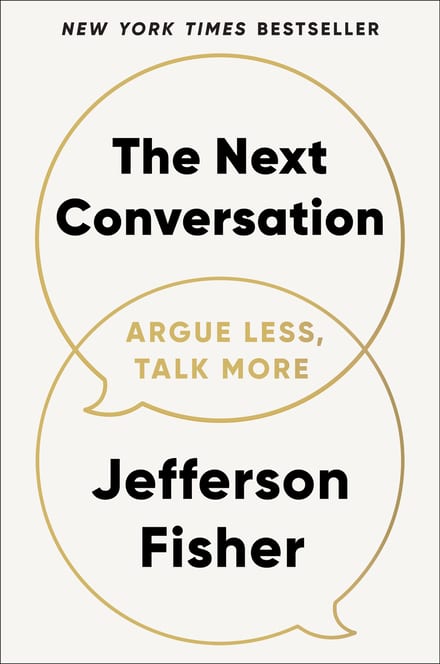
The Next Conversation: Argue Less, Talk More
The key ideas
- Aim for the core issue, not victory.
- Read anger as a threat, not an attack.
- Breathe, scan, and pause before you react.
- Practice assertive actions; confidence follows.
- Frame conversations and redirect deflections calmly.
- Set boundaries with clear consequences you enforce.
The summary
Win the argument and you lose almost everything worth having — the other person’s trust, their respect, the relationship. Jefferson Fisher’s core move is to give up on winning entirely. The real goal of any disagreement is to reach the core issue, and the person raising their voice at you usually isn’t showing you their whole self. Anger, defensiveness, and stubbornness are surface weather over some hidden driver: a fear, a wound, a threat they couldn’t name if you asked. Your task is to find that driver, and you don’t have to fix the whole relationship to do it. You just have to fix the next conversation.
Winning is the losing move
Treat conflict as an opening for connection rather than a battle for points. Most conversations fail because we bring impossible goals to them — expecting an instant apology, or for the other person to abandon their view and adopt ours. Drop those and get curious instead: what is this person actually afraid of, and what do they hope for? Before a hard talk, name your own values to yourself, kindness or honesty or whatever they are, so you can move through the conflict without trading away your integrity. And remember that a text or email is information transmission, not connection; real connection needs both private understanding and some outward acknowledgment that the other person has been heard.
Every argument is a body before it’s a mind
A heated exchange runs in two physiological phases. First ignition: fight-or-flight floods in, rational thought switches off, and communication turns destructive. Then cooling, when the body settles and reflection becomes possible again. Ignition is set off by triggers — usually a psychological threat to your identity (your competence, your autonomy), to your social standing (fear of judgment), or to something you’re scared of losing. The trick is to study your own triggers first. Once you can feel your own fire catch, you start hearing someone else’s raised voice not as an attack but as a plea to remove a threat. Find their trigger and you can put out their fire.
Steady yourself first
The most important moment in any conflict is the instant right before ignition, and three small practices keep it from catching. Take a conversational breath — two deep inhales through the nose, then a long exhale, repeated — to keep your head clear. Do a quick scan of your physical and mental state and label what you find (“I’m tense,” “I’m getting defensive”). And use a short, action-based phrase you repeat to yourself, something like “Find the heart of it” or “Stand firm.” Then slow down. Rushing your words signals anxiety and breeds mistakes, while a deliberate pause adds weight and shows you’re steering. Short pauses of one to four seconds make you look considered and credible; long pauses of five to ten seconds hand the silence back to the other person and make them reflect on what they just said — which is exactly what you want after an insult or a lie. It’s like using the brakes on a car: control the speed and you can steer the whole thing somewhere constructive.
Assertiveness builds confidence, not the reverse
Confidence is a feeling; assertiveness is an action. You can’t summon the feeling on command, but you can act assertively and let the confidence follow as a feedback loop. Cut the minimizing words — “just,” “sorry” — that shrink your point. State your needs in “I” statements. Replace filler with silence. Let sentences fall on a downward inflection so they land as statements, not questions. When someone tries to bait you, don’t hand them the emotional reaction they came for: use a long pause, ask them to repeat themselves, or ask a question aimed at their intent, like “Did you want that to hurt?” It quietly returns the discomfort to them. And when you get a non-apology — “I’m sorry you feel that way” — refuse the dodge: “Don’t apologize for my feelings, apologize for what you did.”
Frame the conversation, then guard the frame
A frame keeps a talk from sprawling into a fight. State the topic, define the outcome you want, and get the other person’s commitment to it; if they drift or deflect, acknowledge the point and steer calmly back. To keep defensiveness from flaring on either side, pause before answering, get curious, open with “I” rather than “you,” and ask “what” or “how” instead of an accusing “why.” You don’t owe every argument your attendance — declining some is how you keep a wall from going up between you.
Boundaries need the same clarity. Say “no” directly, thank them for asking, and end on something kind. To enforce a limit, assert it with an “I” statement (“I don’t accept disrespect”), spell out the consequence (“If you continue, I will end this conversation”), and then actually follow through, or the boundary means nothing. For genuinely hard conversations, pick a dedicated time and place and lead with the point — “This is going to be hard to hear” — since opening with small talk reads as insincere. If someone brings a hard conversation to you, acknowledge the nerve it took (“Thank you for telling me”), and resist hijacking it with your own stories; ask permission before offering what you’ve learned.
The bottom line
Never try to win an argument, or you’ll lose far more than you gain; regulate your body before you respond, speak with assertive words that protect your values, and stop trying to overhaul the whole relationship. Change the next conversation instead, framing it as something to learn rather than something to prove. Read this if you’re tired of arguments that go nowhere and want concrete tools to stop reacting and start connecting.
Fact check
Popular books repeat findings that later research has complicated. Where The Next Conversation makes a testable claim, here's what the evidence actually shows.
The "conversational breath" — two inhales through the nose followed by one long exhale — settles you down better than other breathing techniques.
A Stanford randomized trial tested exactly this pattern, which the researchers call cyclic sighing, and it came out ahead: five minutes a day for 28 days produced greater mood improvement and a greater drop in respiratory rate than mindfulness meditation, box breathing, or cyclic hyperventilation. The evidence is thinner than the book's confidence suggests — 108 people enrolled, 100 finished, and only 27 of those were in the cyclic sighing arm. It also tested a daily practice, not the mid-argument rescue Fisher prescribes, so the effect on someone whose fight-or-flight response has already fired is untested.
- Balban MY, Neri E, Kogon MM, et al. Brief structured respiration practices enhance mood and reduce physiological arousal. Cell Rep Med. 2023;4(1):100895. PubMed
Once a conflict trigger sets off fight-or-flight, rational thought switches off until the body cools down.
The mechanism behind this is real. Even mild, uncontrollable acute stress causes a rapid loss of prefrontal cognitive function through catecholamine signalling, which is why people reason badly when they are flooded. But the prefrontal cortex is degraded rather than switched off, and how much capacity is lost depends on how intense and how controllable the stressor feels. Fisher's two-phase ignition-then-cooling picture is a workable simplification of a graded shift, not a physiological on/off switch.
- Arnsten AF. Stress signalling pathways that impair prefrontal cortex structure and function. Nat Rev Neurosci. 2009;10(6):410-22. PubMed
Pausing for one to four seconds before you reply makes you come across as more considered and more credible.
Measured listener reactions turn negative well before one second. When 380 people rated identical affirmative replies that differed only in how long the speaker waited, ratings of the responder's willingness dropped off at 600 ms, with a significant difference between 700 and 800 ms. A separate study found faster responses signal social connection on a scale under 250 ms, and that outside listeners rated the same conversations as less connected once response times were slowed. Slowing down may still steady you, but a listener is unlikely to read a multi-second gap as thoughtfulness.
- Roberts F, Francis AL. Identifying a temporal threshold of tolerance for silent gaps after requests. J Acoust Soc Am. 2013;133(6):EL471-7. PubMed
- Templeton EM, Chang LJ, Reynolds EA, Cone LeBeaumont MD, Wheatley T. Fast response times signal social connection in conversation. Proc Natl Acad Sci U S A. 2022;119(4):e2116915119. PubMed
Frequently asked questions
What is The Next Conversation about?
Jefferson Fisher's core move is to give up on winning arguments entirely, because winning costs you the other person's trust, respect, and the relationship. The real goal of any disagreement is to reach the core issue, since the person raising their voice usually isn't showing you their whole self, only surface weather over a hidden fear or wound. Your task is to find that driver, and you don't have to fix the whole relationship to do it. You just have to fix the next conversation.
What are the key takeaways from The Next Conversation?
Treat conflict as an opening for connection and drop impossible goals like an instant apology. Every argument is a body before it's a mind: it runs through "ignition," when fight-or-flight shuts off rational thought, and "cooling," set off by threats to your identity, standing, or something you fear losing. Steady yourself first with a conversational breath, a quick self-scan, a short anchor phrase, and deliberate pauses, since a five-to-ten-second silence hands reflection back to the other person. Assertiveness builds confidence, not the reverse, so cut minimizing words, use "I" statements, and refuse to hand over the reaction a baiter wants. And frame the conversation, guard the frame, and enforce boundaries by stating the limit, the consequence, and then following through.
Who should read The Next Conversation?
Read this if you're tired of arguments that go nowhere and want concrete tools to stop reacting and start connecting.
Is The Next Conversation worth reading?
Its strength is the tactical, physical detail: the conversational breath, timed pauses, downward inflection, and scripted responses to non-apologies give you specific things to do mid-argument rather than vague encouragement. It stays tightly focused on that one skill, and readers who've absorbed similar communication advice may find some pieces familiar. But the emphasis on regulating your body before you respond, and on fixing the next conversation instead of the whole relationship, is a practical, memorable frame.