Book summary
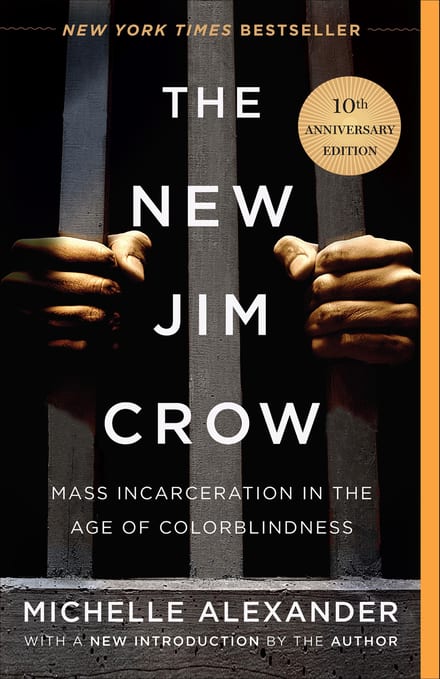
The New Jim Crow
Mass Incarceration in the Age of Colorblindness
The full book runs ~301 pages — roughly 6 hours of reading. You get the key ideas here in 5 minutes.
The key ideas
- Rebranded: racial control mutates from slavery to Jim Crow to prisons.
- Weaponized: the War on Drugs targeted black communities for political gain.
- Disproportionate: equal drug use, wildly unequal arrests and sentences.
- Shielded: courts demand proof of intent, making bias unprovable.
- Branded: the felony label strips jobs, housing, votes for life.
- Deceptive: 'personal responsibility' disguises a system rigged against the poor.
The summary
America didn’t end racial caste; it redesigned it. Mass incarceration is the latest version of a system of control that runs through slavery and Jim Crow, and it works in three moves. The War on Drugs supplies the arrests, plea deals supply the convictions, and the felony label then legally strips people of work, housing, benefits, and the vote for the rest of their lives. What makes this version so durable is that it operates in colorblind language, which renders it nearly invisible and politically untouchable.
Racial caste keeps getting reborn
Since the nation’s founding, African Americans have been controlled through institutions that seem to die and are then reborn in a form tailored to the moment. When slavery collapsed and Reconstruction briefly advanced Black citizenship, Jim Crow laws emerged to preserve the status of white elites, and the criminal justice system was used to force African Americans back into extreme repression. When the Civil Rights Movement dismantled Jim Crow, conservatives reached for “law and order” rhetoric — the Southern Strategy — using racially coded language to appeal to working-class whites without explicit slurs. As Alexander puts it, proponents of racial hierarchy discovered they could install a new caste system without breaking the law by demanding “law and order” rather than “segregation forever.”
The War on Drugs as political strategy
The Reagan administration launched the War on Drugs not in response to a drug crisis but as a strategy to target inner-city communities and cement a new Republican majority, then ran a media campaign in 1985 to sensationalize crack cocaine and build public support. Cloaked in race-neutral terms, the drug war gave whites opposed to racial reform a way to express hostility to Black progress without being called racist. It became the engine of mass incarceration by trampling Fourth Amendment protections, as the Supreme Court granted police sweeping power to stop, question, and search people without warrants or probable cause. Money sealed the arrangement: programs like the Edward Byrne grants tied federal funding to the number of drug arrests, and forfeiture laws let agencies keep seized cash and property, giving police an enormous stake not in the drug war’s success but in its perpetual existence.
The conviction machine
Once police make the arrests, the courts manufacture the convictions. Inadequate legal representation and the threat of harsh mandatory minimums push people, including innocent ones, to plead guilty. Tens of thousands of poor people go to jail each year without ever speaking to a lawyer, and those who do often spend only a few minutes on a case before a decision that will shape the rest of their lives. The system, Alexander argues, is no longer primarily about preventing and punishing crime but about managing and controlling the dispossessed.
The racial skew is the point. Drug use and sales run at similar rates across racial lines — studies suggest white youth are arguably more likely to deal than Black youth — yet the drug war is waged almost entirely in poor communities of color. The idea that most drug activity happens in the ghetto is pure fiction; trafficking occurs everywhere. Media and political rhetoric fused “blackness” with “crime” until police treated African Americans as the enemy in the war.
Colorblind rules that shield the bias
The courts then made the discrimination almost impossible to challenge by requiring proof of explicit, intentional bias by an individual officer or prosecutor. In McCleskey v. Kemp, the Supreme Court rejected the Baldus study, which found that defendants charged with killing white victims received the death penalty eleven times more often than those charged with killing Black victims. The Court’s answer, in effect, was that racial bias would be tolerated to almost any degree so long as no one admitted to it. Later precedents locked the door: Whren v. United States lets police use minor traffic violations as a pretext for drug investigations, and Armstrong requires defendants to produce evidence of selective prosecution before they can even access the files needed to prove it.
The felony label as a life sentence
The final move is the mark that follows people out of prison. Branded a felon, you become a second-class citizen subject to lifetime surveillance and rearrest, often for minor infractions. A criminal record today authorizes precisely the forms of discrimination the country claims to have left behind — in employment, housing, education, public benefits, and jury service. Public housing agencies are pushed to exclude and evict anyone with a record, and court fees, fines, and accumulated child support can pile into debts that send people back to prison for failure to pay, trapping the poor in a cycle of poverty and imprisonment. Felon disenfranchisement laws have shrunk the Black electorate more effectively than poll taxes or literacy tests ever did.
The system’s genius is that it looks voluntary. People choose to commit crimes, we’re told, so they’re locked up or locked out — which makes the politics of personal responsibility tempting. But everyone breaks the law at some point; if the worst thing you’ve done is speed ten miles over the limit, you’ve endangered others more than someone smoking marijuana in their living room. Yet people serve life sentences for first-time drug offenses in the United States, something virtually unheard of anywhere else in the world.
The bottom line
Mass incarceration is a racial caste system that uses the drug war and colorblind law to trap millions, disproportionately Black Americans, in a permanent underclass stripped of the rights the country claims to guarantee everyone. Dismantling it, Alexander argues, requires a grassroots movement willing to talk openly about race rather than piecemeal reform. Read this if you want to understand how systemic racism actually operates in modern America.
Fact check
Popular books repeat findings that later research has complicated. Where The New Jim Crow makes a testable claim, here's what the evidence actually shows.
Drug use and dealing occur at similar rates across racial lines — white youth are arguably more likely to deal — so the racial skew in drug arrests reflects enforcement, not behavior.
Use rates really are close: national survey data show African Americans no more likely than whites to use marijuana, yet about 2.5 times more likely to be arrested for possession. On the dealing side, a study of 12-to-29-year-olds found that African Americans' higher odds of a drug-distribution arrest were not explained by differences in offending or community context, though Hispanic respondents' were — which supports Alexander's conclusion without supporting the specific line that white youth deal more, a claim self-report data do not clearly establish. Part of the possession gap also traces to transaction setting rather than enforcement bias alone: Black users were roughly twice as likely to buy outdoors (0.31 vs 0.14) and three times as likely to buy from a stranger (0.30 vs 0.09).
The Baldus study found that defendants charged with killing white victims received the death penalty eleven times more often than those charged with killing Black victims.
The figure is the Supreme Court's own recitation. In McCleskey v. Kemp the majority summarized Baldus as finding that Georgia defendants charged with killing white victims received the death penalty in 11% of cases against 1% for those charged with killing Black victims. Broken out by pairing, death was imposed in 22% of Black-defendant/white-victim cases and 3% of white-defendant/Black-victim cases. Controlling for 39 nonracial variables narrowed the gap but did not close it — killing a white victim still carried 4.3 times the odds of a death sentence — and the Court accepted the statistics while rejecting the claim, holding that McCleskey had to prove intentional discrimination in his own case.
- McCleskey v Kemp, 481 US 279 (1987). Supreme Court of the United States. Source
Felon disenfranchisement laws have shrunk the Black electorate more effectively than poll taxes or literacy tests ever did.
Felony disenfranchisement is large and sharply racialized: about 4 million Americans were barred from voting in 2024, including 4.5% of voting-age African Americans — one in 22, against 1.3% of everyone else — and more than one in ten Black adults in Arizona, Florida, Kentucky, South Dakota and Tennessee. It is not on the scale of the Jim Crow devices, though. Under poll taxes and literacy tests, Black voting-age registration stood at 6.4% in Mississippi in 1964 and 19.4% in Alabama, meaning the overwhelming majority were excluded rather than one in 22. Alexander's argument that the newer mechanism is more durable because it is race-neutral on its face is a separate point and is not touched by these numbers.
People in the United States serve life sentences for first-time drug offenses, a punishment virtually unheard of elsewhere.
The Supreme Court upheld precisely this in 1991: Ronald Harmelin, who had no prior felony convictions, received Michigan's mandatory life-without-parole term for possessing 672 grams of cocaine, and the Court found no Eighth Amendment proportionality bar for noncapital sentences. The practice is not a stray case — the ACLU documented 3,278 people serving life without parole for nonviolent offenses, an estimated 65% of them Black, with drug crimes the largest category. The international half of the claim rests on the ACLU's comparative survey, which places the US as an outlier among peer countries but argues the point qualitatively rather than with a country-by-country count.
Frequently asked questions
What is The New Jim Crow about?
Michelle Alexander argues that America didn't end racial caste, it redesigned it, and mass incarceration is the latest version of a system running through slavery and Jim Crow. It works in three moves: the War on Drugs supplies the arrests, plea deals supply the convictions, and the felony label then legally strips people of work, housing, benefits, and the vote for life. What makes this version so durable is that it operates in colorblind language, which renders it nearly invisible and politically untouchable.
What are the key takeaways from The New Jim Crow?
Racial caste keeps getting reborn in whatever form fits the moment, and the "law and order" rhetoric of the Southern Strategy let politicians preserve hierarchy without explicit slurs. The War on Drugs was launched as political strategy, not a response to a drug crisis, and forfeiture laws and Byrne grants gave police a financial stake in its perpetual existence. The courts then manufacture convictions through inadequate representation and mandatory minimums, even as drug use runs at similar rates across racial lines. Colorblind rulings like McCleskey, Whren, and Armstrong shield the bias by demanding proof of explicit intent. And the felony label works like a life sentence, authorizing legal discrimination in jobs, housing, and voting that shrinks the Black electorate more than poll taxes ever did.
Who should read The New Jim Crow?
Read this if you want to understand how systemic racism actually operates in modern America, beyond individual prejudice and in the machinery of law and policy.
Is The New Jim Crow worth reading?
It's a rigorous, sobering account that connects drug policy, court rulings, and the felony label into a single system, backed by cases and studies rather than assertion. The argument is dense and legal in places, and it stays tightly focused on one thesis, so readers wanting a broad survey of racial inequality will find it deliberately narrow. For understanding how mass incarceration functions as caste, it's essential and hard to unsee once read.