Book summary
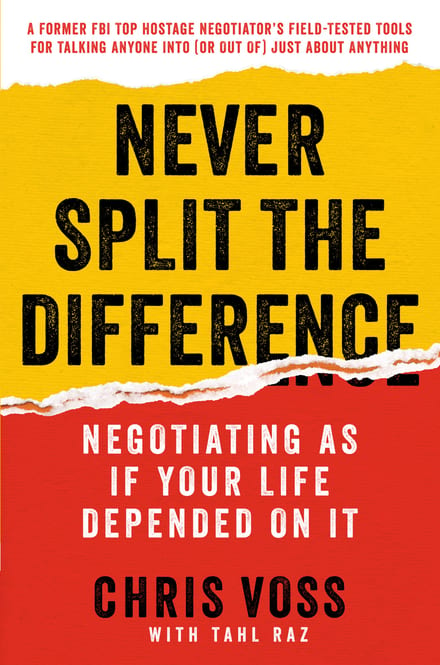
Never Split the Difference: Negotiating as if Your Life Depended on It
The full book runs ~288 pages — roughly 5 hours of reading. You get the key ideas here in 4 minutes.
The key ideas
- Listen actively—negotiation is discovery, not debate.
- Mirror and label emotions to build trust and gather intel.
- Chase 'no' and 'that's right,' not empty 'yes.'
- Refuse compromise; use calibrated 'how' and 'what' questions.
- Audit accusations upfront to defuse emotional obstacles.
- Hunt Black Swans—hidden facts that change everything.
The summary
Negotiation isn’t an argument you win with better logic. Chris Voss, who spent decades talking people out of hostage situations for the FBI, treats it as emotional reconnaissance. The person across the table—whether they’re holding a hostage or holding out on your salary—isn’t a spreadsheet weighing options. They’re moved by fear, by the need to feel understood, and above all by the urge not to lose. Your job isn’t to out-reason them; it’s to draw out what they actually want, make them feel safe enough to say it, and use that intelligence to reach a better deal than any tidy compromise.
Discovery, not debate
Most people run a negotiation like a debate: wait for your turn, deploy your arguments, push for yes. Voss says flip it. You’re there to gather information, and the tool is real listening—the kind that makes someone feel heard, not the polite nodding kind.
Voice does a surprising amount of the work. Your default should be the warm, easygoing “playful” voice that signals collaboration. When you need to land something serious, drop into the slow, calm “late-night FM DJ” voice that carries authority without triggering defensiveness. Keep the blunt, assertive voice for rare moments; it mostly invites pushback. Then mirror: simply repeat the last one to three important words the other person said. It feels almost too simple, but it builds comfort, buys you thinking time, and keeps them talking—and the more they talk, the more you learn. In one study, waiters who mirrored their customers earned 70% higher tips than those who piled on positive reinforcement.
Name the emotion
Once they’re talking, practice what Voss calls tactical empathy: read the face, the gestures, the shift in tone, and find the feeling under the words. Then say it out loud. Labels open with “It seems like…,” “It sounds like…,” or “It looks like…"—“It sounds like you’re worried this timeline won’t hold.” A label validates the emotion without conceding the position, and naming a negative feeling tends to drain it while naming a positive one reinforces it. Behavior is what you see; the label reaches for the motive underneath.
Do this preemptively with an accusation audit. Before you make an ask, list the worst things your counterpart could think about you and say them first: “You probably think I’m lowballing you.” It feels masochistic, but it taps their empathy—they’ll often rush to reassure you it’s not that bad, clearing the emotional obstacle before it can harden.
Chase “no,” not “yes”
Pushing for an early yes is a trap, because there are three of them: the counterfeit yes people give to escape you, the reflexive confirmation yes, and the real commitment yes—and you can’t tell them apart. “No” is more honest. It doesn’t end the negotiation; it starts it. A no usually means “I’m not ready,” “I need more,” or “I’m uneasy,” and it brings the real issues up while making the other person feel safe and in control. So instead of “Is now a good time to talk?” ask “Is now a bad time?"—a no hands you their full attention. What you’re really after is “that’s right,” the moment they hear their own position summarized back and feel truly understood. Get there by restating their story in your own words until they confirm you’ve captured it; that’s the opening for everything that follows.
Never split the difference
Compromise sounds mature and is often a mistake. Voss tells of a couple who couldn’t agree on black or brown shoes for a suit and “compromised”—the husband wore one of each, the single worst outcome available. Splitting the difference is what you do out of fear or fatigue, not because it serves your goal.
Reach instead for calibrated questions, open prompts that begin with “how” or “what” rather than the accusatory “why.” Hit with an unreasonable demand, answer “How am I supposed to do that?"—you haven’t refused, you’ve handed them your problem to solve. Watch the word “fair,” too: when someone insists they only want what’s fair, they’re often about to squeeze you, so turn it around—“I want you to feel this is fair; stop me if it isn’t.” When you do talk numbers, anchor their emotions by naming their fears, since people take bigger risks to avoid a loss than to score a gain. Let them name a price first when you can; it might beat your expectation. Use precise, odd figures like $37,850 rather than $40,000, which read as carefully calculated rather than plucked from air. Voss’s Ackerman method even scripts the climb—open at 65% of your target, then rise in shrinking steps to 85, 95, and 100%, saying an empathetic no before each bump and tossing in a non-monetary item at the end to signal you’re truly tapped out.
Hunt the Black Swan
Every negotiation is really an information hunt, and the richest prize is what Voss calls a Black Swan—a hidden fact that would change everything. Learn that a seller is under financial pressure and you’ve found yours. You surface these by staying in the room, reading cues, and building rapport through the Similarity Principle: people trust those who seem like them. Watch for gaps between words and delivery—by the 7-38-55 rule, only 7% of meaning rides on the words, 38% on tone, and 55% on body language, so when they don’t line up, something’s being hidden. Liars tend to talk more, lean on distancing pronouns like “they” instead of “I,” and dodge ownership. And the Rule of Three—getting someone to affirm the same thing three different ways—makes hollow agreement hard to sustain.
The bottom line
Good negotiation makes the other person feel understood and safe enough to hand you the information you need, then steers past a lazy split toward a genuinely better outcome. Read this if you bargain over anything—pay, contracts, a toddler’s bedtime—and want to stop conceding the middle.
Fact check
Popular books repeat findings that later research has complicated. Where Never Split the Difference makes a testable claim, here's what the evidence actually shows.
Only 7% of a message's meaning rides on the words, with 38% carried by tone and 55% by body language.
The ratios come from two 1967 studies by Albert Mehrabian in which listeners judged how much a speaker liked them from single recorded words deliberately paired with a mismatched tone or facial expression. Mehrabian and Wiener found tone overrode word content when the two conflicted; Mehrabian and Ferris derived the 55/38 split between facial expression and tone. Neither measured how meaning is carried in ordinary conversation, and the percentages do not generalize past judgments of liking from inconsistent one-word cues. The narrower point Voss draws from the rule — that a gap between words and delivery is worth noticing — survives; the arithmetic does not.
Naming an emotion out loud drains a negative feeling and reinforces a positive one.
The first half has real support: labeling negative images cut amygdala response while raising right ventrolateral prefrontal activity, and in follow-up work labeling reduced self-reported distress about as much as reappraisal or distraction did. The second half runs the other way in that same research program — a fourth study using positive images found labeling lowered self-reported pleasure, leading Lieberman to conclude that labeling dampens affect in general rather than negative affect specifically. A later four-study set (N = 49 to 120) then found the reverse again: labeling raised positive intensity but did not replicate the drop in negative emotion. The direction of the effect is genuinely unsettled.
- Lieberman MD, Eisenberger NI, Crockett MJ, Tom SM, Pfeifer JH, Way BM. Putting feelings into words: affect labeling disrupts amygdala activity in response to affective stimuli. Psychol Sci. 2007;18(5):421-428. PubMed
- Lieberman MD, Inagaki TK, Tabibnia G, Crockett MJ. Subjective responses to emotional stimuli during labeling, reappraisal, and distraction. Emotion. 2011;11(3):468-480. PubMed
- Vlasenko VV, Rogers EG, Waugh CE. Affect labelling increases the intensity of positive emotions. Cogn Emot. 2021;35(7):1350-1364. PubMed
A precise, odd opening number such as $37,850 anchors the other side harder than a round $40,000.
Five studies by Janiszewski and Uy found people adjust less far from a precise anchor than a rounded one, apparently because a precise figure is read on a finer mental scale, so each corrective step is smaller. Precision stops helping past a point, though: across five negotiation experiments with 1,320 real-estate, jewelry, car and HR participants, precision produced steady gains against amateurs but an inverted-U against experts, who read an over-precise opener as a sign of incompetence. Supplying a rationale for the number removed that penalty. Voss's advice holds against a non-specialist counterpart; against a professional, an unexplained ultra-precise figure can cost you.
Frequently asked questions
What is Never Split the Difference about?
Chris Voss, a former FBI hostage negotiator, treats negotiation as emotional reconnaissance rather than an argument you win with better logic. The person across the table isn't a spreadsheet weighing options; they're moved by fear, the need to feel understood, and above all the urge not to lose. Your job is to draw out what they actually want, make them feel safe enough to say it, and use that to reach a better deal than any tidy compromise.
What are the key takeaways from Never Split the Difference?
Treat negotiation as discovery, not debate, using tone of voice and mirroring the last few words to keep someone talking. Practice tactical empathy by labeling the emotion out loud ("It sounds like..."), and run an accusation audit that names the worst things they could think about you first. Chase "no" rather than a slippery "yes," and aim for "that's right," the moment they feel truly understood. Never split the difference; instead use calibrated "how" and "what" questions, watch the word "fair," anchor with precise odd numbers, and climb with the Ackerman method. Finally, hunt for the Black Swan, the hidden fact that changes everything, reading the gap between words and delivery.
Who should read Never Split the Difference?
Read this if you bargain over anything, pay, contracts, even a toddler's bedtime, and want to stop conceding the middle.
Is Never Split the Difference worth reading?
The techniques are field-tested and vivid, backed by real hostage cases and small studies, and they translate cleanly to everyday negotiations over salary and contracts. Some of the scripted moves, like the accusation audit or the Ackerman climb, can feel manipulative or awkward to execute until you've practiced them. For anyone who negotiates and tends to give ground too fast, the payoff is well worth the discomfort of trying them.