Book summary
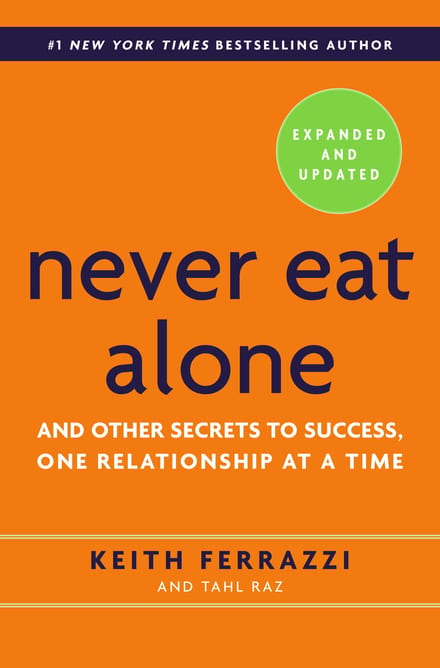
Never Eat Alone: And Other Secrets to Success, One Relationship at a Time
The full book runs ~326 pages — roughly 6 hours of reading. You get the key ideas here in 5 minutes.
The key ideas
- Give first without keeping score of favors owed
- Ask boldly—rejection costs less than never asking
- Follow up within 24 hours while connections stay warm
- Start with your mission, then map who matters
- Court super-connectors and cultivate weak, diverse ties
- Win people through authenticity and vulnerability, not polish
The summary
Your career doesn’t advance on talent and hard work alone; it advances because you’re embedded in a network of people who want to help each other. Keith Ferrazzi’s core claim is that relationships are the real engine of success, and that the people who thrive are the ones who build those relationships generously and long before they need anything from them. The mistake most people make is waiting until they’re desperate and then treating networking as a ledger, a favor bank where debts have to balance. Flip it. Strong networks run on generosity with no scorecard — you help because you can, and, just as importantly, you ask for help as freely as you give it, because it’s the exchange itself, not the tally, that binds people together. One statistic sets the stakes: 56 percent of people found their current job through a personal connection, against only 19 percent through traditional routes like job listings and recruiters.
Start with a mission, then the people
Before building a network, you need to know what it’s for. Look inward to find what you actually care about, turn it into a formal action plan broken into concrete goals, and then identify the specific people who can support you or hold you accountable. This isn’t using people; it’s clarity, because once you know where you’re going, you know who matters. Then start close rather than cold. Your first and easiest network is already around you — family, friends of friends, old acquaintances — warm connections that come with built-in trust because someone already vouches for you.
Ask boldly, because rejection costs less than silence
Ferrazzi calls it the genius of audacity: the courage to ask for what you want, even from strangers or powerful people. The real barrier to opportunity is almost never being told no; it’s never asking at all, and the good news is that boldness is a skill you can learn. When you do ask, he offers a simple script — state the situation, say how you feel about it, deliver the bottom line of what you actually want, then close with an open-ended question. Before an outright cold call, find a bridge: a mutual contact, a shared institution, a reference that gives the person a reason to listen. Come with a concise value proposition and a willingness to compromise, which is more powerful than it looks. Boy Scouts routinely get turned down selling raffle tickets, but when they follow up by offering a cheaper candy bar, people buy the candy even when they don’t really want it, because the smaller ask feels reasonable after the larger one. And treat gatekeepers like executive assistants as allies, not obstacles — persistent but always polite, because they control access and remember exactly how you treated them.
Give first, then follow up fast
The surest way to build a network is to make yourself genuinely useful before anyone asks — connecting people, sharing information, solving problems, especially around the three concerns people care about most: their health, their wealth, and their children. Generosity only sticks, though, if you’re disciplined about follow-up. Send a personal note within 12 to 24 hours while the connection is still warm, referencing a specific detail from the conversation and focusing on what you can do for them. Keep your calendar full and your contact low-friction; combine meetings when time is short, meet virtually when you have to, and build relationships through shared activities you actually enjoy rather than generic networking events where everyone is performing.
A few tactics compound this. Host simple, relaxed dinner parties seeded with an “anchor tenant” or two — interesting people from outside your usual circle who pull in other guests — and co-host events with someone else so you each bring your own contacts, since the fastest way to grow your circle is to connect it to someone else’s. Court super-connectors, the handful of people who know a disproportionate number of others and open whole networks at once. And cultivate your Fringe, the weak social-media ties that feed you information and opportunities your close circle never could. This is how you manufacture what Ferrazzi calls engineered serendipity: useful people and ideas you wouldn’t have known to go looking for.
Be real, not polished
Small talk is a learnable skill tied directly to career success, and the way to be memorable is not smooth patter but authenticity and a willingness to be vulnerable. Open with a warm smile, real eye contact, and relaxed body language, keep a few genuine passions ready to talk about, but spend most of your energy listening and making the other person feel appreciated. The same rule governs your online presence: build trust by showing your real humanity instead of an airbrushed image, organizing what you share around generosity, vulnerability, accountability, and candor. As you start reaching more powerful people, guard against hubris — fold others into your success, keep faith with the people who backed you early, and seek out mentors, who are worth more than any title or salary. Then become a mentor yourself, which cements your own knowledge and keeps the whole learning network self-sustaining.
The bottom line
Careers move through relationships you build generously and well before you need them: give without keeping score, ask boldly because silence costs more than rejection, and follow up fast enough that the connection actually holds. Read this if you’ve been treating networking as an emergency measure for when you need a job, or if you’ve been waiting for talent alone to carry you.
Fact check
Popular books repeat findings that later research has complicated. Where Never Eat Alone makes a testable claim, here's what the evidence actually shows.
Fifty-six percent of people found their current job through a personal connection, against only 19 percent through listings and recruiters.
The direction is right — personal contacts are the single biggest route into a job in the studies that measure it — but that split is not a general labour-market measurement. The foundational survey behind figures of this shape covered recent professional, technical and managerial job changers in one Boston suburb around 1970: 282 respondents, of whom 100 were interviewed in person. That is a narrow, affluent and dated slice of the workforce, so the ratio is better read as an illustration than as a statistic about people generally.
- Granovetter MS. The strength of weak ties. Am J Sociol. 1973;78(6):1360-1380. Source
Loose, diverse acquaintances — Ferrazzi's Fringe — deliver more job opportunities than your close circle can.
A randomised experiment run on LinkedIn's People You May Know algorithm over five years, covering more than 20 million users, 2 billion new connections and 600,000 job placements, produced the first causal test — and weak ties did help, but not in a straight line. The relationship was an inverted U: moderately weak ties drove the most job mobility, while the very weakest did less, and the advantage held in digital industries where stronger ties still paid off better in traditional ones. Granovetter's original Boston data pointed the same way: among those who found a job through a contact, 55.6% saw that contact only occasionally and 27.8% rarely, against 16.7% often (N = 54). So cultivate the Fringe, but the useful ties are dormant acquaintances rather than strangers.
A refused large request makes people more likely to agree to a smaller one straight after — the Boy Scout who sells you a candy bar once you have turned down the raffle ticket.
The sequence is a real, repeatedly replicated compliance effect. A meta-analysis pooling 22 door-in-the-face studies, with roughly 1,611 participants in the technique conditions, found it about as effective as its mirror image, foot-in-the-door. The catch is timing: in a blood-donation field experiment the technique raised actual behavioural compliance only when the smaller request followed immediately, and inserting a delay of a few hours wiped that gain out. The Boy Scout version works because the candy bar is offered on the spot by the same person; the same pitch a week later would not.
Frequently asked questions
What is Never Eat Alone about?
Keith Ferrazzi's core claim is that your career advances because you're embedded in a network of people who want to help each other, not on talent and hard work alone. The people who thrive build those relationships generously and long before they need anything. The mistake most people make is waiting until they're desperate and then treating networking as a ledger where debts have to balance; strong networks instead run on generosity with no scorecard.
What are the key takeaways from Never Eat Alone?
Start with a mission, finding what you care about, turning it into concrete goals, then identifying the people who can help, and begin with the warm connections already around you. Practice the "genius of audacity": ask boldly, because the real barrier is never asking, not being told no. Give first by making yourself useful around people's health, wealth, and children, then follow up within 12 to 24 hours referencing a specific detail. Compounding tactics include relaxed dinner parties seeded with an "anchor tenant," courting super-connectors, and cultivating your "Fringe" of weak ties to manufacture engineered serendipity. Be real rather than polished, spend most of your energy listening, and become a mentor to keep the whole learning network self-sustaining.
Who should read Never Eat Alone?
Read this if you've been treating networking as an emergency measure for when you need a job, or if you've been waiting for talent alone to carry you.
Is Never Eat Alone worth reading?
The tactics are concrete and immediately usable, from the fast follow-up window to seeding a dinner party, and the reframe of networking as generosity rather than transaction is a healthy correction. Its relentless, always-on approach to relationship-building can read as effortful or self-promotional, and introverts may find the pace exhausting. If you take the generosity principle seriously and adapt the tactics to your temperament, it pays off.