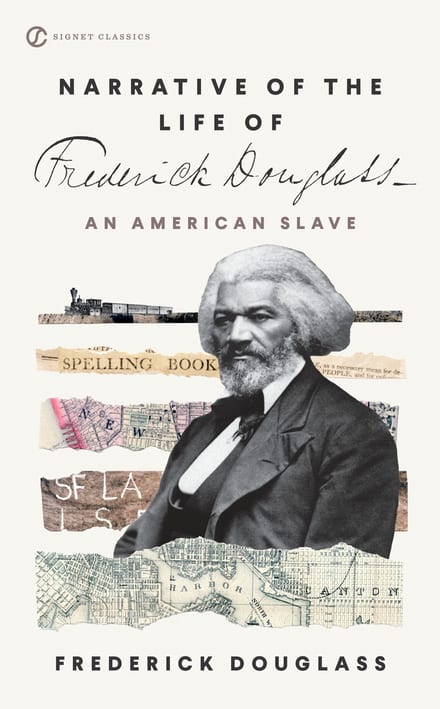
Book summary
Narrative of the Life of Frederick Douglass: An American Slave
An American Slave
The full book runs ~160 pages — roughly 3 hours of reading. You get the key ideas here in 5 minutes.
The key ideas
- Start with the opening admission: he cannot name the year he was born.
- Note what Hugh Auld gave away — reading would forever unfit a man for slavery.
- Steal the lessons: bread traded to Philpot Street boys, chalk on a board fence.
- Expect no uplift — literacy opened the pit and showed no ladder out of it.
- Watch the role deform Sophia Auld, kind on arrival, fiercer than her husband after.
- Read the two hours in Covey's stable: nothing legal changed, everything else did.
The summary
Frederick Douglass could not tell you how old he was. He opens his 1845 narrative with that admission — he had never seen any authentic record containing his age — and then explains it: on his account, most masters wanted their slaves ignorant of exactly this, and he was not allowed to ask. All he can offer is arithmetic: his master said in 1835 that he was about seventeen, so he reckons himself twenty-seven or twenty-eight. The Library of Congress dates his birth to 1818 in Talbot County, Maryland; the National Park Service puts it in February.
That opening is the argument in miniature. On Douglass’s reading, slavery did not merely coexist with ignorance; it had to manufacture ignorance continuously and on purpose, and everything else rested on that work holding.
The sentence that gave the game away
Sent to Baltimore as a boy, Douglass was taught the alphabet by Sophia Auld, the wife of the man he served. Hugh Auld shut it down — unlawful as well as unsafe, he told her — and then said why. Teach him and there would be no keeping him; it would forever unfit him to be a slave, and do him no good beyond making him discontented.
Douglass treats that as the most useful thing anyone ever told him. The prohibition explained how the power to enslave was actually maintained, and it handed him the method. What Auld most dreaded, he most desired. From that moment, he writes, he understood the pathway from slavery to freedom.
Reading opened the pit and showed no ladder
Getting there took years of theft. He turned the white boys on Philpot Street into teachers, trading bread for reading lessons, and learned his first written letters off ship timber in a Baltimore shipyard, where carpenters chalked L, S and L.F. onto pieces to mark where they belonged. His copy-book was a board fence, his pen a lump of chalk. Around twelve he got hold of The Columbian Orator, Caleb Bingham’s compilation, and its dialogue in which a recaptured slave out-argues his master.
Then the price came due, as Auld had predicted. Reading gave him words for his condition and no way out of it: it opened his eyes to the horrible pit, he writes, but to no ladder upon which to get out. He envied the slaves who could not think about it, and wished himself an animal. This is not a book about literacy as uplift. He taught anyway — hired out to William Freeland, he ran a Sabbath school past forty pupils, each of them liable to thirty-nine lashes for attending.
Slavery deformed the people holding the whip
The damage ran both ways, and Sophia Auld is his proof: kind when he arrived, then remade by the role, snatching newspapers from his hands and growing fiercer than her husband. Slavery, he writes, proved as injurious to her as it did to him. Religion gets the same reading. Northerners who heard enslaved people singing and took it for contentment had it backwards; slaves sang most, he says, when they were most unhappy. The Appendix draws his line: between the Christianity of this land and the Christianity of Christ he recognizes the widest possible difference, loving one and hating the other.
The fight in Covey’s stable
By the book’s own dating he was hired to Edward Covey, a farmer known locally for breaking recalcitrant slaves, on 1 January 1833. Six months of near-weekly whippings left him, in his phrase, broken in body, soul and spirit. Then he announces the turn: you have seen how a man was made a slave; you shall see how a slave was made a man.
In August he collapsed while fanning wheat, was kicked and struck on the head with a hickory slat, then walked seven miles to Thomas Auld for protection. Auld sent him back. On the Monday, Covey came at him with a rope in the stable and Douglass seized him by the throat; they fought close to two hours. Covey never struck him again, and never handed him to the constable — his reputation as a breaker, Douglass reckons, could not have survived the admission. Nothing legal changed; he stayed enslaved four more years. What changed, he says, is that the day had passed when he could be a slave in fact.
A book that needed white men to vouch for it
The first edition says Written by Himself on the title page, then spends its opening pages proving it. Garrison’s preface of 1 May 1845 declares the book essentially true in all its statements. Wendell Phillips’s letter of 22 April puts the most entire confidence in Douglass’s truth, candor and sincerity — and warns him that in his place, Phillips would throw the manuscript in the fire, since naming real masters and places made a fugitive findable. Scholars including Beth A. McCoy read that apparatus as a reminder of white control over a Black author’s text.
The gamble paid. Published at the Anti-Slavery Office, 25 Cornhill, Boston, it sold 4,500 copies in four months by UNC’s Documenting the American South count. Douglass sailed for Britain and Ireland, lectured for eighteen months, and came home in 1847 legally free — English supporters raised the money, and Hugh Auld took £150 sterling, $711.66, to manumit him. He withholds only the route of his escape, arguing that publicizing it would educate slaveholders rather than the enslaved.
The bottom line
Douglass’s case is that slavery ran on managed ignorance, and that Hugh Auld stated the mechanism more honestly than any abolitionist when he said reading would ruin a slave. Everything after that — the chalk on the fence, the forty pupils, the two hours in the stable — tests whether the man who ran the system was right.
Read it for the argument that education is contested ground, made by someone who had to steal his. Pair it with The Warmth of Other Suns.
Fact check
Popular books repeat findings that later research has complicated. Where Narrative of the Life of Frederick Douglass makes a testable claim, here's what the evidence actually shows.
Teaching an enslaved person to read was unlawful in Maryland — the reason Hugh Auld gives his wife for ending Douglass's lessons.
Maryland never passed such a statute. The state archives' own answer is blunt: there was no legislation specifically prohibiting enslaved people from reading and writing, though the practice was strongly discouraged. Nor had the regional wave of anti-literacy laws begun when Sophia Auld's lessons were stopped in 1827 — those came after Nat Turner's revolt in 1831, and every slave state except Maryland, Kentucky and Tennessee then passed them (Alabama's 1833 code fined a teacher $250 to $500). Douglass reports Auld's words accurately; Auld was wrong about the statute, not about the risk.
Slavery depended on keeping enslaved people illiterate, and the suppression largely worked.
A University of Arkansas study of Southern reading between 1800 and 1860 estimates that nearly 10 percent of enslaved people were literate, against more than 80 percent of the white population. The first census to ask after emancipation found 79.9 percent of the Black population illiterate in 1870, against 20.0 percent of the population overall. Douglass's route was rare but not unique: he taught over forty pupils himself.
- University of Arkansas. UA Researcher Explores History of Reading in the South. Arkansas News, January 25, 2002. Estimates by Beth Barton Schweiger, assistant professor of history. Source
- National Center for Education Statistics. 120 Years of Literacy. Illiteracy rates 1870-1979, from U.S. Bureau of the Census, Historical Statistics of the United States, Colonial Times to 1970. Source
Frequently asked questions
What is Narrative of the Life of Frederick Douglass about?
Douglass's 1845 account of his own life in slavery in Maryland, written while he was still a fugitive and still legally the property of the men he names in it. Its central argument is that slavery depended on manufactured ignorance: he opens by admitting he cannot say what year he was born, because that knowledge was deliberately withheld. Learning to read, on his account, is the moment the system starts coming apart.
What are the key takeaways from Narrative of the Life of Frederick Douglass?
Four ideas carry the book. Ignorance was maintained on purpose, and Hugh Auld admitted as much when he stopped the reading lessons by saying literacy would forever unfit a man to be a slave. Literacy had to be stolen in pieces — bread traded to white boys for lessons, letters copied off ship timber, a board fence for a copy-book. It brought no relief at first: reading opened the pit, in his phrase, and showed no ladder out. And the damage ran both ways, which is why Sophia Auld, kind when he arrived, turned fiercer than her husband.
Who should read Narrative of the Life of Frederick Douglass?
Anyone who wants the case for why education is contested ground, made by someone who had to steal his. It is also the shortest way into American slavery as described by a person who lived it rather than by a historian working from records.
Is Narrative of the Life of Frederick Douglass worth reading?
Yes, and it is short enough to read in an evening. The prose is deliberately controlled — he is arguing a case to skeptical readers, not just recounting — and the fight with Covey and the Appendix on slaveholding Christianity are as sharp as anything written on the subject. The one thing to know going in is that the 1845 edition opens with prefaces by two white abolitionists vouching for its truth, which tells you something about the terms on which a Black author was allowed to publish.