Book summary
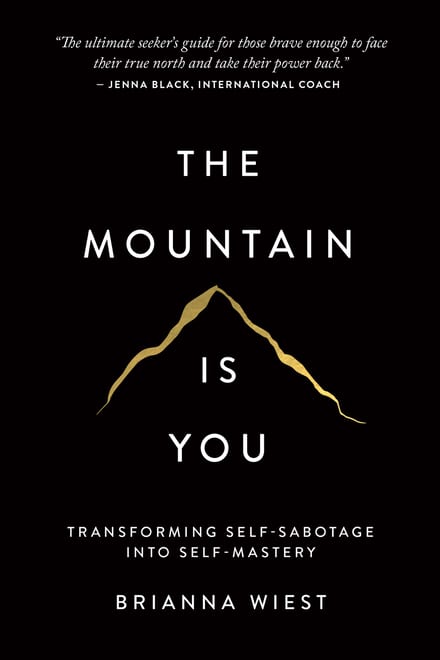
The Mountain Is You: Transforming Self-Sabotage Into Self-Mastery
The full book runs ~248 pages — roughly 5 hours of reading. You get the key ideas here in 4 minutes.
The key ideas
- Map your sabotage behaviors to the fears they protect against.
- Name the missing skill each fear reveals, then build it.
- Distinguish calm intuition from loud, distorting fear.
- Treat emotions as data pointing toward needed action.
- Change incrementally—consistency beats threatening overhauls.
- Design guiding principles from your values and anxieties.
The summary
Self-sabotage is not weakness. It’s protection. The résumé you never send, the relationship you can’t leave, the project you abandon at the halfway mark—Brianna Wiest argues these aren’t character flaws but avoidance tactics your brain builds to keep you away from a specific fear. The fear feels real to your nervous system even when nothing is actually threatening you, and the behavior soothes the discomfort in the moment while quietly costing you your potential. The mountain in your way, in other words, is you. Getting over it isn’t a matter of willpower. It’s tracing each sabotaging habit back to the fear beneath it, naming the emotional skill you never got to build, and building it now in steps small enough to survive.
Your sabotage is a map
Wiest gives a concrete way in. List everything in your life you’re unhappy with and want to change. Then, beside it, list the specific actions—or failures to act—that keep those changes from happening. That second list is your sabotage. If you hate your job but never look for another, the behavior is procrastination. If you keep chasing shiny new hobbies instead of the thing that matters, that’s uprooting: diverting your attention to trivial details to avoid the real issue. Even pride does it—staying in a bad marriage because you dread what people will say about a divorce.
Then ask what each behavior is protecting you from. Clinging to a harmful relationship usually guards against the fear of being alone; never starting your dream guards against the fear of failure. These fears take hold when you’re missing the mental and emotional skills to handle the outcome, and those gaps often trace back to circumstances that never let you build them—a childhood without encouragement can leave an adult short on self-confidence and self-love, so you look to others for validation and fear being disliked. The last move is the useful one: link each fear to the skill that would dissolve it. Loneliness calls for independence and self-love; fear of failure calls for resilience and self-trust. Once you can name the deficiency, you can build it on purpose instead of gritting your teeth against the fear forever.
Fear is loud, intuition is calm
If sabotage grows from fear, healthy action grows from intuition—your instinctive sense of the right next move. The trouble is telling them apart, and Wiest’s test is the texture of the thought. Fear distorts reality and shoves you to react out of worry, panic, or anger. Intuition arrives as clarity and calm, anchored in the present. As she puts it, intuitive thoughts show you how to respond, while invasive thoughts demand that you react.
So drop out of the imagined future and into now, and follow the thoughts that feel steady and helpful rather than the ones that churn. A simple gauge is how an activity leaves you feeling. Scrolling social media is one of the easiest ways to numb yourself precisely because it’s so accessible, and the tell is what you feel when you put the phone down. If it isn’t relaxed or inspired, you were probably avoiding some discomfort—the very discomfort that may be telling you something needs to change.
Emotions are cues, not verdicts
The next skill is reading your emotions instead of being ambushed by them. Start by naming and accepting what you feel; suppression only lets it boil over later. Then work out why, because emotions are information pointing toward action. Anger shows you what you care about. Jealousy reveals something you want but lack. Resentment marks an expectation that went unmet. Once you know the cause, you can take the fitting step—actually talking through what’s breeding the resentment, say—rather than acting out.
Change itself is hard because your brain clings to the familiar, keeping you in a comfort zone even when it’s harming you, which is also how it feeds distortions like spotlighting, the belief that everyone is scrutinizing you when in truth they’re absorbed in themselves. Because sweeping overhauls feel too threatening, they collapse. Go incremental. To build a reading habit, aim for five minutes a day, not two hours. Consistency beats heroics, and the real question, Wiest writes, isn’t whether you feel like doing the work but whether you do it regardless.
Build the person to build the life
Underneath the habits is a bigger project: becoming the person who doesn’t need to sabotage. Your purpose lives where your talents and passions meet a need in the world—not a job title but a calling. Wiest’s prompts help you find it: What are you willing to toil over? What would you do with no obligations? What are you naturally good at? What do you want to be remembered for? To picture the person who lives that purpose, sit somewhere quiet, let the negativity drain, and visualize your ideal future self in detail—their routines, their work, their relationships—then ask for their guidance and imagine them handing their knowledge and abilities over to you.
Turn that vision into guiding principles: firm rules drawn from your values that carry you through hard decisions. Make one list of what you value and the feelings you want to live in, and another of what makes you anxious, then write rules that serve the first and manage the second. If you value reading, commit to ten books a year; if money frightens you, save 15 percent of every paycheck. Fill in the edges with small daily joys, relationships that lift you—you become who you spend time with—and a habit of counting each day by the healthy things you actually did.
The bottom line
Self-sabotage is your brain’s clumsy way of shielding you from fears rooted in emotional skills you never got to develop. Name the behavior, trace it to the fear, identify the missing skill, and grow it in small, survivable steps. Read this if you keep running into the same patterns you know are holding you back and can’t seem to break.
Fact check
Popular books repeat findings that later research has complicated. Where The Mountain Is You makes a testable claim, here's what the evidence actually shows.
People chronically overestimate how much others are noticing and scrutinising them — what the book calls spotlighting.
This one holds up. In the original experiments, participants made to wear a T-shirt with a conspicuous image substantially overestimated how many observers could recall what was pictured on it, and in group discussions people overstated how salient their own comments had been to everyone else. The cause is mechanical rather than moral: we anchor on our own vivid experience of ourselves and then adjust too little for the fact that nobody else shares that view.
- Gilovich T, Medvec VH, Savitsky K. The spotlight effect in social judgment: an egocentric bias in estimates of the salience of one's own actions and appearance. J Pers Soc Psychol. 2000;78(2):211-222. PubMed
Pushing an emotion down only makes it boil over later; naming and accepting it defuses it.
Suppression does backfire, but modestly and unevenly. A meta-analysis of controlled thought-suppression experiments found a small-to-moderate rebound effect — the suppressed thought returns more often once you stop pushing — and the size varied by the type of thought and how it was measured, with clinical participants rebounding no more than anyone else. A larger meta-analysis of 306 experimental comparisons found the same split: trying to suppress thoughts backfired, distraction helped, and cognitive change such as reinterpreting the situation produced a small-to-medium benefit. The advice to stop suppressing is well founded; the case for naming a feeling as the specific fix is thinner than the case for reframing it.
- Abramowitz JS, Tolin DF, Street GP. Paradoxical effects of thought suppression: a meta-analysis of controlled studies. Clin Psychol Rev. 2001;21(5):683-703. PubMed
- Webb TL, Miles E, Sheeran P. Dealing with feeling: a meta-analysis of the effectiveness of strategies derived from the process model of emotion regulation. Psychol Bull. 2012;138(4):775-808. PubMed
Small incremental change survives where sweeping overhauls collapse — five minutes of reading a day beats aiming for two hours.
The consistency half is right and the keep-it-small half is not established. A 2024 systematic review of 20 studies and 2,601 people found health habits took a median of 59-66 days to form, with enormous individual spread (4 to 335 days), and that the frequency and timing of repetition were among the strongest determinants of habit strength — so showing up repeatedly is what builds automaticity. Ambition points the other way: across 35 years of goal-setting experiments, specific and difficult goals produced higher performance than easy or vague ones, provided the person was committed and capable. No evidence shows a deliberately small target outperforms a demanding one; the case for five minutes rests on making repetition easy, not on small being better.
- Singh B, Murphy A, Maher C, Smith AE. Time to Form a Habit: A Systematic Review and Meta-Analysis of Health Behaviour Habit Formation and Its Determinants. Healthcare (Basel). 2024;12(23):2488. PubMed
- Locke EA, Latham GP. Building a practically useful theory of goal setting and task motivation. A 35-year odyssey. Am Psychol. 2002;57(9):705-717. PubMed
Frequently asked questions
What is The Mountain Is You about?
Brianna Wiest's argument is that self-sabotage isn't weakness, it's protection: the résumé you never send or the project you abandon are avoidance tactics your brain builds to keep you away from a specific fear. The behavior soothes discomfort in the moment while quietly costing you your potential, which is why the mountain in your way is really you. Getting over it means tracing each sabotaging habit back to the fear beneath it and building the emotional skill you never got to develop.
What are the key takeaways from The Mountain Is You?
Your sabotage is a map: list what you're unhappy with, then the behaviors that keep it from changing, ask what each one is protecting you from, and link that fear to the skill that would dissolve it, so loneliness calls for independence and self-love, fear of failure for resilience and self-trust. Fear is loud and distorting while intuition is calm and present, so follow the steady thoughts. Emotions are cues, not verdicts: anger shows what you care about, jealousy reveals what you want, resentment marks an unmet expectation. Change is hard because the brain clings to the familiar, so go incremental, five minutes a day, not two hours. And underneath it all is building your ideal future self and turning your values into firm guiding principles.
Who should read The Mountain Is You?
Read this if you keep running into the same patterns you know are holding you back and can't seem to break.
Is The Mountain Is You worth reading?
It reframes self-sabotage in a genuinely useful way, as fear plus a missing skill rather than a character flaw, and hands you concrete prompts for naming the behavior and building the skill in survivable steps. The writing runs poetic and circles its ideas, so readers who prefer tight, linear how-to advice may find it repetitive or vague in places. If you resonate with a reflective style, its core method is worth applying.