Book summary
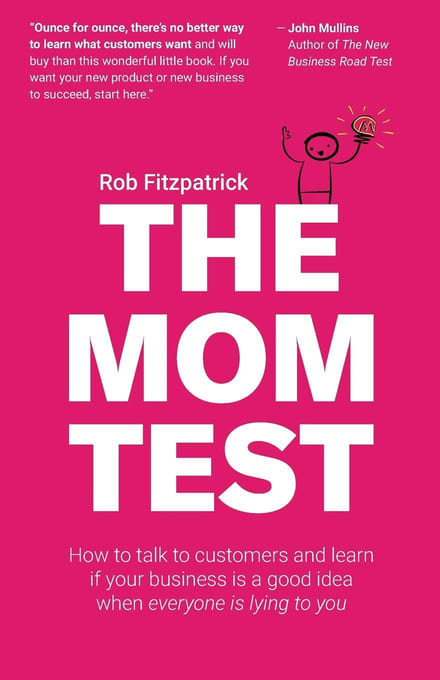
The Mom Test: How to Talk to Customers and Learn if Your Business Is a Good Idea When Everyone Is Lying to You
How to Talk to Customers and Learn if Your Business Is a Good Idea When Everyone Is Lying to You
The full book runs ~135 pages — roughly 2 hours of reading. You get the key ideas here in 5 minutes.
The key ideas
- Three rules: talk about their life, ask about the past, listen more.
- Compliments, fluff and feature requests are the three forms of bad data.
- 'I would definitely buy that' cost one startup about ten million dollars.
- Anchor generic claims: when did it last happen, what did you do?
- Ideas and feature requests should be understood, but not obeyed.
- A meeting succeeds only if it ends in commitment: time, reputation or cash.
The summary
“Mom, mom, I have an idea for a business — can I run it by you?” Fitzpatrick prints the thought running under each line. The son’s: I am about to expose my ego — please don’t hurt my feelings. Mom’s: You are my only son and I am ready to lie to protect you. He asks whether she’d buy a $40 cookbook app for her iPad, talks over her hesitation until she says it sounds amazing, then quits his job and sinks in his savings.
The mistake wasn’t asking his mother. “You shouldn’t ask anyone whether your business is a good idea.” It’s a bad question wherever you point it, and invites everyone to lie a little.
Three rules that make lying pointless
Run the visit again without the pitch. “How’s that new iPad treating you?” Then: “What’s the last thing you did on it?” She was finding somewhere to stay on the trip she and dad are planning — on Google, because she didn’t know there were apps for that. A nudge toward the cookbooks on her shelf gets: “They’re one of those things you just end up getting at Christmas. Haven’t even opened it. As if I need another lasagna recipe at my age!” Though she did buy a vegan cookbook three months ago, because dad is eating healthier.
Nothing was pitched, and the idea is already in pieces: experienced cooks don’t want generic recipes, this customer will never find an app in the App Store, and gifts and niche cuisines beat “cookbook for iPad.” Mom couldn’t lie because they never discussed the idea. Hence the three rules:
- Talk about their life instead of your idea.
- Ask about specifics in the past instead of generics or opinions about the future.
- Talk less and listen more.
By that standard, “Do you think it’s a good idea?” is worthless — only the market can answer it. Ask instead how they handle it today, what else they’ve tried, and whose budget it would come from. And make the question one that could hurt: “You should be terrified of at least one of the questions you’re asking in every conversation.”
Compliments, fluff, ideas
Bad data comes in three flavours, each with its own countermove: deflect, anchor, dig.
Most meetings end in a compliment, and it feels like progress. “Compliments are the fool’s gold of customer learning: shiny, distracting, and entirely worthless.” Catch one and change the subject: “Whoops — really sorry about that — I got excited and started pitching. Do you mind if I ask how you’re dealing with this stuff at the moment?” The answer — two full-time people keeping everyone in sync, plus Excel and a lot of email — beats any praise: it’s money already being spent.
Fluff is generic claims (“I always”, “I never”), future promises, and hypothetical maybes. “The world’s most deadly fluff is: ‘I would definitely buy that.’” The first startup Fitzpatrick worked at believed it and lost about ten million dollars. Anchor the claim to something that happened. A man calls himself an Inbox Zero zealot: ask what his inbox is at right now (ten), and when it last fell apart (three weeks ago, dead hotel wifi, ten days to recover). “While using generics, people describe themselves as who they want to be, not who they actually are.” Same move on the guy cursing the thousand café loyalty cards in his wallet: ask whether he’s tried the apps that already exist. “Those exist?” Then: “Why don’t you download it now?” — “I’ll do it next time.” A complainer, not a customer.
Ideas are sneakiest, because they arrive as help. MTV said they needed analytics, so Fitzpatrick built them a dashboard that could carve up their data every which way. They kept calling every Friday asking him to email the numbers instead. He added CSV export; they asked for PDF; they still called. When they asked to put their logo on the reports, he finally asked why: “nobody even reads these. Our clients just like to get something emailed to them at the end of every week and we think they’d be happier if it was a bit fancier.” They wanted their own clients kept happy, not a way to explore data. “Ideas and feature requests should be understood, but not obeyed.”
No meeting ever just “went well”
Every meeting succeeds or fails. You lose it the moment you leave with a compliment or a stall; you win when it ends in a commitment to a next step. Skip that and you collect zombie leads — people who keep taking meetings, say nice things, and never cut a check. “It’s like your startup has been friend-zoned. Thankfully, you caused it.”
Commitment means giving up something they value: time (a next meeting with a known goal, a trial they actually run), reputation (an intro to their boss, a public testimonial), or cash (a letter of intent, a pre-order, a deposit). “A compliment costs them nothing, so it’s worth nothing and carries no data.”
So “Looks great, let me know when it launches” is the polite form of don’t-call-me. “What are the next steps?” and “When can you come back to talk to the rest of the team?” are wins. The best ending is the rarest: a designer demoing a 3D-printed smartphone tripod laughed when Fitzpatrick asked to buy the prototype — he’d been through a dozen already, because people kept buying them.
The bottom line
Nobody can tell you whether your idea is good, and asking makes it worse: people protect your feelings with praise, optimism about the future, and helpful feature requests. What they will give you honestly is their past — what the problem costs them, what they’ve already tried, and whether they’ll hand over time, reputation or money today. Facts and commitments, not compliments.
Read it if you’re about to build something and want to know within a week whether anyone actually cares.
Fact check
Popular books repeat findings that later research has complicated. Where The Mom Test makes a testable claim, here's what the evidence actually shows.
"I would definitely buy that" is worthless data — stated purchase intent tells you nothing about whether someone will actually buy.
Stated intent is a weak predictor, not an empty one. Pooling 47 experiments that successfully moved people's intentions, a medium-to-large shift in intention (d = 0.66) produced only a small-to-medium shift in actual behaviour (d = 0.36) — roughly half the intended change never showed up. On price specifically, 28 studies that measured hypothetical and real willingness to pay through identical mechanisms found a median hypothetical-to-actual ratio of 1.35: people overstate by about a third at the median. That is a real and predictable inflation, but weaker than Fitzpatrick's framing of stated intent as pure noise.
- Webb TL, Sheeran P. Does changing behavioral intentions engender behavior change? A meta-analysis of the experimental evidence. Psychol Bull. 2006;132(2):249-68. PubMed
- Murphy JJ, Allen PG, Stevens TH, Weatherhead D. A meta-analysis of hypothetical bias in stated preference valuation. Environ Resour Econ. 2005;30(3):313-325. Source
Asking what someone actually did in the past predicts their behaviour better than asking what they think or would do.
It depends on the behaviour. The standard meta-analytic synthesis found that when an action is repeated often in a stable setting, past behaviour predicts future behaviour directly and stated intention adds little — habit is doing the work. When the behaviour is infrequent or the context unstable, the pattern reverses: past behaviour predicts poorly and intention becomes the stronger route. Buying an unfamiliar product is usually the second kind, so the rule is strongest applied the way Fitzpatrick actually applies it — to how someone already handles the problem, which is a routine, rather than to a purchase they have never made.
- Ouellette JA, Wood W. Habit and intention in everyday life: the multiple processes by which past behavior predicts future behavior. Psychol Bull. 1998;124(1):54-74. Source
Frequently asked questions
What is The Mom Test about?
It's about how to talk to customers without being lied to. Rob Fitzpatrick's argument is that you shouldn't ask anyone whether your business idea is good, because opinions about the future are worthless and people soften them to protect your feelings. Ask about their life instead: what they already do, what it costs them, and what they've already tried to fix it.
What are the key takeaways from The Mom Test?
Three rules carry the book: talk about their life instead of your idea, ask about specifics in the past instead of generics or opinions about the future, and talk less. Bad data arrives in three forms — compliments, fluff ("I always", "I would definitely buy that"), and feature requests — which you deflect, anchor to a concrete past event, and dig beneath for the motivation. And no meeting ever just goes well: it either ends in a commitment of time, reputation or money, or it failed.
Who should read The Mom Test?
Founders about to build something who want to know within a week whether anyone cares, plus anyone doing product research, early sales, or mentoring startups. It's equally useful if you find these conversations awkward — the author is a self-described introverted techie, not a natural salesperson.
Is The Mom Test worth reading?
Yes, if you want something usable rather than theoretical. It's short and built almost entirely out of transcribed conversations, each shown going wrong and then right, so the lessons stick — the MTV analytics dashboard nobody used, the ten million dollars lost to "I would definitely buy that." Skip it if you want a full framework for building a company; it deliberately covers only the talking part.