Book summary
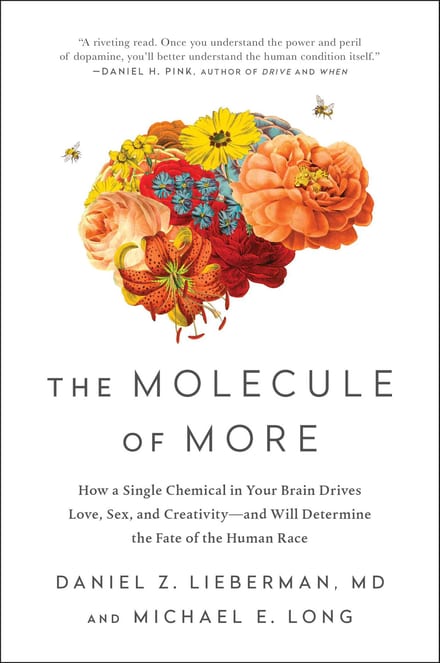
The Molecule of More: How a Single Chemical in Your Brain Drives Love, Sex, and Creativity—and Will Determine the Fate of the Human Race
How a Single Chemical in Your Brain Drives Love, Sex, and Creativity—and Will Determine the Fate of the Human Race
The full book runs ~249 pages — roughly 5 hours of reading. You get the key ideas here in 4 minutes.
The key ideas
- Wanting and liking are separate systems; dopamine only builds the first.
- Dopamine fades as the unknown does — the new job stops feeling new.
- Hand time back to the here-and-now molecules: serotonin, oxytocin, endorphins, endocannabinoids.
- Passionate love runs nine to twelve months, then converts to companionate or ends.
- Desire dopamine promises, control dopamine plans — neither one can produce contentment.
- Read the creativity, genetics and politics chapters as hypotheses, not findings.
The summary
Dopamine isn’t the pleasure molecule. It’s the anticipation molecule, and that one correction reorganizes a lot of behavior you thought was unrelated. The chemistry that makes you want something is not the chemistry that lets you enjoy it. Dopamine runs wanting. It evolved to push you toward whatever sits just beyond your reach, and it is indifferent to whether you arrive — it holds no standard for good enough and recognizes no finish line. So it can promise happiness and never deliver it. Delivery was never its department.
The pleasure of what’s possible
Dopamine’s business is the future, specifically the part of the future you don’t have yet — the drive, as Lieberman and Long put it, to possess the world beyond your immediate grasp. Once you have the thing, the chemistry that made it glow switches off. The more you learn about something, Lieberman says, the less there is left to explore, and the dopamine begins to fade. That’s the new job that stops feeling new, the app that was fascinating for a week, the relationship that was electric until it was familiar. The book’s stock characters here are Mick Jagger and Seinfeld’s George Costanza — men who are never satisfied and always moving on to someone new.
This is also the honest answer to why you keep doing things you no longer enjoy. In the experiments the book leans on, amplifying the dopamine circuit raised the wanting without raising the liking. Craving and enjoyment are separable, and dopamine only builds one of them.
The chemicals of the here and now
If dopamine handles what’s coming, something else has to handle what’s already in the room. The authors group those into what they call the here-and-now molecules, the H&Ns: serotonin, oxytocin, endorphins (your brain’s own morphine) and endocannabinoids (your brain’s own marijuana). These give you pleasure from sensation and emotion rather than from expectation — the taste of the water in front of you, the color of the walls, the person across the table.
Romantic love is where the handover is most visible. Passionate love, the near-insane version where anything feels possible, is dopaminergic and lasts roughly nine to twelve months. After that it has to convert into companionate love, driven more by chemicals like oxytocin and serotonin, or it ends. Lieberman is blunt that the conversion isn’t automatic; it’s a choice you make when the chemistry that got you there runs out.
The trade-off cuts the other way too. High dopamine suppresses H&N functioning, which is why, as the authors note, brilliant people are often bad at human relationships.
Desire dopamine and control dopamine
Dopamine isn’t one circuit but two, and confusing them is how people misread their own behavior. The desire circuit generates wanting — the raw pull toward more, and the machinery underneath addiction. It breaks its promises routinely, and it has to: satisfaction is produced somewhere else entirely, so the circuit doing the promising has no way of paying out.
The control circuit is the planner: it delays gratification, builds strategies, and sacrifices today for a bigger payoff later. That sounds like the healthy one, and often it is. But Lieberman’s example of pure control dopamine is the Type A workaholic who can’t relax and can’t enjoy an achievement, because the moment a goal is reached the circuit is already costing out the next one. Neither circuit is capable of contentment. That’s a job for the other system entirely.
It’s the same mechanism that makes addiction feel rational from the inside. Dopamine doesn’t remove your free will, Lieberman argues, but it ranks the drug above things that keep you alive, and it makes the right choice much harder to make.
Where the argument overreaches
The book pushes the framework a long way — into creativity and madness (high dopamine makes unlikely associations, which is useful in art and dangerous near psychosis), into genetics (the 7R variant of the dopamine receptor gene is associated with impulsive, novelty-seeking behavior, and turns up more often in populations that migrated farthest), and into politics, where the authors read progressive and conservative temperaments as future-focused versus here-and-now, citing survey work in which simply placing a hand-sanitizer dispenser in the room nudged answers in a more conservative direction.
Read those chapters as hypotheses, not findings. Neuroscientists broadly agree with the book’s core move — dopamine is not the pleasure chemical — but the field’s own accounts are messier: reward prediction error, incentive salience, Berridge’s wanting-versus-liking distinction, and dopamine signaling that also fires during aversive events. The going advice among researchers is that we should stop trying to define any neurotransmitter by a short list of actions. One molecule that explains love, art, madness and elections is a great organizing device and a poor scientific claim.
The bottom line
You have two systems, and only one of them can make you happy about what you already have. Dopamine will keep generating the next want no matter how much you achieve, so a good life depends on deliberately handing time back to the here-and-now circuits: put the phone down at dinner and actually look at the person, take small breaks in nature, stop multitasking, make and fix things with your hands. Read it if you’re driven, successful, and quietly puzzled that arriving never feels like you expected it to.
Fact check
Popular books repeat findings that later research has complicated. Where The Molecule of More makes a testable claim, here's what the evidence actually shows.
Dopamine is the chemistry of wanting rather than of liking — it drives you toward a reward without producing the pleasure of having it.
This is the book's central move and it is the mainstream position, not a contrarian one. The incentive-salience account, which pulled apart hedonic impact, reward learning and wanting as three separable things, rests on findings that stripping dopamine leaves the "liking" reactions to a sweet taste intact while abolishing the pursuit of it. Dopamine neurons meanwhile signal prediction error — better or worse than expected — rather than reward as such, which is why the chemistry switches off once a thing becomes familiar. The caveat Lieberman and Long half-acknowledge is that "anticipation molecule" is also too small a box: the same system carries aversive and alerting signals, with different neuron populations responding in opposite directions to punishment, so no single verb covers it.
- Berridge KC, Robinson TE. What is the role of dopamine in reward: hedonic impact, reward learning, or incentive salience? Brain Res Brain Res Rev. 1998;28(3):309-69. PubMed
- Schultz W, Dayan P, Montague PR. A neural substrate of prediction and reward. Science. 1997;275(5306):1593-9. PubMed
- Bromberg-Martin ES, Matsumoto M, Hikosaka O. Dopamine in motivational control: rewarding, aversive, and alerting. Neuron. 2010;68(5):815-34. PubMed
Passionate love is dopaminergic and lasts roughly nine to twelve months, after which it has to convert into companionate love or the relationship ends.
Something does normalize on approximately that timescale, but not what the number gets attached to. In the study that put a clock on it, 24 people who had fallen in love within the previous six months showed raised cortisol and shifted testosterone relative to controls, and every one of those differences had disappeared when they were retested 12 to 24 months later — hormones rather than dopamine, and a wider window than nine to twelve months. The harder problem for a deadline is that intense romantic love does not reliably expire. An fMRI study of 10 people married an average of 21.4 years who reported still being intensely in love found activity in the dopamine-rich ventral tegmental area and dorsal striatum consistent with early-stage love, alongside attachment-related regions, while the obsession-linked areas tracked obsession scores separately. What fades looks like the obsessive component, not the reward circuitry.
The 7R variant of the dopamine D4 receptor gene is associated with impulsive, novelty-seeking behavior and turns up more often in populations that migrated farthest.
This is among the most-tested candidate-gene claims in psychology and the meta-analyses do not agree with each other. A 2008 meta-analysis extended by a replication sample drawn from 40,090 people supported an association for a different DRD4 variant (C-521T) but not for the exon III repeat that produces 7R, found significant publication bias, and put the ceiling at about 3 percent of trait variance even if the association is genuine. A 2018 meta-analysis of 24 studies and 4,933 participants did report a significant 7R link to novelty seeking, while noting the result conflicts with the earlier meta-analysis and depends on moderators including age, sex and ethnicity. The migration correlation does survive a control for neutral population structure, but it compares populations rather than individuals, which cannot show the allele did the migrating.
- Munafò MR, Yalcin B, Willis-Owen SA, Flint J. Association of the dopamine D4 receptor (DRD4) gene and approach-related personality traits: meta-analysis and new data. Biol Psychiatry. 2008;63(2):197-206. PubMed
- He Y, Martin N, Zhu G, Liu Y. Candidate genes for novelty-seeking: a meta-analysis of association studies of DRD4 exon III and COMT Val158Met. Psychiatr Genet. 2018;28(6):97-109. PubMed
- Matthews LJ, Butler PM. Novelty-seeking DRD4 polymorphisms are associated with human migration distance out-of-Africa after controlling for neutral population gene structure. Am J Phys Anthropol. 2011;145(3):382-9. PubMed
Simply placing a hand-sanitizer dispenser in the room nudged people's reported political attitudes in a more conservative direction.
The 2011 experiment did report it: people surveyed in a public hallway near a hand-sanitizer dispenser rated themselves more politically conservative than people surveyed near a bare wall. It is also one of the social-priming results that did not come through the replication decade. A 2020 paper in the Journal of Personality and Social Psychology reports two failed direct replications of that experiment and, pooling them with the original and a third failed replication, finds only a very small effect. The original authors framed their result as preliminary evidence about attitudes usually assumed to be stable; the book presents it as an established finding, which the literature no longer supports.
- Helzer EG, Pizarro DA. Dirty liberals! Reminders of physical cleanliness influence moral and political attitudes. Psychol Sci. 2011;22(4):517-22. PubMed
- Burnham BR. Are liberals really dirty? Two failures to replicate Helzer and Pizarro's (2011) study 1, with meta-analysis. J Pers Soc Psychol. 2020;119(6):e38-e42. PubMed
Frequently asked questions
What is The Molecule of More about?
It corrects one widespread mistake: dopamine isn't the pleasure molecule, it's the anticipation molecule. The chemistry that makes you want something is not the chemistry that lets you enjoy it, and dopamine evolved to push you toward whatever sits just beyond your reach without holding any standard for good enough. Lieberman and Long then run that correction through desire, love, addiction, creativity and ambition.
What are the key takeaways from The Molecule of More?
Once you have the thing, the chemistry that made it glow switches off, which is why the new job stops feeling new and the fascinating app lasts a week. Handling what's already in the room is the job of the here-and-now molecules, the H&Ns, serotonin, oxytocin, endorphins and endocannabinoids, and high dopamine suppresses them, which is why brilliant people are often bad at relationships. Passionate love is dopaminergic and runs roughly nine to twelve months before it has to convert into companionate love or end. Dopamine also splits into two circuits, desire dopamine that generates raw wanting and sits under addiction, and control dopamine that plans and delays gratification but produces the Type A workaholic who is already costing out the next goal. Neither circuit is capable of contentment.
Who should read The Molecule of More?
It's for people who are driven and successful and quietly puzzled that arriving never feels the way they expected it to.
Is The Molecule of More worth reading?
The core move is sound and useful, and the wanting-versus-liking split explains a lot of behavior that otherwise looks irrational, including why you keep doing things you no longer enjoy. Where it overreaches is the later stretch into genetics, creativity and politics, where the framework gets pushed well past the evidence. Read those chapters as hypotheses, since the field's own accounts are messier and researchers increasingly warn against defining any neurotransmitter by a short list of actions.