Book summary
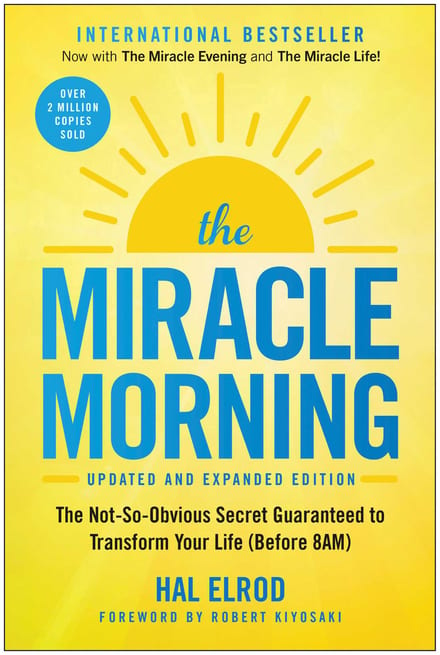
The Miracle Morning: The Not-So-Obvious Secret Guaranteed to Transform Your Life
The Not-So-Obvious Secret Guaranteed to Transform Your Life
The full book runs ~176 pages — roughly 3 hours of reading. You get the key ideas here in 5 minutes.
The key ideas
- Life S.A.V.E.R.S.: silence, affirmations, visualization, exercise, reading, scribing.
- Five steps beat snooze: intention, alarm across the room, teeth, water, clothes.
- Ten pages a day comes to roughly eighteen books a year.
- New habits run unbearable ten days, uncomfortable ten, then unstoppable.
- Six minutes works when an hour doesn't — one minute per practice.
- The proof on offer is testimonials and celebrity names, not studies.
The summary
By 2008 Hal Elrod had already survived the thing he’s famous for. At twenty he was hit head-on by a pickup doing an estimated eighty miles an hour, then hit again in the driver’s door by the car behind him: eleven broken bones, permanent frontal-lobe damage, six minutes with no heartbeat, and a coma he woke from to hear he might never walk again.
The second collapse is the one this book is actually about. The recession took his coaching clients, half his income vanished, and he was $425,000 in debt and behind on the mortgage. He says it was harder than dying: in the hospital, family sat with him and nurses brought food; this time nobody came. Thoughts of suicide arrived daily. A friend told him to go for a run. He hated running, but he went, in basketball shoes, and heard a Jim Rohn recording say something he’d heard many times before: “Your level of success will rarely exceed your level of personal development, because success is something you attract by the person you become.” He wanted a Level 10 life on about a Level 2 of personal development. He ran home and opened his planner.
Ten minutes each, before anyone else is up
Evenings belonged to his fiancée, and he was barely coherent by then anyway. Afternoons never produce the spare hour they promise. That left the morning, which he dreaded. He listed the practices he’d learned over the years and never done, gave each ten minutes, and set the alarm for 5:00 a.m. The acronym came later — the Life S.A.V.E.R.S.:
- Silence — prayer, meditation, breathing, gratitude, done out of the bedroom.
- Affirmations — written statements of what you want and who you must become, read aloud.
- Visualization — rehearsing the day going well and yourself enjoying the work.
- Exercise — anything that raises the heart rate; his own became yoga.
- Reading — ten pages a day, 3,650 pages a year, roughly eighteen books.
- Scribing — journaling; his word, because “W” wouldn’t fit the acronym.
His sample hour: five minutes each of silence, affirmations, visualization and scribing, twenty each of exercise and reading. Too busy? There’s a six-minute version, one minute per practice. And a concession most readers skip past — the point is waking thirty to sixty minutes earlier than you otherwise would, not the clock reading five.
Getting out of bed is the actual skill
The routine is worthless if you can’t get vertical, so Elrod rates your Wake Up Motivation Level from one to ten and walks it upward in five steps: decide the night before how you intend to feel, put the alarm across the room, brush your teeth, drink a glass of water, get dressed. Each step buys a point or two, and by the fifth, staying up costs no willpower — the most practical thing in the book.
The chapter around it is where he loses the plot. He claims we need as much sleep as we believe we need: he ran himself from nine hours down to four, told himself each night the amount was exactly right, and woke energized every time. He admits he isn’t being scientific here. Take it as one man’s self-report, offered as a reason to sleep less.
Thirty days, in three phases
The habit chapter earns its keep. Days 1–10 are Unbearable: the novelty burns off and every part of you rejects the change. Days 11–20 are Uncomfortable, not agony but still a daily negotiation. Days 21–30 are Unstoppable, and his argument is that this is where the popular 21-day rule does its damage — he traces it to a 1960 book by a cosmetic surgeon who watched amputees adjust to a lost limb in about three weeks. Quit at twenty-one days and you’ve done the painful part and skipped the part where the habit turns pleasant and becomes identity: where “I’m not a morning person” becomes “I am.”
He tested it on himself. Still hating running, he agreed to train for a charity marathon and twisted his ankle on the curb on his first stride. He started again the next day, logged fifty miles in thirty days, and six months and 475 training miles later ran fifty-two in one go — onto the Atlantic City boardwalk at 3:30 a.m., across the line fifteen and a half hours later, partly crawling.
The proof on offer is testimonials
Elrod’s central claim is that 95% of people settle for less than they want. The number comes from a Social Security Administration breakdown of a hundred workers followed forty years — one wealthy, four secure, fifty-four broke — a retirement-savings fact stretched to cover health, relationships and purpose. His other headline statistic — the average American is twenty pounds overweight, $10,000 in debt, with less than one close friend — he introduces as something he “recently read,” then hedges: “even if only a fraction of this statistic is true.”
The rest of the evidence is celebrities and readers. Oprah meditates; Jim Carrey wrote himself a $10 million check dated Thanksgiving 1995; Jack Nicklaus never hit a shot without picturing it. Then the emails: day 79, day 83, twenty-five pounds gone, income doubled. He quotes a psychologist against himself once — vision boards are for dreaming, action boards are for achieving. The practices need no defending — nobody argues that meditation, exercise, reading and journaling are bad for you. What’s unproven is the packaging.
The bottom line
Strip out the guarantees and you’re left with a workable hour: six things worth doing, ten minutes each, done before the day can take them from you — plus a good trick for getting out of bed and an honest map of the first ten days. Read it if you keep meaning to meditate, exercise, read and journal and never manage it; skip it if “guaranteed to transform your life” makes you want to argue with the page.
Fact check
Popular books repeat findings that later research has complicated. Where The Miracle Morning makes a testable claim, here's what the evidence actually shows.
A new habit takes thirty days to lock in — ten unbearable, ten uncomfortable, ten unstoppable — and the popular 21-day rule makes people quit just before it sticks.
Elrod is right that 21 days is too short, but 30 is not enough either. A 2024 systematic review and meta-analysis of 20 studies covering 2,601 people found health habits took a median of 59 to 66 days to form, with means of 106 to 154 days and individual times spanning 4 to 335 days. That spread is the actual finding: there is no fixed day on which a behaviour turns automatic, so any three-phase calendar is a motivational device rather than a measured timeline. The review does back one of his choices — morning routines and self-chosen habits formed faster than the alternatives.
- Singh B, Murphy A, Maher C, Smith AE. Time to Form a Habit: A Systematic Review and Meta-Analysis of Health Behaviour Habit Formation and Its Determinants. Healthcare (Basel). 2024;12(23):2488. PubMed
You need as much sleep as you believe you need — tell yourself four hours is enough and you will wake up energized.
Waking up feeling fine on four hours is precisely what chronic sleep restriction looks like from the inside. In a 14-day dose-response experiment, adults held to 4 or 6 hours in bed accumulated significant, dose-dependent deficits on every cognitive task measured, while their own sleepiness ratings jumped once at the start and then barely moved — never even separating the 4-hour group from the 6-hour group. The researchers concluded participants were largely unaware of their worsening impairment. Elrod grants he is not being scientific here, and the evidence says self-report is the one measure that will not catch this.
- Van Dongen HP, Maislin G, Mullington JM, Dinges DF. The cumulative cost of additional wakefulness: dose-response effects on neurobehavioral functions and sleep physiology from chronic sleep restriction and total sleep deprivation. Sleep. 2003;26(2):117-126. PubMed
95 percent of people settle for less than they want, per a Social Security Administration study of 100 workers over 40 years in which one ends up wealthy, four secure and 54 broke.
The "54 broke" figure does not match how Americans actually end up. The Census Bureau put the official poverty rate for people aged 65 and older at 9.7 percent in 2023 — below the rates for both children (15.3 percent) and working-age adults (10.0 percent). Retirement savings are genuinely thin for many families: the Federal Reserve's 2022 survey found only 54.3 percent of families held a retirement account at all, and the median balance among those that did was $86,900. That is a real problem, but it is not a 95 percent failure rate, and the hundred-workers breakdown circulates through motivational writing without a citation to any specific SSA publication.
- Shrider EA. Poverty in the United States: 2023. Washington, DC: US Census Bureau; 2024. Current Population Reports P60-283. Source
- Aladangady A, Bricker J, Chang AC, et al. Changes in U.S. Family Finances from 2019 to 2022: Evidence from the Survey of Consumer Finances. Washington, DC: Board of Governors of the Federal Reserve System; 2023. Source
Frequently asked questions
What is The Miracle Morning about?
It's about one routine: waking thirty to sixty minutes earlier than you have to and spending that time on six personal-development practices before the day starts making demands. Hal Elrod built it in 2008 while $425,000 in debt and severely depressed, after a friend told him to go for a run and a Jim Rohn recording convinced him his level of success would never exceed his level of personal development. The claim is that changing how you wake up changes everything downstream.
What are the key takeaways from The Miracle Morning?
The core is the Life S.A.V.E.R.S. — silence, affirmations, visualization, exercise, reading and scribing (his word for journaling) — ten minutes each, or one minute each if you're pressed. There's a five-step wake-up strategy that beats the snooze button: set your intention the night before, move the alarm across the room, brush your teeth, drink a glass of water, get dressed. And a 30-day habit cycle in three phases — days 1-10 unbearable, 11-20 uncomfortable, 21-30 unstoppable — with the argument that quitting at the popular 21 days means doing all the pain and none of the payoff. Small numbers help: ten pages a day is roughly eighteen books a year.
Who should read The Miracle Morning?
Anyone who already knows meditation, exercise, reading and journaling would help and can never fit any of them into a day. It's also aimed squarely at people in a bad stretch — broke, stuck, or flat — who want a small, concrete thing to do tomorrow morning rather than a plan.
Is The Miracle Morning worth reading?
The routine itself is sound and cheap to test, and the wake-up steps and the three-phase habit map are genuinely useful. What's thin is the evidence: the support comes from reader emails, celebrity anecdotes and a couple of statistics Elrod himself hedges, and his claim that you need only as much sleep as you believe you need is one man's self-experiment. If the word "guaranteed" on the cover makes you want to argue, read a summary and just try the hour.