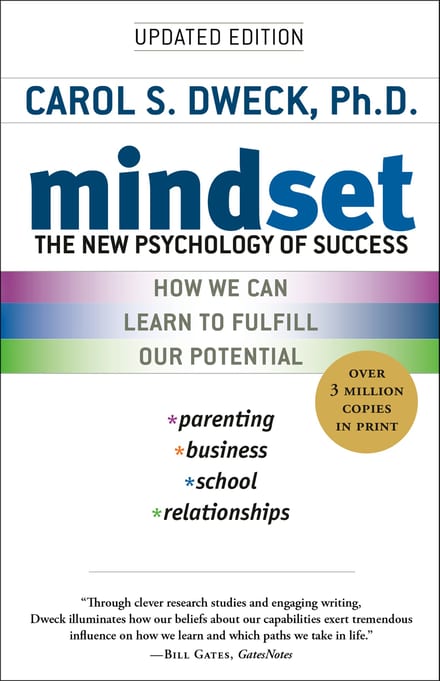
Book summary
Mindset: The New Psychology of Success
The full book runs ~288 pages — roughly 5 hours of reading. You get the key ideas here in 2 minutes.
The key ideas
- Contrast fixed mindset with growth mindset as competing beliefs about ability
- Recognize fixed mindsets treat every challenge as a worth test
- Embrace failure as feedback that shows what to practice next
- Notice mindsets shaping relationships, sports, business, and classrooms
- Beware praise like 'you're so smart' that ties worth to talent
- Rewire self-talk in key areas to build growth momentum
The summary
Two people fail the same test and walk away with opposite conclusions. One decides the failure proves they lack the talent; the other reads it as information about what to practice next. Carol Dweck’s research shows the split comes down to a single underlying belief — whether you think ability is a fixed allotment you’re born with, or something you build through effort. That belief gets absorbed early, from parents and teachers, and then compounds across a lifetime.
Two beliefs about ability
People with a fixed mindset assume talent is innate and unchangeable: you either have it or you don’t, and practice can’t move the needle much. This quietly turns every challenge into a referendum on your worth. A poor grade, a clumsy presentation, a weak first draft each become evidence of permanent inadequacy, so you learn to stay inside the narrow zone where you already look capable. Because self-image rides on seeming talented, fixed-mindset people crave approval, dread looking incompetent, and sort both themselves and others into “good” and “bad.” The aim isn’t to learn; it’s to keep proving you’ve got it.
A growth mindset starts from the opposite premise: skills develop with effort, so a shortcoming just tells you where to work — the open, eager-to-learn stance the Zen tradition calls shoshin. That makes difficulty inviting rather than threatening. When you stumble, you examine what went wrong, adjust, and try again. Michael Jordan went through stretches of poor play, but instead of blaming teammates or luck he studied his mistakes, practiced relentlessly, and asked others for advice. The failure that devastates one person becomes a to-do list for the other.
How the mindset shows up
The same fork appears everywhere. In relationships, a fixed mindset treats compatibility as static, so any conflict means you’re simply wrong for each other; a growth mindset treats the relationship as something both people build through communication and feedback. In sports, fixed-mindset athletes protect their image while growth-mindset athletes prize teamwork and treat each game as a chance to improve. In business, the fixed-mindset leader needs to be the smartest person in the room, while the growth-minded one wants candid feedback and a team that pushes back. Children live this too: a kid who believes intelligence grows with effort shows more motivation, more resilience, and better results, while a kid who reads a bad score as proof of stupidity checks out.
Where mindset comes from
We’re born leaning toward growth — small children learn voraciously — but role models reshape us. Parents with a growth mindset encourage learning and treat mistakes as useful; parents with a fixed mindset judge and label. Even praise can do damage. “You’re so smart” sounds encouraging, but it ties a child’s worth to being smart, so the next failure feels like a threat to their identity. Teachers carry the same weight: those who assume a student’s performance is permanent teach the student to believe it, while those who assume every student can learn change how they teach — and their students earn better grades and shed the sense of being hopeless.
You can change it
The brain adapts, which means a mindset can be trained, and the everyday lever is self-talk. “I’m so stupid” after a mistake reinforces the fixed view; “failures happen — I’ll learn from this and do better” reinforces growth. You don’t have to overhaul every domain at once. Adopting a growth perspective in a few areas that matter most, like work or relationships, builds momentum that tends to spread to the rest of your life. The point isn’t relentless positivity; it’s treating your own abilities as works in progress rather than fixed quantities you were handed at birth.
The bottom line
Believing that effort builds ability, rather than exposing its absence, changes how you meet difficulty and how far you eventually go. Read this if you’ve watched people stall after early promise while others keep climbing, or if you’re raising or teaching children whose beliefs about themselves are still taking shape.
Fact check
Popular books repeat findings that later research has complicated. Where Mindset makes a testable claim, here's what the evidence actually shows.
Children who believe intelligence grows with effort are more motivated, more resilient after setbacks, and get better results than children who think ability is fixed.
The association is real but small. A meta-analysis of 273 samples covering 365,915 students found an average correlation of r = .10 between growth mind-set and academic achievement — about 1% of the variance — rising to r = .19 for children and r = .17 for low-SES students, and falling to r = .02 for adults. A close replication with 624 Chinese children aged 9-13 found no relationship between their mind-sets and either resilience after failure or their grades across a semester. Mind-set tracks achievement most among younger and struggling students, which is narrower than a belief that compounds across a lifetime.
- Sisk VF, Burgoyne AP, Sun J, Butler JL, Macnamara BN. To what extent and under which circumstances are growth mind-sets important to academic achievement? Two meta-analyses. Psychol Sci. 2018;29(4):549-571. PubMed
- Li Y, Bates TC. You can't change your basic ability, but you work at things, and that's how we get hard things done: testing the role of growth mindset on response to setbacks, educational attainment, and cognitive ability. J Exp Psychol Gen. 2019;148(9):1640-1655. PubMed
Praising a child for being smart backfires, while praising effort keeps them motivated when they later fail.
Mueller and Dweck's six experiments with fifth graders found precisely this pattern: children praised for intelligence went on to prize looking capable over learning, persisted less after a failure, enjoyed the task less, and performed worse than children praised for effort. Replication has been uneven. A study of 624 Chinese children reran the procedure and found an effect on a single post-failure test (p = .049) but none of eight motivation and attribution measures; two follow-ups with active control groups found nothing (p = .189 to .974), and one result ran the opposite way. Effort-focused praise is still a sensible default, but the effect looks smaller and more setting-dependent than the 1998 studies implied.
- Mueller CM, Dweck CS. Praise for intelligence can undermine children's motivation and performance. J Pers Soc Psychol. 1998;75(1):33-52. PubMed
- Li Y, Bates TC. You can't change your basic ability, but you work at things, and that's how we get hard things done: testing the role of growth mindset on response to setbacks, educational attainment, and cognitive ability. J Exp Psychol Gen. 2019;148(9):1640-1655. PubMed
A mindset can be trained, and switching to a growth mindset improves how you perform.
Mindsets do move, and moving them helps some students. The largest test — a pre-registered national experiment across 65 US high schools, with independent data collection and a blinded Bayesian check — improved grades among lower-achieving students and raised enrolment in advanced maths, but the grade effect appeared only where peer norms backed the message. The two 2023 Psychological Bulletin meta-analyses then split on the wider literature: Macnamara and Burgoyne found d = 0.05 across 63 studies (N = 97,672), falling to a nonsignificant d = 0.02 among the six best-designed ones, while Burnette and colleagues found d = 0.14 for achievement in targeted, well-implemented samples. Both readings put the gains well below a shift that spreads across the rest of your life.
- Yeager DS, Hanselman P, Walton GM, et al. A national experiment reveals where a growth mindset improves achievement. Nature. 2019;573(7774):364-369. PubMed
- Macnamara BN, Burgoyne AP. Do growth mindset interventions impact students' academic achievement? A systematic review and meta-analysis with recommendations for best practices. Psychol Bull. 2023;149(3-4):133-173. PubMed
- Burnette JL, Billingsley J, Banks GC, et al. A systematic review and meta-analysis of growth mindset interventions: for whom, how, and why might such interventions work? Psychol Bull. 2023;149(3-4):174-205. PubMed
Frequently asked questions
What is Mindset about?
Carol Dweck's research shows that two people can fail the same test and draw opposite conclusions: one decides the failure proves a lack of talent, the other reads it as information about what to practice next. The split comes down to a single belief, whether you think ability is a fixed allotment you're born with or something you build through effort. That belief gets absorbed early from parents and teachers, then compounds across a lifetime.
What are the key takeaways from Mindset?
A fixed mindset assumes talent is innate, so every challenge becomes a referendum on your worth and you cling to what already makes you look capable. A growth mindset starts from the premise that skills develop with effort, so a shortcoming just shows you where to work, the way Michael Jordan studied his mistakes instead of blaming luck. The same fork appears in relationships, sports, business, and children. Mindset comes from role models and even from praise, since "you're so smart" ties a child's worth to being smart and makes the next failure a threat. Because the brain adapts, you can train a growth mindset through self-talk, and adopting it in a few areas that matter most builds momentum that spreads.
Who should read Mindset?
Read this if you've watched people stall after early promise while others keep climbing, or if you're raising or teaching children whose beliefs about themselves are still taking shape.
Is Mindset worth reading?
It builds one genuinely useful idea, that effort builds ability rather than exposing its absence, and illustrates it across enough domains that you start noticing the pattern in yourself and the people around you. Because it returns to that single distinction again and again, the book can feel repetitive once you've grasped it. But the insight about praise and about treating your abilities as works in progress is worth the read, especially for parents and teachers.