Book summary
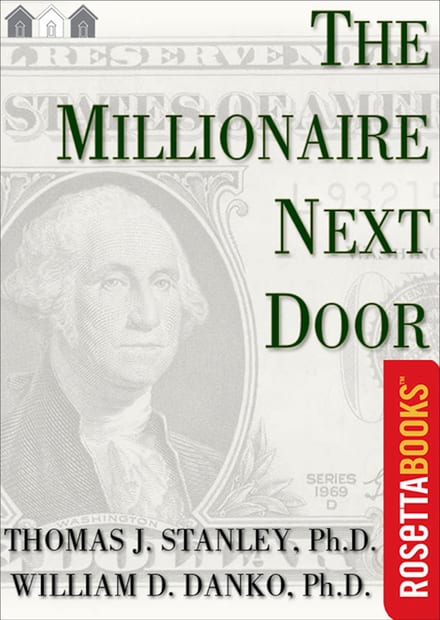
The Millionaire Next Door: The Surprising Secrets of America's Wealthy
The full book runs ~258 pages — roughly 5 hours of reading. You get the key ideas here in 3 minutes.
The key ideas
- Live below your means to accumulate real wealth.
- Skip status symbols; buy for utility, not badge value.
- Invest time in finances, networking, and skill-building.
- Avoid handouts that erode your children's work ethic.
- Specialize in a niche to command higher value.
- Build multiple income streams beyond a single salary.
The summary
The people who look rich and the people who are rich are, more often than not, two different groups. The authors spent years studying American millionaires — households worth more than a million dollars, not counting the home they live in — and the picture that emerged looks nothing like the television version. Most millionaires drive used cars, wear unremarkable clothes, and live in ordinary middle-class neighborhoods. Meanwhile, plenty of high earners who spend to broadcast their status stay perpetually one paycheck deep. Real wealth, it turns out, comes from what you keep and invest, not from what you make and display.
Wealth is what you keep, not what you earn
Around 80 percent of millionaires are first-generation, self-made. They didn’t inherit the money; they built it slowly over decades through disciplined saving and investing, and their net worth typically peaks in their fifties and sixties after years of living below their means. The typical millionaire owns a small business or works as a self-employed professional — only about 20 percent got there as employees drawing a corporate salary. What sets them apart from high earners who never accumulate anything isn’t income. It’s the gap between what they earn and what they spend.
They also raise their children to value financial independence over comfort, which is why they rarely hand out large inheritances. The self-made ones tend to be well educated and use that education to land high-paying work or run successful companies. Heirs, by contrast, often end up in less demanding occupations, leaning on money they didn’t earn.
Frugality is a tool, not a sacrifice
The authors call the core behavior asymmetric spending: millionaires spend far less on cars, clothes, and status symbols than their wealth would allow, while non-millionaires routinely overspend to project a higher station than they hold. A millionaire buys a car for utility and reliability and thinks hard about depreciation, insurance, and maintenance before doing it — a used, dependable model is perfectly fine. The clothes are functional, the labels beside the point. Even the leisure runs cheap: reading, exercise, and time with family over lavish nights out.
This isn’t self-denial for its own sake. Frugality is simply the instrument that builds independence. Millionaires are relentless comparison shoppers who research prices, wait for sales, and refuse to be swayed by marketing. They’re skeptical of anything that doesn’t hold its value and would rather put money into appreciating assets. Their financial goals are defined and specific, while the hyperconsumer — the one buying to be seen — is chasing prestige. Tellingly, the wealthy who inherited rather than earned their money are the ones most likely to become hyperconsumers.
Time and money get managed like capital
Millionaires treat their hours the way they treat their dollars. “You reap what you sow” is close to a creed, and they invest time in the things that compound: managing their finances, networking, and steadily improving their skills. Where others pour leisure into entertainment, the wealthy spend it on seminars, professional communities, and continuous learning. They track their expenses, keep a budget, and avoid waste, because they see money as a tool to be managed rather than merely enjoyed.
They also refuse to depend on a single stream of income. Rather than leaning on wages alone, like the under-accumulators do, they build multiple sources through businesses and investments — and they steer clear of heavy debt, keeping their money aimed at assets and long-term security instead of short-term gratification.
Handouts backfire; specialization pays
One of the book’s sharpest findings concerns what the authors call economic outpatient care — the ongoing financial help parents give adult children. However well meant, it tends to erode the very discipline and work ethic it’s supposed to support. Children who receive regular cash grow accustomed to a lifestyle they can’t fund themselves and never learn to stand on their own. So the wealthy give tools instead of checks: education, guidance, values, and chores from a young age to build a work ethic, all in the service of raising independent adults.
The last piece is focus. Millionaires find a niche and go deep, becoming genuine experts in a field — business, technology, a specialized profession — because expertise commands higher pay. Many built their fortunes by spotting an unmet need in the market and creating something specific to fill it. It’s better, the authors conclude, to be a specialist than a generalist, and better still to be a persistent one who keeps adapting when things go wrong.
The bottom line
Real wealth is built by living below your means, staying out of debt, and investing the difference year after year — not by earning a big salary and spending it on the costume of success. Read this if you want to understand why financial independence is a matter of discipline and patience far more than income.
Fact check
Popular books repeat findings that later research has complicated. Where The Millionaire Next Door makes a testable claim, here's what the evidence actually shows.
Around 80 percent of American millionaires are first-generation self-made and did not inherit their money.
The "didn't inherit a fortune" half holds up: in nationally representative panel data, past parental transfers and expected bequests explain very little of why wealthy children are wealthy. But the same study puts the age-adjusted elasticity of a child's wealth with respect to parental wealth at 0.37 before any bequest changes hands, with roughly two-thirds of that traced to similar lifetime incomes and similar asset-holding behaviour. So family background still predicts who becomes a millionaire, just through income and habits rather than a cheque. The 80 percent figure itself comes from the authors' own survey of affluent households, not from a nationally representative sample.
- Charles KK, Hurst E. The Correlation of Wealth Across Generations. Cambridge, MA: National Bureau of Economic Research; 2002. NBER Working Paper 9314. Source
The typical millionaire owns a small business or is a self-employed professional; only about 20 percent got there on a corporate salary.
Business ownership does skew hard toward the affluent, and among the very highest earners it dominates — US tax records covering 11 million firms show top earners are largely owner-managers of mid-size private companies whose profits collapse by about three-quarters when the owner retires or dies. But it is nowhere near universal: the Federal Reserve's 2022 Survey of Consumer Finances found 20 percent of all families owned a privately held business and just under half of families in the top income decile did, leaving about half of high earners with no business at all. Business equity was held by 14.6 percent of families, at a conditional median value of $90,000. A salaried route to wealth is far more common than one household in five.
- Aladangady A, Bricker J, Chang AC, et al. Changes in U.S. Family Finances from 2019 to 2022: Evidence from the Survey of Consumer Finances. Washington, DC: Board of Governors of the Federal Reserve System; 2023. Source
- Smith M, Yagan D, Zidar OM, Zwick E. Capitalists in the Twenty-First Century. Cambridge, MA: National Bureau of Economic Research; 2019. NBER Working Paper 25442. Source
"Economic outpatient care" — ongoing cash gifts to adult children — erodes their work ethic and leaves them financially worse off.
Unearned money does reduce work, but by less than the book implies. Swedish population-wide lottery data show a prize immediately and persistently lowers earnings, with a lifetime marginal propensity to earn of -0.17 at age 20 shrinking to -0.04 at age 60 — so recipients keep the large majority of the windfall rather than working it away. The sharpest effect comes from big one-off sums: US tax records show a single person inheriting over $150,000 is roughly four times more likely to leave the labour force than one inheriting under $25,000. Neither literature tests recurring parental subsidies specifically, and neither finds recipients ending up poorer than they started.
- Cesarini D, Lindqvist E, Notowidigdo MJ, Östling R. The effect of wealth on individual and household labor supply: evidence from Swedish lotteries. Am Econ Rev. 2017;107(12):3917-3946. Source
- Holtz-Eakin D, Joulfaian D, Rosen HS. The Carnegie Conjecture: Some Empirical Evidence. Cambridge, MA: National Bureau of Economic Research; 1992. NBER Working Paper 4118. Source
Frequently asked questions
What is The Millionaire Next Door about?
After years studying American millionaires, the authors found that the people who look rich and the people who are rich are usually two different groups. Most millionaires drive used cars, wear unremarkable clothes, and live in ordinary neighborhoods, while many high earners who spend to broadcast status stay one paycheck deep. Real wealth comes from what you keep and invest, not from what you make and display.
What are the key takeaways from The Millionaire Next Door?
Wealth is the gap between what you earn and what you spend, not income itself, which is why about 80 percent of millionaires are first-generation and self-made, building slowly by living below their means. Frugality is a tool, not a sacrifice: the authors call it asymmetric spending, and the wealthy comparison-shop, buy cars for utility, and put money into appreciating assets. They manage time and money like capital, investing in skills and networking and building multiple income streams while avoiding heavy debt. "Economic outpatient care," ongoing cash gifts to adult children, backfires by eroding discipline, so they give tools, education, and a work ethic instead. And they specialize, going deep in a niche because expertise commands higher pay.
Who should read The Millionaire Next Door?
Read this if you want to understand why financial independence is a matter of discipline and patience far more than income.
Is The Millionaire Next Door worth reading?
Its strength is the data behind the myth-busting: the portrait of the quietly frugal self-made millionaire is grounded in real research rather than aspiration, and the core habits are concrete enough to copy. It repeats its central point often and its examples come from an earlier era, so readers wanting fresh tactics or investing specifics may find it thin. As a mindset reset about spending and status, though, it holds up.